
You lift the lid on your deep water culture tote and the roots look a little less white than last week. The pump is humming, there’s a stream of bubbles in one corner, and you start to wonder: is that one little air stone actually doing enough?
Short answer: an air stone for hydroponics turns air from a pump into fine bubbles that keep the nutrient solution near oxygen saturation, which is about 7–9 mg/L (ppm) at normal room temperatures. Aim for roughly 0.15–0.29 litres of air per litre of solution per minute (about 0.5–1.1 L/min per US gallon), place the stones on the reservoir floor, and keep the water cool. Below about 3–4 mg/L, leafy greens slow down sharply.
This guide turns the research into plain numbers. By the end you’ll know how to size an air pump for your reservoir, how many stones to use and where to put them, which systems don’t need a bubbler at all, and how to tell when a clogged stone is quietly starving your roots.
What an air stone for hydroponics actually does
Roots breathe. They burn sugars using oxygen, just like your muscles do, and that respiration powers water and nutrient uptake. In soil, roots get oxygen from air pockets. In a reservoir of water, the only oxygen they get is what’s dissolved in it, and still water loses that oxygen fast once a crop of thirsty roots is pulling from it.
An air stone is a porous diffuser (ceramic, mineral or a rubber membrane disc) on the end of an airline. The pump pushes air through it, and the stone breaks that air into many small bubbles. Two things then happen. Oxygen moves from the bubbles into the water across their surface, and the rising bubble column stirs the reservoir so oxygen-rich water reaches the roots. University of Florida aquaculture specialists describe the same principle for fish ponds: small-bubble diffusers maximise oxygen transfer, and releasing air near the bottom both aerates and mixes the water as it rises (McGee and Cichra, UF/IFAS FA6).
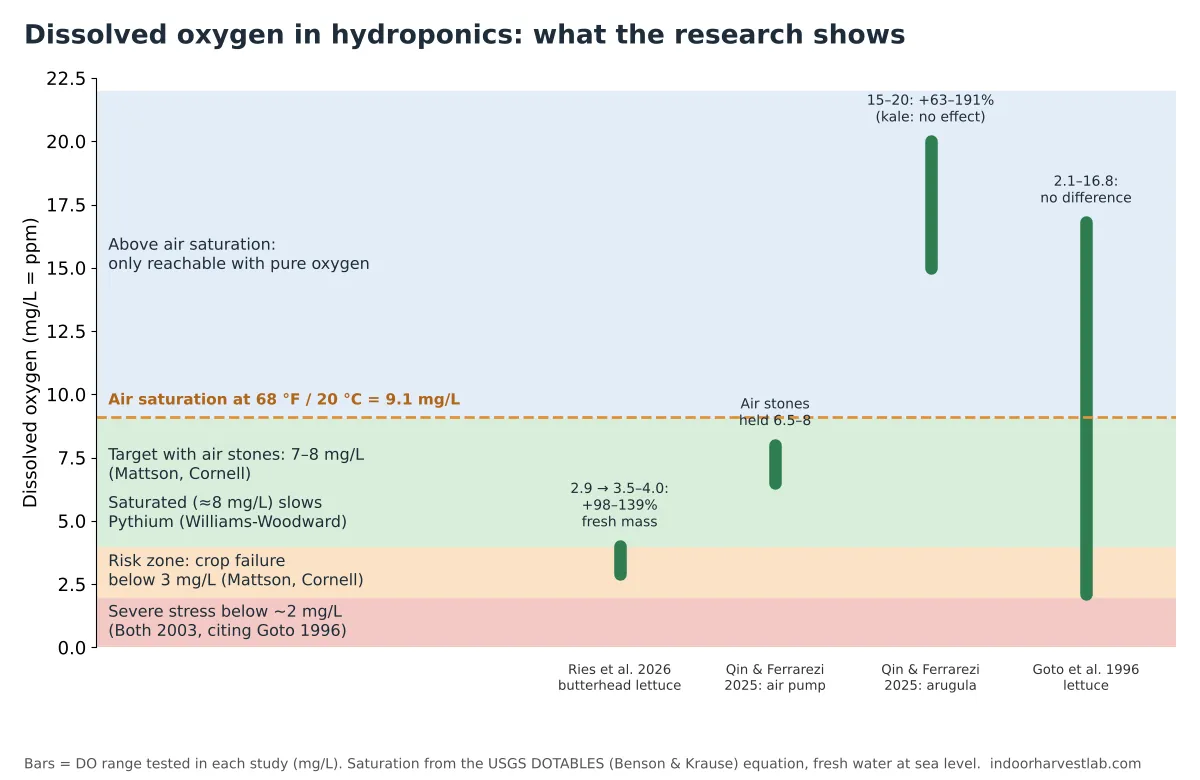
The payoff is measurable. In a 2026 deep-water-culture trial with butterhead lettuce, raising dissolved oxygen (DO) from 2.9 to just 3.5–4.0 mg/L with moderate active aeration increased shoot fresh mass by 98–139% at 21 days (Ries et al., 2026). Same nutrients, same light, roughly double the lettuce. That’s what a working air stone buys you.
Which systems need an air stone (and which don’t)
Not every hydroponic method needs a bubbler. It depends on whether roots ever sit fully submerged in still water.
| System | Air stone needed? | Why |
|---|---|---|
| Deep water culture (DWC) | Yes, always, 24/7 | Roots hang fully in the solution; the stone is the main oxygen source |
| Rafts and floating beds | Yes | Same as DWC; air pumps or oxygen injection keep the pond aerated (Mattson, Cornell) |
| Kratky method | No (by design) | The solution level drops as plants drink, leaving an air gap where upper roots breathe |
| Nutrient film technique (NFT) | Optional, in the reservoir | The thin film flowing over roots gets oxygen from the air in the channel |
| Ebb and flow | Optional, in the reservoir | Draining pulls fresh air into the medium between floods |
| Dutch buckets | Usually no | Free-draining perlite or clay pebbles keep the root zone airy |
Even in NFT or ebb and flow, an air stone for hydroponics reservoirs that run warm does no harm and can help keep the solution mixed between changes.
Dissolved oxygen in hydroponics: the numbers to hold
Before you shop for a pump, it helps to know what you’re aiming at. Dissolved oxygen is measured in mg/L, which is the same as ppm. The ceiling is set by physics: cold water holds more oxygen than warm water, and bubbling air can only bring the solution up to air saturation, never beyond it.
| What to watch | Target or limit | Source |
|---|---|---|
| DO target in deep water culture (lettuce) | About 7–8 mg/L (ppm) | Mattson, Cornell CEA (GPN 2016) |
| Crop failure seen | Below 3 mg/L | Mattson, Cornell CEA |
| Recommended minimum (lettuce) | At least 4 mg/L; severe stress below 2 mg/L | Both 2003, citing Goto et al. 1996 |
| Saturated DO to suppress Pythium | About 8 mg/L | Williams-Woodward, e-GRO 2022 |
| Solution temperature for lettuce and spinach | 68–72 °F (20–22 °C) | Williams-Woodward, e-GRO 2022 |
| Root-zone ceiling for quality lettuce in warm rooms | Below 20 °C (68 °F) | Both 2003, citing Thompson et al. 1998 |
| Air-stone aeration rate | 0.15–0.29 L air per L solution per min | Baiyin et al. 2021 |
Now the temperature side. These are the maximum DO values that air bubbling can reach in fresh water at sea level, calculated with the oxygen-solubility equation used by the USGS DOTABLES program:
| Water temperature | Max DO at air saturation | What it means for you |
|---|---|---|
| 59 °F (15 °C) | 10.1 mg/L | Plenty of headroom |
| 64 °F (18 °C) | 9.5 mg/L | Comfortable |
| 68 °F (20 °C) | 9.1 mg/L | Ideal target zone for greens |
| 72 °F (22 °C) | 8.7 mg/L | Fine with good aeration |
| 77 °F (25 °C) | 8.3 mg/L | Aeration has to work harder |
| 82 °F (28 °C) | 7.8 mg/L | Little margin; root-rot risk rises |
| 86 °F (30 °C) | 7.6 mg/L | Even saturated water sits near the 7 mg/L floor |
Look at the bottom of that table. At 86 °F, a perfectly aerated reservoir only just reaches the Cornell target. That’s why a bigger pump can’t rescue a hot reservoir; cooling the water matters as much as bubbling it. If your plants droop on warm afternoons, our guide to hydroponic plants wilting walks through the oxygen-and-temperature link in more detail.
How to size an air pump for hydroponics
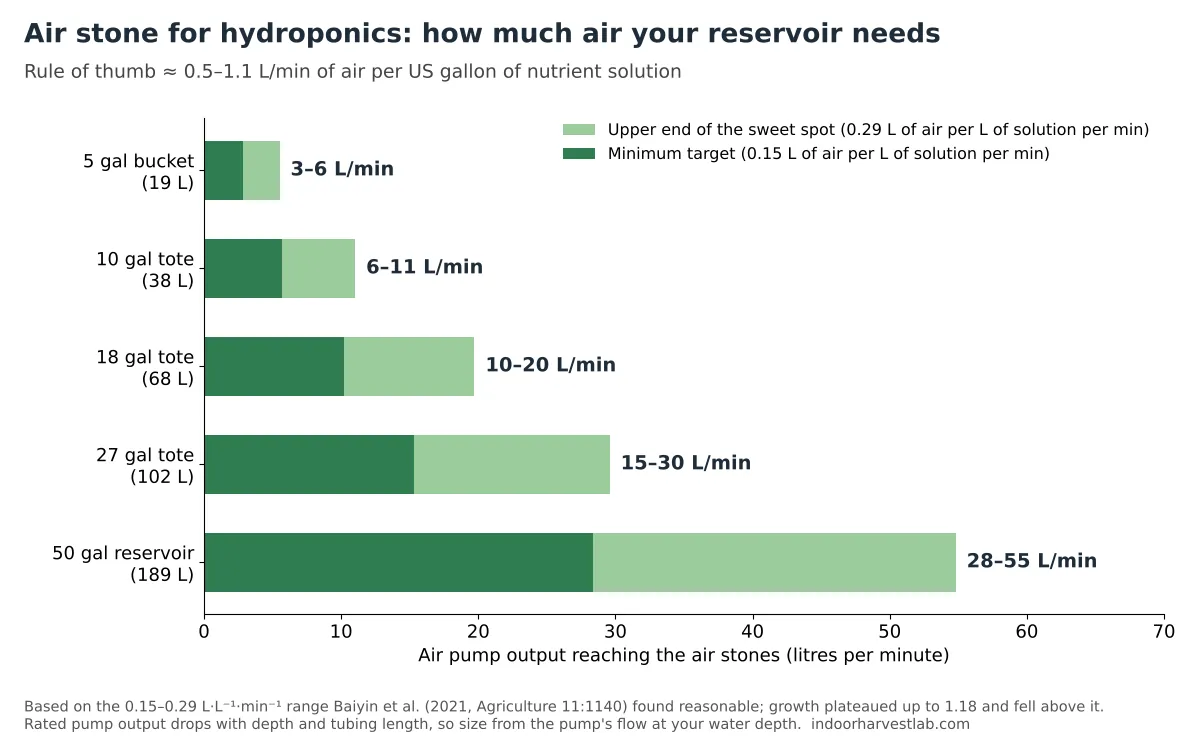
Here’s the honest truth about air pump sizing: most hobby advice is a guess. The most useful research number we found comes from a Japanese study that measured plant growth across six aeration intensities. Working with Swiss chard in 3.4-litre buckets fitted with a 25 mm air stone, Baiyin and colleagues found that growth rose as aeration increased from 0.07 to 0.15 L of air per litre of solution per minute, held steady from 0.15 up to 1.18, and then fell at 1.18–2.35. They described 0.15–0.29 L·L⁻¹·min⁻¹ as a reasonable intensity (Baiyin et al., 2021).
Convert that to gallons and you get a practical rule of thumb: about 0.5–1.1 L/min of air per US gallon of solution. Here’s what that looks like for common home setups:
| Reservoir | Solution volume | Minimum airflow (0.15) | Sweet-spot upper end (0.29) |
|---|---|---|---|
| 5-gallon bucket (single DWC plant) | 19 L | ≈ 3 L/min | ≈ 6 L/min |
| 10-gallon tote | 38 L | ≈ 6 L/min | ≈ 11 L/min |
| 18-gallon tote | 68 L | ≈ 10 L/min | ≈ 20 L/min |
| 27-gallon tote | 102 L | ≈ 15 L/min | ≈ 30 L/min |
| 50-gallon reservoir | 189 L | ≈ 28 L/min | ≈ 55 L/min |
Two catches matter when you read a pump box:
- Rated output is measured with almost no back-pressure. Every inch of water depth, every metre of tubing and every fine-pored stone reduces the air that actually comes out. Pick a pump comfortably above your target, especially for deep reservoirs, and check the maker’s flow-at-depth figure if one is given.
- Split outlets split the air. A two-outlet pump rated at 4 L/min delivers roughly 2 L/min per outlet. Add those up against the table, not the box headline.
For a real-world reference point, the University of Georgia team in a 2025 HortScience study ran 190-litre DWC trays using four 5.1 cm (2-inch) air stones fed by a commercial aeration pump; that air-pump-only control held DO between 6.5 and 8 mg/L (Qin and Ferrarezi, 2025). In other words, a sensible number of ordinary stones keeps a well-run tray right in the Cornell target band.
Choosing an air stone for hydroponics: types, sizes and how many
Once the pump is sized, the stone’s job is to break that air into the finest bubbles it can without choking the flow. Small bubbles have far more surface area per litre of air, which is why aquaculture engineers favour small-bubble diffusers (UF/IFAS FA6).
| Air stone type | Bubble size | Best for | Watch out for |
|---|---|---|---|
| Cylinder or ball stone (ceramic/mineral) | Fine to medium | Single buckets, Kratky top-ups, small totes | Pores clog with minerals and biofilm |
| Disc or dome diffuser (membrane or ceramic) | Fine, wide spread | Totes and DWC tubs; even coverage across the floor | Needs to sit flat; can float if not weighted |
| Bar or flexible hose diffuser | Fine curtain | Long troughs and rafts | Needs higher pump pressure along its length |
| Open airline (no stone) | Large, coarse | Emergency only | Poor oxygen transfer; lots of splash |
How many air stones do you need?
Think in coverage, not count. Roots in every corner of the reservoir need moving, oxygenated water. A practical way to plan:
- One 5-gallon bucket: one 2–4 inch stone or a single disc in the centre of the floor.
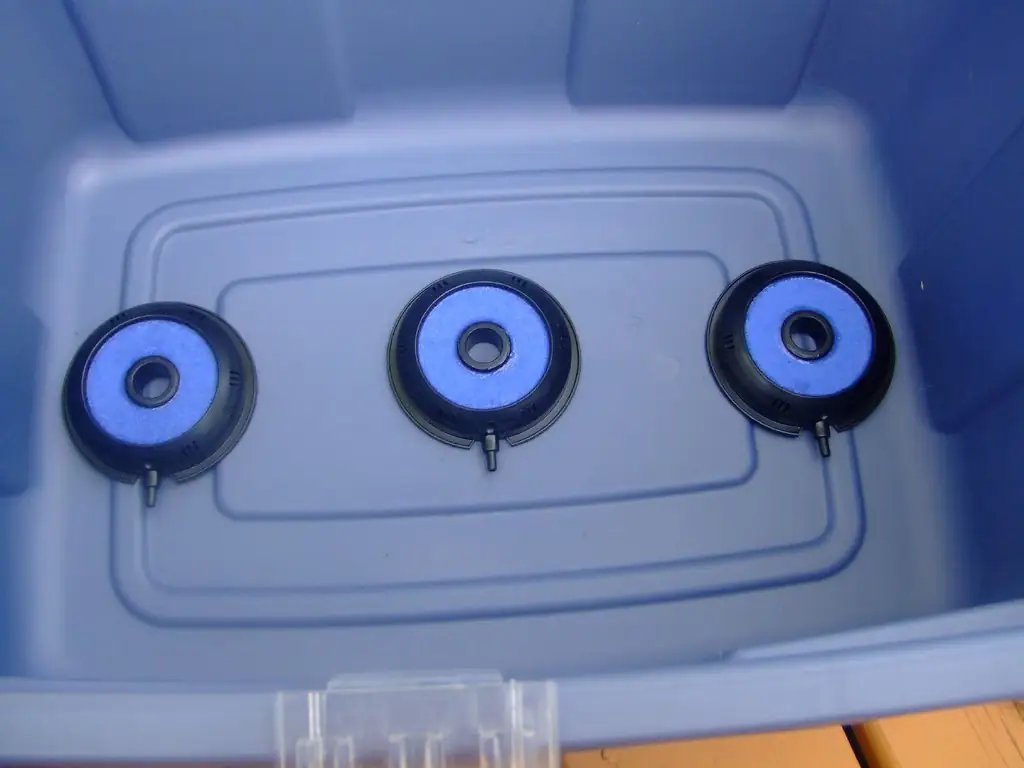
- Totes up to about 20 gallons: two to three stones or discs spread along the floor (like the three-disc tote below).
- Larger tubs and rafts: about one stone per 12 gallons is in line with the UGA trays above (four stones per 190 L), or use a bar diffuser along the length.
Then let the airflow table set the pump, and use a gang valve to balance flow between stones so none of them sputters.
How to set up an air stone for hydroponics, step by step
A good setup takes ten minutes and saves you from the two classic failures: water back-siphoning into the pump, and a single stone bubbling in one corner while the other side goes stale.
Step 1: Put the pump above the water line
Set the pump on a shelf higher than the reservoir surface, or fit a check valve in the airline. University of Illinois Extension’s home hydroponics guide tells growers to insert a check valve to prevent backflow. Without one, a power cut can let solution siphon back down the tubing into the pump.
Step 2: Run the shortest airline you can
Every extra metre of tubing adds resistance. Keep runs short, avoid kinks, and use a gang valve if one pump feeds several stones.
Step 3: Lay the stones on the floor, spread out
Air released near the bottom aerates and mixes the whole water column as it rises (UF/IFAS). Weight or clip the stones so they don’t float, and space them so bubbles rise under the whole raft or lid, not just one side.
Step 4: Fill, mix nutrients, and switch on
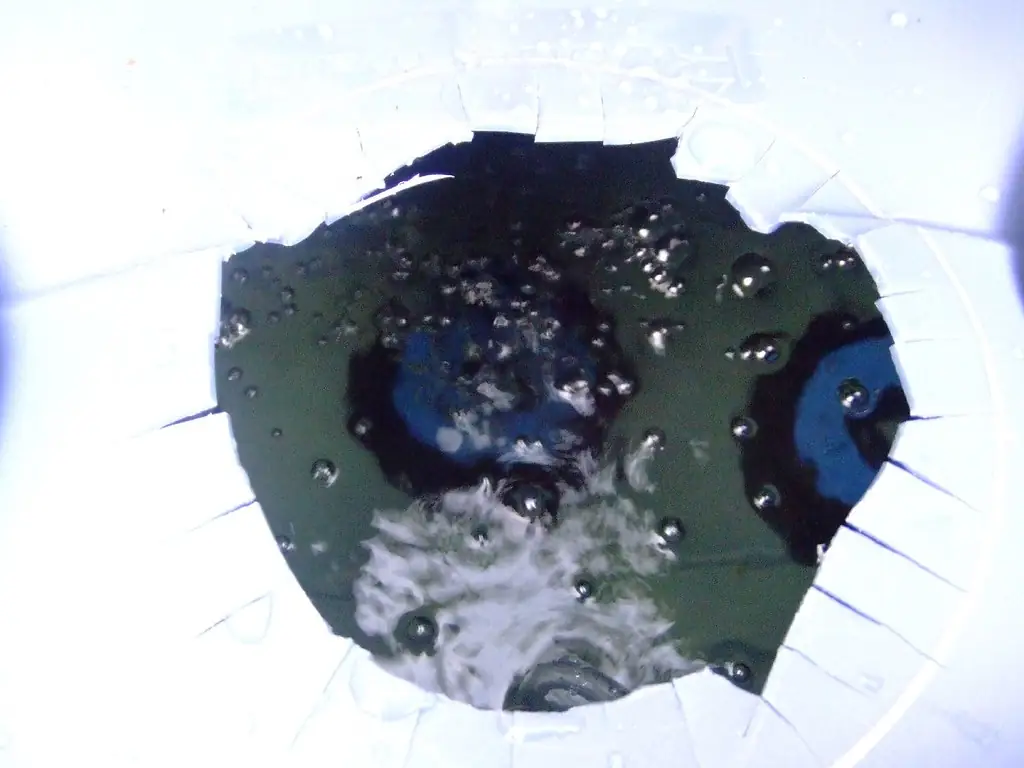
Mix your hydroponic nutrient solution first, then start the pump before plants go in. Check that every stone produces an even stream; a sputtering stone usually means the valve needs opening or the stone is clogged.
Step 5: Run it 24/7 and check the roots weekly
Roots respire day and night, so aeration runs continuously in deep water culture. Healthy roots are white or cream and firm. Tan, slimy or smelly roots are your early warning; see hydroponic root rot for the rescue plan.
Common air stone mistakes and how to fix them
Most aeration problems aren’t about buying a bigger pump. They’re about stones that quietly stopped working, or water that got too warm for any amount of bubbling to keep up.
| What you see | Likely cause | What to do |
|---|---|---|
| Weak, uneven or one-sided bubbles | Clogged stone, kinked line, unbalanced gang valve | Clean or replace the stone; straighten tubing; rebalance valves |
| Brown, slimy roots despite bubbling | Warm water lowering DO; Pythium | Cool the solution toward 68–72 °F; aim for saturated DO; sanitise |
| Plants wilt on warm afternoons, recover at night | Root zone too warm, oxygen near the floor of the target | Shade or insulate the reservoir; add a chiller or move it somewhere cooler |
| Water squirting into the pump after a power cut | No check valve; pump below water line | Fit a check valve; raise the pump |
| Pale new leaves in a violently bubbling tank | Over-agitation of the root zone (crop-dependent) | Turn airflow down into the sweet-spot range |
| Green film and slime on the stone | Light reaching the reservoir; algae | Block light; clean the stone (see algae in hydroponics) |
That fifth row surprises people. More bubbles isn’t always better. In the Swiss chard study, growth declined above 1.18 L·L⁻¹·min⁻¹ (Baiyin et al., 2021). Separately, Utah State researchers found that even gentle bubbling agitation cut iron uptake and chlorophyll in hydroponic sunflower and corn, while tomato was barely affected (Langenfeld and Bugbee, 2025). The likely reason is that a calm root surface holds a thin, beneficial layer of solution and root exudates that helps iron uptake, and churning water strips it away.
How to clean air stones for hydroponics
Every air stone for hydroponics clogs over time as dissolved minerals, biofilm and root fragments block its pores. The flow drops, back-pressure rises, and oxygen delivery falls without any obvious warning. A simple routine:
- Check the bubble pattern every time you change your hydroponic water. An even, fine stream is good; big burps from one spot mean a blockage.
- Between crops, scrub the stones, airline and reservoir and disinfect them with a horticultural sanitiser used at its label rate, then rinse well. Extension root-disease specialists stress cleaning and disinfecting equipment between runs because Pythium survives in debris (Williams-Woodward, e-GRO 2022).
- Replace stones that still sputter after cleaning. They’re cheap; a dead stone in a full reservoir is not.
From the lab bench
Here’s how we’d read the research on the air stone for hydroponics question if you’re growing at home.
First, the threshold matters more than the maximum. Goto and colleagues saw no growth difference in lettuce across 2.1–16.8 mg/L in a carefully controlled system, yet the 2026 Ries trial saw fresh mass roughly double when DO rose from 2.9 to about 4 mg/L. Those findings fit together once you think of oxygen as a floor, not a fertiliser: above a minimum, more oxygen buys little; below it, growth collapses. Your air stone’s job is to keep you safely off that floor, especially at night and on hot days, which is exactly why Cornell’s practical target sits up at 7–8 mg/L.
Second, temperature is the hidden half of aeration. Warm water holds less oxygen, roots respire faster, and Pythium thrives. A cool reservoir with a modest pump will usually beat a warm reservoir with a huge one.
Third, enrichment beyond air is crop-specific. In the UGA study, pure-oxygen enrichment to 15–20 mg/L boosted arugula biomass by 63–191% but did nothing measurable for kale, and it used over 140% more electricity than air pumps alone (Qin and Ferrarezi, 2025). For a home grower, a properly sized air pump and clean stones remain the best value by a wide margin.
Finally, trust the roots. A DO meter is the gold standard, but bright white root tips and steady growth are a free, daily readout. If they change, check the stone, then the temperature, then the pump.
FAQ
Do I need an air stone for hydroponics?
In deep water culture and raft systems, yes: the roots sit fully in the solution and the air stone is their main oxygen source. Kratky systems don’t need one because the falling water level leaves an air gap, and NFT, ebb-and-flow and Dutch-bucket systems get air from the channel or drained medium.
How big an air pump do I need for a 5-gallon DWC bucket?
Aim for roughly 3–6 L/min of actual airflow at the stone. That matches the 0.15–0.29 L of air per litre of solution per minute range from Baiyin et al. (2021). Choose a pump rated above that, because depth, tubing and a fine-pored stone all reduce real output.
How many air stones do I need?
Plan for coverage: one stone or disc for a 5-gallon bucket, two to three spread across the floor of a tote up to about 20 gallons, and about one stone per 12 gallons (or a bar diffuser) in larger tubs. Then size the pump to the total airflow you need.
Can you over-aerate a hydroponic system?
Yes. In one study growth fell when aeration went above about 1.18 L of air per litre of solution per minute, and strong agitation has been shown to reduce iron uptake in sunflower and corn. Stay in the moderate range rather than maximising bubbles.
What dissolved oxygen level is best for hydroponics?
For lettuce in deep water culture, Cornell researchers recommend about 7–8 mg/L (ppm) and have seen crop failure below 3 mg/L. Saturated levels of around 8 mg/L also help suppress Pythium root rot.
Should the air pump run 24 hours a day?
In deep water culture, yes. Roots respire day and night, so aeration should be continuous. If the power goes off for a long time, restart the pump as soon as possible and check the roots.
How often should I clean or replace air stones?
Check the bubble pattern at every reservoir change and clean or replace stones between crops. If a stone still sputters or shows weak, uneven bubbles after cleaning, replace it.
Sources
- Baiyin, B., Tagawa, K., Yamada, M., Wang, X., Yamada, S., Yamamoto, S. and Ibaraki, Y. (2021). Study on plant growth and nutrient uptake under different aeration intensity in hydroponics with the application of particle image velocimetry. Agriculture 11(11): 1140. doi:10.3390/agriculture11111140
- Both, A.J. (2003). Ten years of hydroponic lettuce research. Rutgers University (includes summaries of Goto et al. 1996 and Thompson et al. 1998). PDF
- Goto, E., Both, A.J., Albright, L.D., Langhans, R.W. and Leed, A.R. (1996). Effect of dissolved oxygen concentration on lettuce growth in floating hydroponics. Acta Horticulturae 440: 205–210.
- Langenfeld, N.J. and Bugbee, B. (2025). Aeration and agitation in hydroponic culture have detrimental effects on iron uptake. Frontiers in Plant Science 16. doi:10.3389/fpls.2025.1675950
- Mattson, N. (2016). Growing hydroponic leafy greens. Greenhouse Product News, October 2016. Cornell CEA. PDF
- McGee, M. and Cichra, C. The role of aeration in pond management. UF/IFAS Extension FA6 (reviewed 2024). EDIS
- Qin, K. and Ferrarezi, R.S. (2025). Boosting hydroponic production of kale and arugula by managing dissolved oxygen. HortScience 60(10): 1744. doi:10.21273/HORTSCI18774-25
- Ries, J., Park, Y. and Meng, Q. (2026). Active aeration enhances tissue hydration and fresh mass in hydroponic lettuce and modulates calcium-mobilizing biostimulant efficacy. Scientific Reports 16. doi:10.1038/s41598-026-46661-0
- University of Illinois Extension. Hydroponics at home. PDF
- U.S. Geological Survey. DOTABLES: dissolved oxygen solubility tables. water.usgs.gov
- Williams-Woodward, J. (2022). Root disease management in hydroponic systems. e-GRO Edible Alert 7(6). PDF