
Short answer: to mix a hydroponic nutrient solution, fill the reservoir with clean water first, then dissolve each fertilizer part separately and completely: the calcium part, stir, then the part with phosphate and sulfate, stir again. Check EC, and adjust pH last. A proven two-part recipe from Cornell University uses 2.84 g of calcium nitrate plus 2.84 g of a 5-12-26 hydroponic fertilizer per US gallon (about 0.75 g of each per litre), which gives roughly 150 ppm nitrogen for lettuce and herbs. Never pour the two concentrates into each other: calcium reacts with phosphate and sulfate and falls out as sludge.
This guide covers the water you start with, the three kinds of fertilizer programme, exact amounts for common reservoir sizes, a step-by-step mixing routine, how to make A and B stock concentrates, and when to top up or replace the solution.
Table of Contents
What a hydroponic nutrient solution has to supply
In soil, some nutrients come from the soil itself. In hydroponics, the water carries everything. Neil Mattson of Cornell University and Cari Peters of J.R. Peters Laboratory list 14 essential elements that the root zone needs: the macronutrients nitrogen, phosphorus, potassium, sulfur, calcium and magnesium, and the micronutrients iron, manganese, zinc, boron, copper, molybdenum, chloride and nickel. All of them must come from the hydroponic nutrient solution, although chloride and nickel are usually present as impurities and are left out of most recipes (Mattson and Peters, “A Recipe for Hydroponic Success,” 2014).
The good news from the same article is that plants cope with a wide range of concentrations, so many different recipes work. A beginner does not need a custom formula; one sound hydroponic nutrient solution, mixed carefully and checked with an EC meter, will grow lettuce, herbs and leafy greens well.
Step 1: know your water before you mix a hydroponic nutrient solution
Every hydroponic nutrient solution starts from the water in the tap, so start there. Cornell recommends a laboratory analysis of the source water and names three numbers to look at: alkalinity, EC and specific elements.
| Water property | Target | Why it matters | Source |
|---|---|---|---|
| EC of source water | Below 0.25 mS/cm for systems that reuse water; below 1.0 for run-to-waste | Leaves room for fertilizer and slows salt build-up | Cornell |
| Alkalinity | 40–160 ppm CaCO3 | High alkalinity pushes pH up after mixing | University of Missouri |
| Sodium | Under 50 ppm | Not a nutrient; builds up in recirculating systems | Cornell |
| Chloride | Under 70 ppm | Same as sodium | Cornell |
| pH of final solution | 5.5–6.5 for most crops | Keeps nutrients available | University of Missouri |
University of Minnesota Extension adds two practical warnings for home growers: avoid softened water, which “can start your system off with excess salt,” and if your water’s alkalinity is above 75 ppm, test pH regularly. It also notes that reverse osmosis water, sold by refill at many grocery stores, is an option when tap water is poor. If your water already contains useful calcium and magnesium, Cornell advises taking that into account rather than ignoring it.
Step 2: choose one-part, two-part or made-from-scratch
There are three ways to build a hydroponic nutrient solution. Cornell’s article compares them for lettuce, herbs and leafy greens, each set to 150 ppm nitrogen:
| Approach | What you buy | Amount per 100 US gal | Calcium supplied | Best for |
|---|---|---|---|---|
| One-part | A complete hydroponic blend (Cornell used a 16-4-17) | 355 g | 38 ppm | Simplest; suits water that already has some calcium |
| Two-part | A 5-12-26 hydroponic fertilizer plus calcium nitrate (15-0-0) | 284 g of each | 139 ppm | Most home growers; cheap and forgiving |
| From scratch | Individual salts (modified Sonneveld recipe) plus micronutrients | About 10 ingredients | 90 ppm | Larger growers who want full control |
Liquid concentrates sold for home hydroponics work the same way: UMN Extension notes they are easy to use, since you simply measure the amount on the label, while dry fertilizers are cheaper but often come as several separate bags. Whatever you choose, pick a product labelled for hydroponics, because it contains the micronutrients that general garden fertilizers may leave out.
Hydroponic nutrient solution: how much fertilizer per gallon or litre
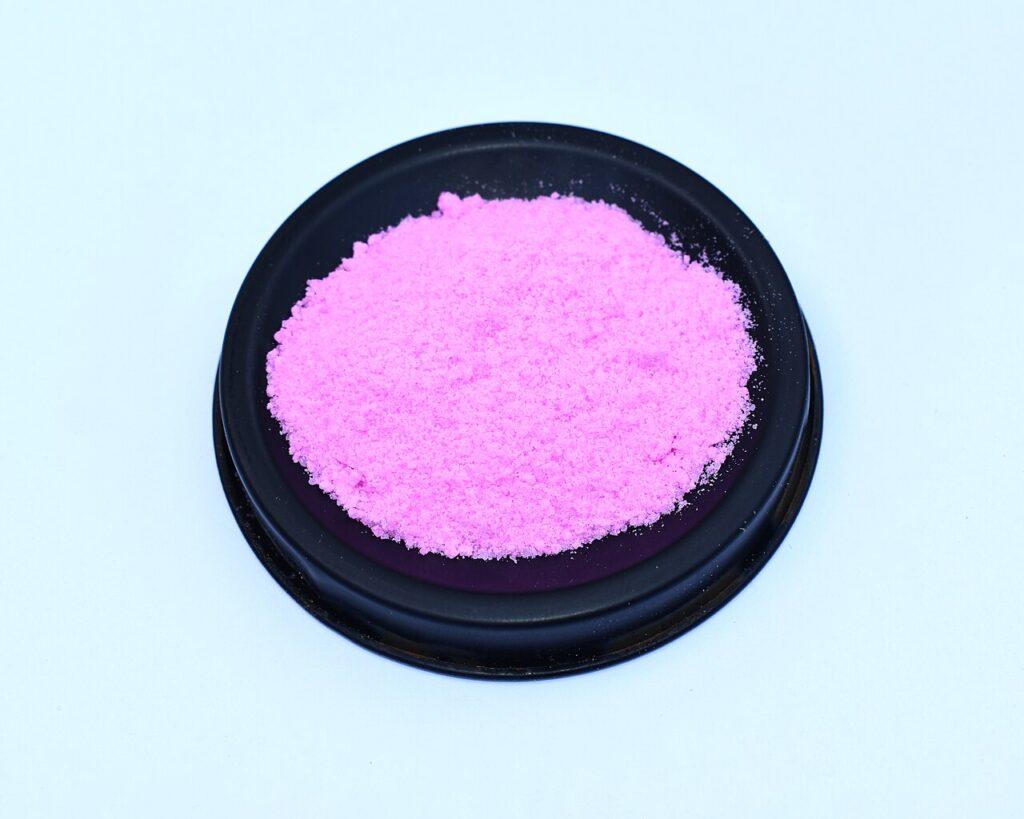
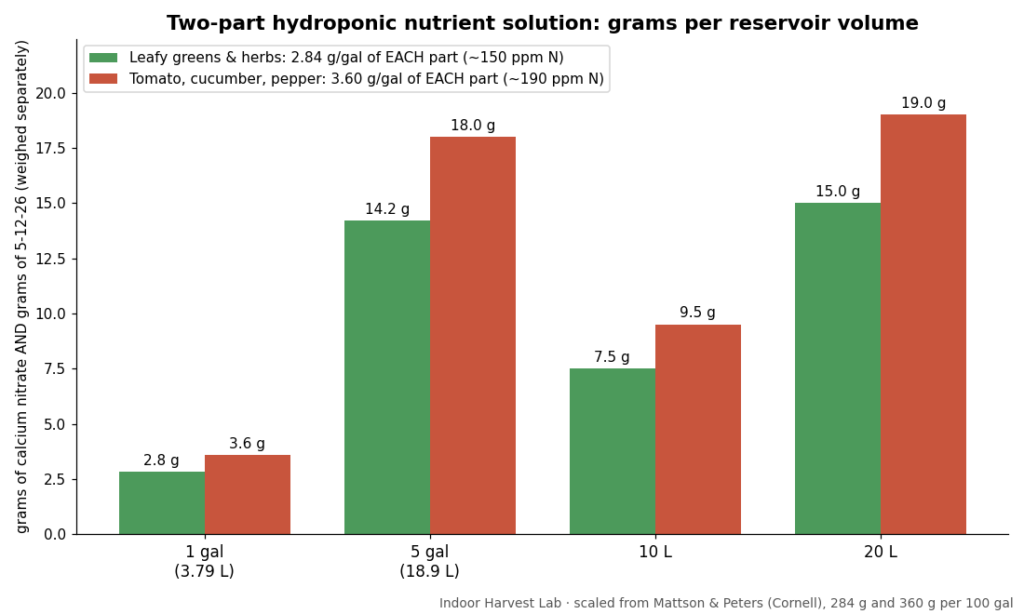
The two-part recipe is the one most readers will use, so here it is scaled to home reservoir sizes. Cornell gives 284 g of each part per 100 US gallons for leafy crops and 360 g of each part for tomatoes, cucumbers and peppers (about 190 ppm nitrogen). Weigh each part separately; the amounts in the table are for each part.
| Reservoir | Leafy greens and herbs (each part) | Tomato, cucumber, pepper (each part) |
|---|---|---|
| 1 litre | 0.75 g | 0.95 g |
| 1 US gallon (3.79 L) | 2.84 g | 3.60 g |
| 10 litres | 7.5 g | 9.5 g |
| 5 US gallons (18.9 L) | 14.2 g | 18.0 g |
| 20 litres | 15.0 g | 19.0 g |
A kitchen scale that reads to 0.1 g is enough for these amounts. A precise scale matters much more if you build a solution from individual micronutrient salts, where Cornell’s recipe calls for fractions of a gram per 100 gallons.
Adjusting the strength by crop
Cornell’s target nitrogen levels show how much the right strength of hydroponic nutrient solution varies by crop. Scale the table above up or down in proportion (for example, 175 ppm N is about 17% stronger than 150 ppm).
| Crop | Propagation (ppm N) | Production (ppm N) |
|---|---|---|
| Butterhead, romaine and leaf lettuce | 125 | 150 |
| Arugula, watercress, spring mix | 125 | 125–150 |
| Basil | 125 | 175 |
| Other culinary herbs | 125 | 150 |
| Kale, Swiss chard, spinach, mustard greens | 125 | 175–200 |
| Tomatoes | 125 | 200 |
| Peppers | 125 | 150 |
| Cucumber | 125 | 175 |
How to mix hydroponic nutrient solution, step by step
This routine is for mixing a ready-to-use hydroponic nutrient solution directly in the reservoir, which is how most home systems are run.
- Fill the reservoir with the full volume of water. Adding fertilizer to a small amount of water and topping up later makes a strong concentrate, which is exactly when precipitates form.
- Measure the plain water’s EC and write it down. This is your baseline. Anything above it comes from your fertilizer.
- Weigh each fertilizer part into its own dry cup. Use the table above. Label the cups so the two parts never get mixed dry.
- Add the calcium part first and stir until it is fully dissolved. Cornell advises adding each component individually so it goes into “a true solution before you add the next nutrient.” Calcium nitrate dissolves quickly; give it a minute or two.
- Add the second part and stir again until clear. The University of Missouri warns that calcium from one formulation “will immediately react with phosphorus and sulfate from the other formulation, creating insoluble particles” if they meet in concentrated form, so each part must be dissolved separately.
- Measure EC. Compare it with the range for your crop in our hydroponic EC chart. If your meter reads in ppm, our ppm to EC guide explains the 500 and 700 scales.
- Adjust pH last. Oklahoma State University is direct: “pH should always be checked after getting the EC into the optimum range.” Aim for 5.5 to 6.5. See our guides to lowering pH and raising pH for dose sizes.
- Wait, stir and re-check. Give the hydroponic nutrient solution a few minutes to settle, then check pH once more before the plants go in.
A cloudy hydroponic nutrient solution, or white grains on the bottom after mixing, usually mean the parts met while too concentrated. Mix a fresh batch rather than trying to rescue it, since the calcium and phosphorus in that sediment are no longer dissolved where roots can use them.
Making A and B stock concentrates
If you mix often, it is quicker to keep two concentrated stock bottles and dilute them into each fresh batch. Cornell’s recipes are written so that the same weights dissolved in 1 gallon of water make a 100× stock, diluted at 1:100. UF/IFAS (Hochmuth and Hochmuth) use the same ratio: “1 gallon each stock to 100 gallons of final solution.”
- Calcium tank (half of a two-part hydroponic nutrient solution): calcium nitrate, plus any iron chelate.
- Second tank: the phosphate, potassium and magnesium sulfate sources and the micronutrients, and any acid used against alkalinity.
The labels “A” and “B” are not standard. Cornell puts calcium nitrate in Tank A, while the UF/IFAS tomato recipe puts it in Stock B. The rule that matters, stated by Penn State Extension, is that “calcium should be in a different tank than phosphates and sulfates.”
For a home reservoir, dilute the stocks one at a time into the full volume of water: add the first stock, stir, then add the second. Store stocks in opaque, clearly labelled bottles away from children and pets.
Topping up and replacing a hydroponic nutrient solution
Plants drink water faster than they take up salts, so the level drops and the hydroponic nutrient solution gradually changes. Advice on full replacement varies with system and crop:
| Situation | Guidance | Source |
|---|---|---|
| General hydroponic reservoirs | Replace completely every two weeks | Oklahoma State University |
| Short crops such as lettuce (6–7 weeks) | Often never changed during the crop | University of Minnesota |
| Long-season crops such as tomatoes | Change once or twice a season | University of Minnesota |
| NFT systems | After every crop cycle, or more often if growth is slow | University of Minnesota |
The EC trend tells you which schedule suits you. Top up with plain water when EC is rising, and with a diluted hydroponic nutrient solution when it is falling. If EC stays in range but the plants look unhappy, replace the whole batch: Cornell notes that in systems that reuse water, the only way to counter salt build-up is to drain off part of the solution and replace it with fresh water. In a passive Kratky setup you usually do not top up at all, and in deep water culture the reservoir is small enough that full changes are easy.
Hydroponic nutrient solution for tomatoes and fruiting crops
Fruiting crops need more than a stronger dose. Cornell notes that besides raising nitrogen, it is important to increase potassium, calcium and magnesium. Commercial tomato growers also change the recipe as the crop develops. UF/IFAS recommends keeping nitrogen low early, at 60 to 70 ppm, to avoid excessive leafy growth, then raising it in stages to 150 ppm by the fifth fruit cluster, with potassium rising from 120 to 200 ppm and calcium held at 150 ppm.
UF/IFAS also warns that high potassium “can interfere with the plant’s capability to absorb Ca and Mg,” which is linked to blossom-end rot. That is one reason a one-part blend high in potassium and low in calcium is a weaker choice for tomatoes than a two-part hydroponic nutrient solution with separate calcium nitrate.
Hydroponic nutrient solution mistakes to avoid
- Mixing the two concentrates together. This is the classic error, and it causes the sludge Cornell describes.
- Adding fertilizer to a half-full reservoir. Fill with the full volume first.
- Adjusting pH before EC. Every fertilizer addition shifts pH, so the pH correction is wasted.
- Using softened water. The sodium it carries adds to the salt load.
- Using a general garden fertilizer. Many lack calcium or complete micronutrients for water culture.
- Guessing by the spoonful. Powder density varies; weigh it.
- Chasing EC with more fertilizer every day. A slowly rising EC in a shrinking reservoir usually means the plants need water, not food.
Where this applies
Tap water differs a great deal from place to place, and that changes how you mix a hydroponic nutrient solution. UF/IFAS notes, for example, that most Florida well water has a pH above 6.5 and may contain 40 to 60 ppm calcium, which a recipe should account for. Hard, alkaline water needs more acid and more frequent pH checks; very soft or reverse osmosis water has no buffer, so pH can swing quickly and calcium and magnesium must come entirely from the fertilizer. If you are on a private well or your municipal water report shows high sodium, test before you plan your recipe. More articles on feeding and pH are collected in our nutrients and pH/EC category.
FAQ
Can I use regular fertilizer for hydroponics?
Not reliably. Hydroponic formulas are fully water-soluble and include micronutrients and, in two-part systems, a separate calcium source. UMN Extension recommends a hydroponic fertilizer tailored to your crop.
Why is my hydroponic nutrient solution cloudy?
Usually because calcium met phosphate or sulfate in concentrated form. Dissolve each part fully in the full reservoir volume, one at a time.
Should I add Epsom salt?
Only if your recipe or water test calls for it; a complete hydroponic nutrient solution rarely needs it. Complete two-part recipes already supply magnesium; Cornell’s 5-12-26 plus calcium nitrate mix gives about 47 ppm magnesium. Our cal-mag guide explains when RO water or fruiting crops need a calcium and magnesium top-up.
What temperature should a hydroponic nutrient solution be?
Oklahoma State University gives 72 to 75 °F as optimal. Warmer water holds less oxygen, as the University of Missouri points out.
Related guides: How Often to Change Hydroponic Water (by System Size)
Sources
- Mattson, N.S., Peters, C. (2014). A Recipe for Hydroponic Success. Inside Grower; Cornell University Controlled Environment Agriculture.
- Penn State Extension. Hydroponics systems: nutrient solution programs and recipes.
- Penn State Extension (Sánchez, Di Gioia, Berghage, Ford, Flax). Using the two basic equations to calculate a nutrient solution recipe.
- Hochmuth, G.J., Hochmuth, R.C. UF/IFAS Extension. Nutrient solution formulation for hydroponic (perlite, rockwool, NFT) tomatoes in Florida (CV216).
- Cabrera-Garcia, J. University of Missouri Extension. Hydroponic nutrient solutions (G6984).
- University of Minnesota Extension. Small-scale hydroponics.
- Singh, H., Dunn, B. Oklahoma State University Extension. Electrical conductivity and pH guide for hydroponics (HLA-6722).
Featured image: “Hydroponics Lettuce” by MarvinBikolano, CC BY-SA 4.0.