
You lift the lid of your reservoir and there it is again: a green film creeping up the walls, slimy tubing, water that ran crystal clear last week now tinged emerald. You scrubbed everything a month ago, yet the green keeps coming back. Where is it getting the light it needs, and is it actually hurting your plants?
Short answer: algae in hydroponics grows whenever light reaches nutrient solution: the water and fertilizer are already there, so a lid gap, a translucent reservoir or clear tubing is all it takes. Algae compete with your crop for nutrients, can lower dissolved oxygen, foul pumps and roots, and in controlled trials have reduced lettuce yield. The fix is mostly physical: make every wet surface light-proof, keep the solution cool and well aerated, and clean the system between crops; chemical treatments such as hydrogen peroxide are a backup, not the first line.
Table of Contents
Table of Contents
This guide explains what the research actually shows about algae in hydroponic systems, how to find the light leaks that feed it, a step-by-step clean-out, safe hydrogen peroxide dosing with real numbers, and a troubleshooting table for green water, slimy roots and drifting pH. Every figure is traced to university extension or peer-reviewed sources listed at the end.
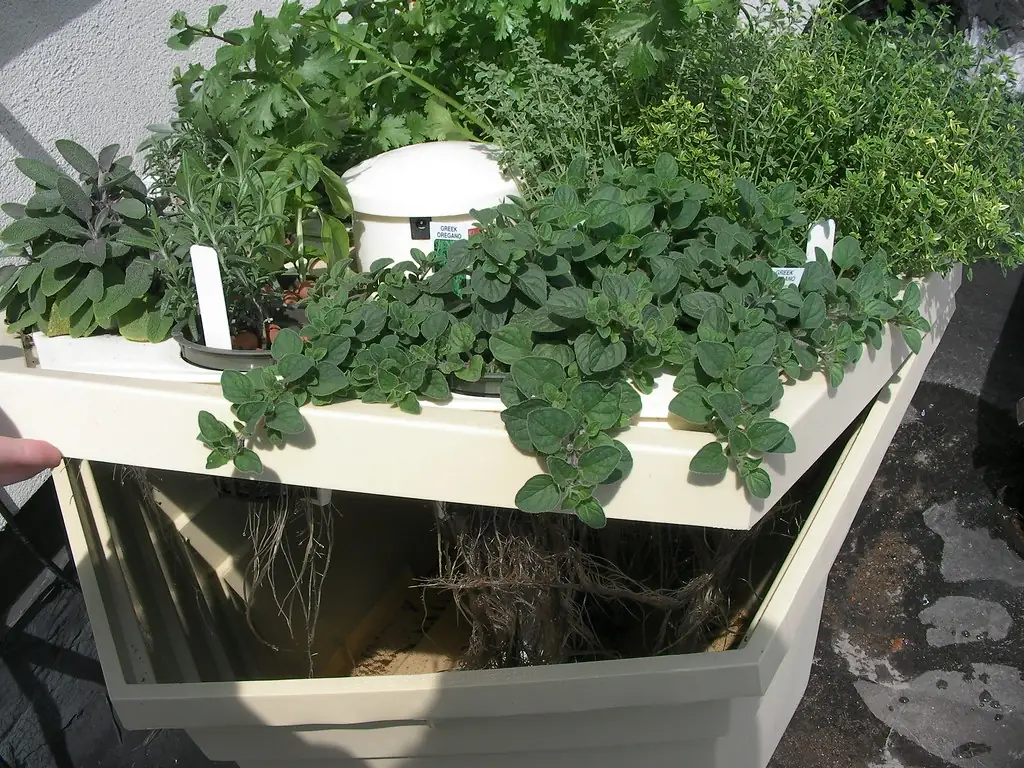
What Causes Algae in Hydroponics?
Algae need only three things: water, light and mineral nutrients. UConn Extension’s greenhouse fact sheet lists exactly these three conditions, and notes that the warm temperatures, high humidity and fertigation that suit crops also suit algae. A hydroponic system supplies two of the three by design, so light is the variable you control.
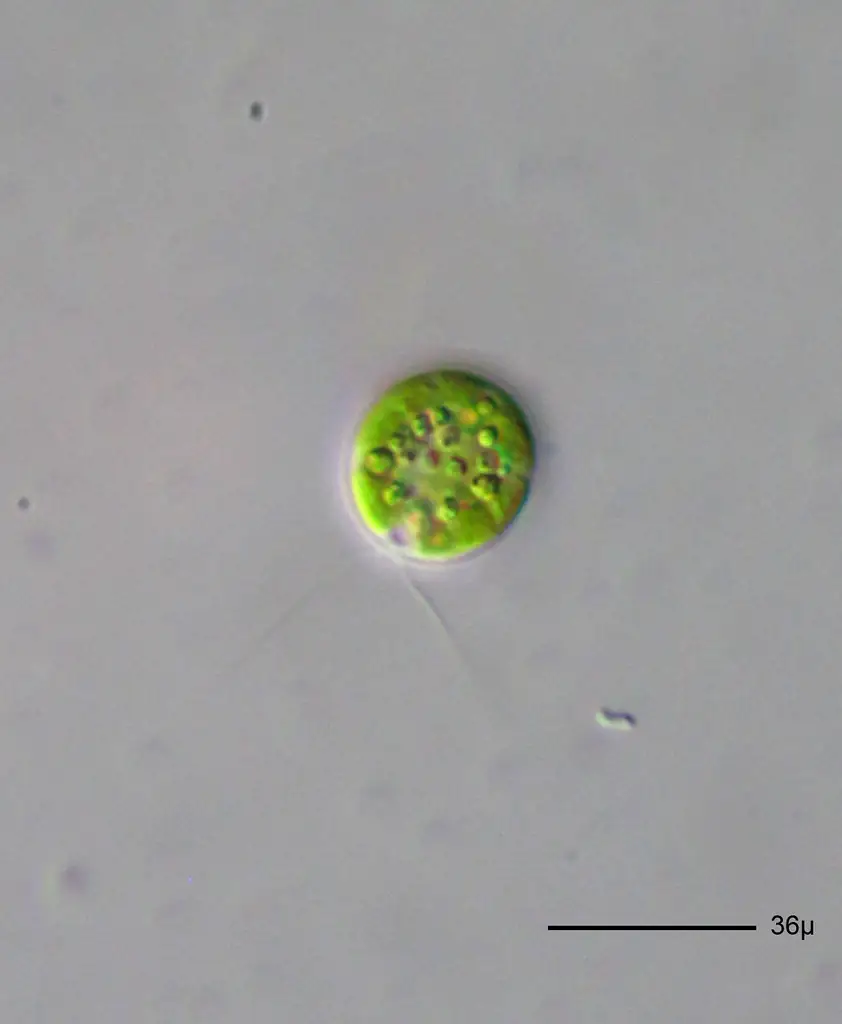
Recirculating systems are especially prone. German vegetable researchers described hydroponic systems with recirculating solution as “an ideal environment for algal growth”. In their open lettuce troughs, the algae were almost entirely single-celled green algae, mainly Chlamydomonas and Scenedesmus species, and their density depended on the starting water, temperature and nutrient concentration.
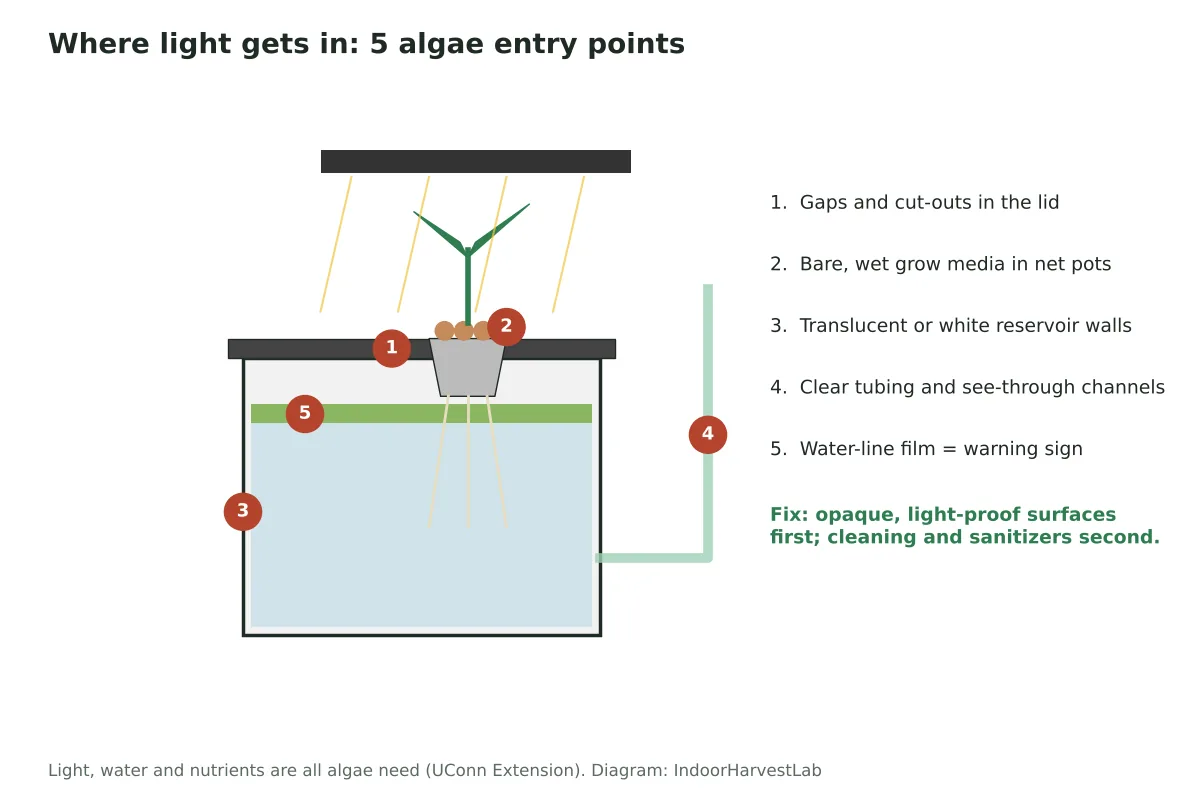
The usual sources of light
- Translucent or white reservoirs. Many storage totes and buckets pass enough light to grow algae on the inner walls.
- Lid gaps and oversized net-pot holes. Even a thin slot under a grow light lets in a strong beam.
- Wet grow media at the surface. Clay pebbles or rockwool that stay damp and lit form a green crust.
- Clear tubing and see-through channels. Common in DIY NFT and tower builds.
- Spills and standing water on trays and shelves, which UConn Extension flags as a sanitation problem in their own right.
Is Algae Bad for Hydroponic Plants? What the Research Shows
Mostly yes, though the effect depends on the crop. The clearest evidence comes from the lettuce study above. With algae densities of roughly 16,000 to 40,000 cells per mL in the greenhouse and 1.3 to 3.2 million cells per mL in climate-chamber containers, lettuce fresh weight, shoot-to-root ratio, and water and nitrogen uptake were all significantly lower than in treatments that excluded algae. The authors concluded that algae “have more negative effects on crop yield in hydroponic systems.”
A follow-up by the same group found that algae reduced shoot fresh weight in both lettuce and cucumber, and reduced lettuce yield, although cucumber fruit yield was not affected. Their honest conclusion was that the impact depends on several factors, so it cannot be generalized to every crop.
How algae cause harm
- Nutrient competition. Algae take up the same nitrogen and phosphorus your plants need. In a 2020 greenhouse study, added microalgae removed more than 98% of phosphorus in some treatments (Huo et al., Journal of Cleaner Production).
- Oxygen swings. The University of Saskatchewan’s hydroponic guide warns that algae use up the “air and nutrients” in the tank. Algae release oxygen in light but respire like any living cell, so a dense bloom adds oxygen demand, especially in the dark.
- pH drift. Algal photosynthesis pulls carbon dioxide out of the water, and Huo et al. measured a rise in pH from this effect.
- Clogging and slime. UConn Extension lists clogged lines, drip tubes and emitters as a main algae problem in irrigation systems. (Interestingly, the German lettuce study did not see clogging, which suggests it depends on the plumbing.)
- Pests. Algae are a food source for shore flies, according to UConn Extension.
One nuance: in the same Huo et al. study, added microalgae hurt arugula but did not reduce, and sometimes increased, lettuce and purple kohlrabi production. That was a deliberate co-culture in nitrate-rich wastewater, not the uncontrolled bloom in a home reservoir, so treat it as a research direction rather than a reason to tolerate green water.
Numbers to Hold for an Algae-Resistant System
These are the targets that keep algae in hydroponics under control while protecting roots. Where sources report a range or a specific trial condition, it is shown as such.
| Parameter | Target | Source |
|---|---|---|
| Light reaching the solution | None: opaque tank, lid and channels | University of Saskatchewan |
| Root-zone (solution) temperature | 68–75°F (20–24°C) | Cornell University (Mattson, e-GRO) |
| Dissolved oxygen | Above 6 ppm; ideally saturated at about 8–9 ppm | Cornell University (Mattson, e-GRO) |
| System clean-out | Full flush, scrub and sanitize at the end of each crop cycle | University of Saskatchewan |
| Hydrogen peroxide in mineral nutrient solution | Stay below 37.5 mg/L; that dose damaged lettuce | Lau & Mattson (2021), Horticulturae |
| Commercial peroxide products (trial dose) | 35–70 mL per 40-gal (151 L) reservoir, weekly or biweekly | Thakulla et al. (2022), HortScience |
| Quaternary ammonium on empty surfaces | Keep surfaces wet for at least 10 minutes; never on plants | UConn Extension |
| Algae density that cut lettuce growth | About 104 to 106 cells per mL | Schwarz et al. (2004) |
Temperature matters twice. The USGS notes that cold water holds more dissolved oxygen than warm water, and warm, still water also suits algae. Our guide to hydroponic root rot explains why the same 68–75°F band protects against Pythium.
How to Prevent Algae in Hydroponics
Prevention is cheaper than any treatment, and it works because it removes the one input algae cannot get elsewhere. The University of Saskatchewan’s leafy-greens guide puts it simply: the nutrient tank “should be opaque to keep algae from growing.”
1. Make every wet surface light-proof
Shine a torch into the reservoir in a dark room, or put the light inside and look for glow from outside. Paint or wrap translucent tanks with opaque material, swap clear tubing for black, and cover NFT channels. A light-coloured outer layer over a black inner layer keeps the tank opaque without absorbing heat.
2. Cover the tops of net pots
Bare, wet media under a grow light is the most common place algae appear first. Use net-pot collars or a thin opaque disc around each stem, and size lid holes to the pot so there is no ring of light around it. In a Kratky jar or deep water culture bucket, a simple sleeve over the container does the same job.
3. Keep the solution cool and oxygenated
Hold solution temperature in the 68–75°F (20–24°C) band and run air stones or water movement to keep dissolved oxygen above 6 ppm. In summer, move reservoirs off warm floors and away from lamp ballasts.
4. Avoid overfeeding and spills
UConn Extension advises avoiding excessive fertilization and letting surfaces dry between waterings. Mix your nutrient solution to the crop’s target EC rather than “a bit extra,” wipe drips and keep trays dry.
5. Change and top up on a schedule
Regular solution changes stop a small bloom from building up. See how often to change hydroponic water for intervals by system size.
How to Get Rid of Algae: A Step-by-Step Clean-Out
If green film is already on the walls, slime is on the roots, or the water has turned green, a mid-crop dose of anything will only buy time. The reliable fix is a clean-out between crops, followed by fixing the light leak. The steps below follow the University of Saskatchewan’s end-of-cycle routine.
Step 1: Drain and flush
Harvest or move the plants, drain the reservoir and flush the whole system with clean water to remove root debris and loose algae.
Step 2: Scrub every surface
Scrub the reservoir walls, lid underside, channels, pump intake and air stones. Pre-cleaning matters: UConn Extension notes that quaternary ammonium sanitizers are inactivated by organic matter, so a sanitizer applied over a film of algae does far less.
Step 3: Sanitize
Rinse with a dilute bleach solution, as the Saskatchewan guide advises, or use a labeled horticultural sanitizer (hydrogen peroxide with peroxyacetic acid, or a quaternary ammonium product) according to its label. If you use a quat, keep surfaces wet for at least 10 minutes.
Step 4: Rinse thoroughly
Rinse with clean water until no sanitizer smell remains, then run the pump with plain water for a short cycle and discard it.
Step 5: Fix the leak, then refill
Before refilling, close the light leak you found, or the algae will return within weeks. Then mix fresh solution and check pH and EC. If your water source is a pond, rain barrel or untreated well, note that the lettuce researchers found the starting water’s algae load strongly influenced algal density; our page on tap water for hydroponics covers source-water choices.
Hydrogen Peroxide for Algae: Doses That Help and Doses That Hurt
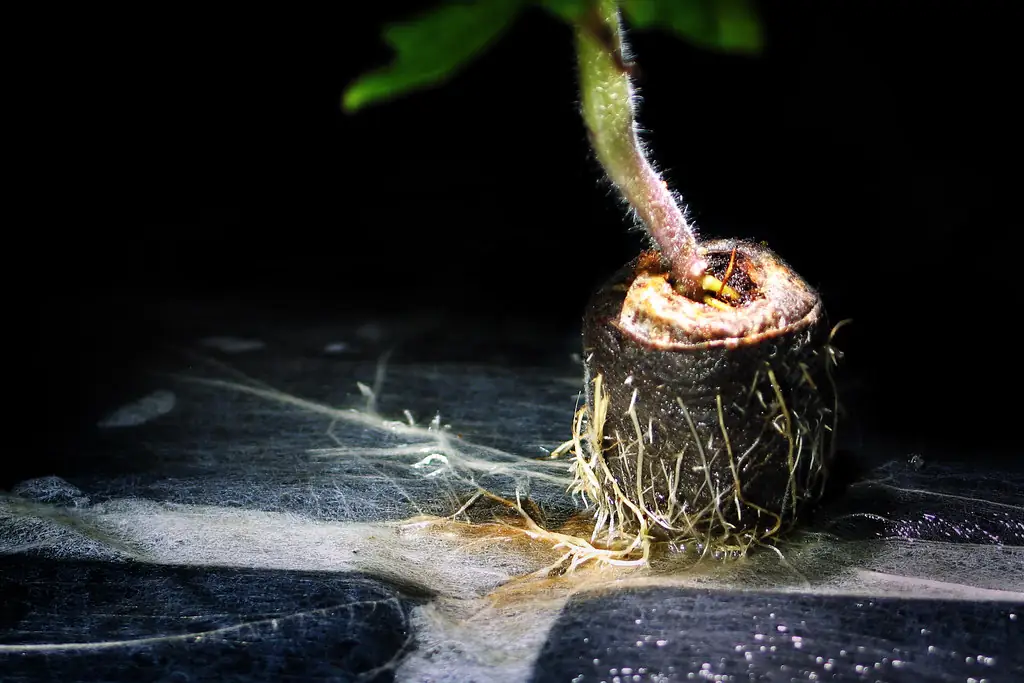
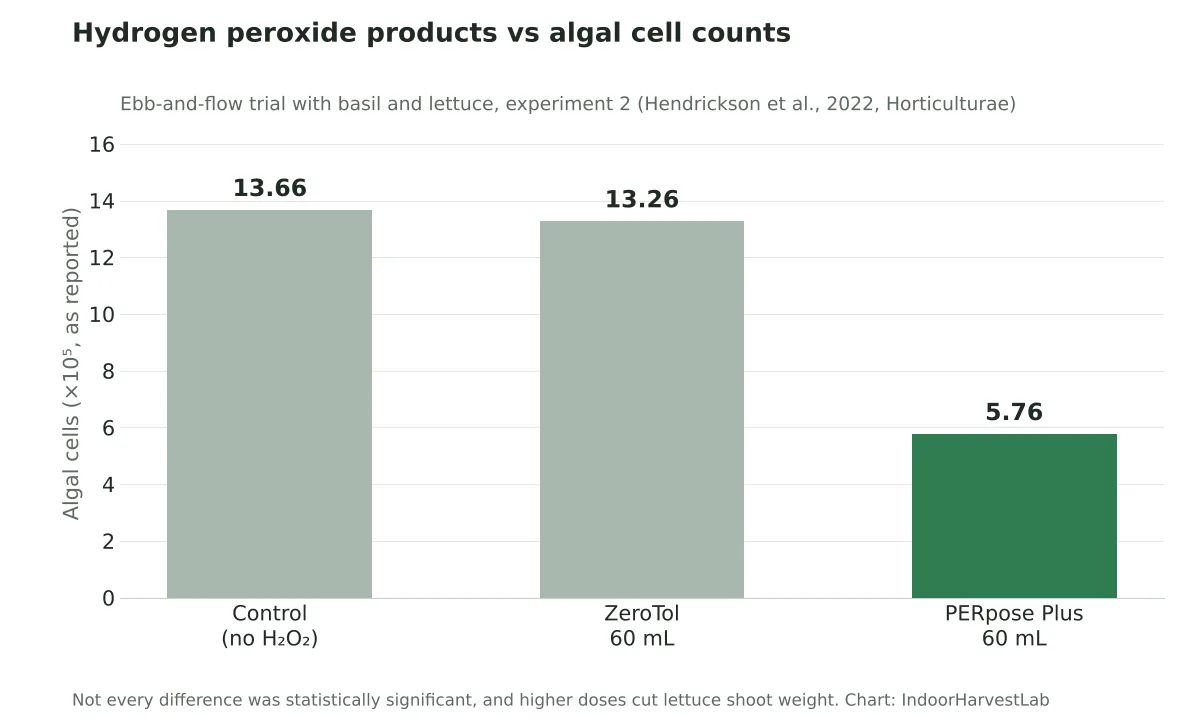
Hydrogen peroxide (H2O2) is the most studied in-system treatment, and Oklahoma State University has run several trials. The results support it as a tool, but with a narrow safety margin.
| Study | System and crop | Treatment | Result |
|---|---|---|---|
| Thakulla et al. (2022), HortScience | Ebb and flow, 40-gal reservoir; pepper and tomato | ZeroTol or PERpose Plus at 35 or 70 mL, weekly or biweekly | Algae counts, dry weight and chlorophyll a fell as rate and frequency rose; 70 mL weekly gave the best overall results |
| Hendrickson et al. (2022), Horticulturae | Ebb and flow; basil and lettuce | 3% H2O2, ZeroTol or PERpose Plus at 15–70 mL | Visual algae ratings improved; lettuce shoot weight fell at higher doses; basil was tolerant |
| Lau & Mattson (2021), Horticulturae | Lettuce; mineral vs fish-based organic fertilizer | 0, 37.5 or 75 mg/L H2O2 | Both doses damaged lettuce with mineral fertilizer; 37.5 mg/L helped in the organic system |
Turning the research into a home dose
Drugstore hydrogen peroxide is usually 3%, which is about 30 mg of H2O2 per mL. One mL of 3% peroxide in one US gallon (3.785 L) therefore gives roughly 8 mg/L. On that arithmetic, the 37.5 mg/L dose that damaged lettuce in mineral solution is only about 5 mL of 3% peroxide per gallon. If you use peroxide in a standard mineral nutrient reservoir, start well below that, watch the roots for browning and the leaves for scorch, and never tank-mix it with other products; UConn Extension warns that peroxide products are strong oxidizers that should not be mixed with fertilizers or pesticides.
Commercial products such as ZeroTol and PERpose Plus are more concentrated than drugstore peroxide, so follow the label dilution for your reservoir volume rather than copying a trial dose. Many algaecides are not labeled for use around plants, and UConn Extension cautions that they can be phytotoxic.
Other options under study
Researchers are testing alternatives. Slightly acidic electrolyzed water at 10–40 mg/L available chlorine suppressed algae without changing tomato seedling germination, length or fresh weight (Wu et al., 2024), and plasma-activated nutrient solution cut algae by up to 24% in a basil ebb-and-flow trial (Date et al., 2023). Neither is a home-grower tool yet, but both point the same way: oxidizing treatments work, and dose control is what decides crop safety.
Troubleshooting Algae and Look-Alike Problems
Not everything green or slimy is algae, and not every algae problem looks green. Use this table before you reach for a chemical. Brown, scorched edges on lettuce inner leaves point somewhere else entirely: lettuce tip burn, which is about calcium transport and airflow, not water quality.
| Symptom | Likely cause | What to do |
|---|---|---|
| Green film on walls or at the water line | Light leak into the reservoir | Light-proof the tank; scrub at the next solution change |
| Green crust on clay pebbles or rockwool tops | Wet media exposed to the grow light | Cover pot tops; let the surface dry where possible |
| Water turns pea-green | Free-floating single-celled algae bloom | Full clean-out; check source water and lid gaps |
| Roots green but firm and white inside | Algae coating roots, not rot | Block light; roots recover once covered |
| Roots brown, mushy, smelly | Root rot (often Pythium), made worse by warm, low-oxygen water | Cool to 68–75°F, aerate; see our root rot guide |
| pH keeps rising during the day | Algal photosynthesis removing CO2 | Find and remove the algae; avoid repeated pH-down dosing |
| Small dark flies around the system | Shore flies feeding on algae | Remove algae from surfaces and media; keep trays dry |
| Slow pump flow or clogged emitters | Algae and biofilm in lines | Flush and sanitize lines; use opaque tubing |
If algae keeps returning in an NFT system, check the channel end caps and inspection ports; they are easy to miss.
From the Lab Bench
The best way to think about algae in hydroponics is as a light-budget problem, not a chemistry problem. Every photon that reaches the nutrient solution is energy you paid for that grows a competitor instead of your crop. That is why opaque surfaces outperform any additive: they remove the energy supply, while sanitizers only knock back a population that will regrow as long as the light leak exists.
The peroxide data show a classic dose-response trade-off. Oxidizers do not discriminate between algal cells and root tips, so the dose that clears algae fastest is close to the dose that injures sensitive crops such as lettuce. Fast-growing, tolerant crops like basil handle more; leafy greens handle less. In practice, that means using peroxide as a short reset after cleaning, not as a standing additive.
Finally, the mixed results on whether algae harm crops are worth reading carefully. A controlled, chosen microalga in a wastewater system is not the same as an uncontrolled bloom in a hobby reservoir, where you cannot know which species is present or how dense it will get. For a home grower, the low-risk position is simple: keep the solution dark, cool and oxygenated, and clean between crops.
FAQ
Is algae bad for hydroponics?
Usually, yes. In a controlled study, algae significantly reduced lettuce fresh weight and water and nitrogen uptake. Algae also compete for nutrients, raise pH during the day, add oxygen demand and can clog lines, so it is best prevented.
What causes algae in a hydroponic reservoir?
Light reaching nutrient solution. Algae need only water, light and mineral nutrients, and a hydroponic system already supplies water and nutrients. Translucent tanks, lid gaps, bare wet media and clear tubing are the usual entry points.
How do I get rid of algae in my hydroponic system?
Drain and flush the system, scrub every surface, sanitize with a dilute bleach solution or a labeled horticultural sanitizer, rinse well, then fix the light leak before refilling. Chemicals alone will not stop algae returning.
How much hydrogen peroxide should I add to kill algae in hydroponics?
Use as little as possible. A study found 37.5 mg/L of hydrogen peroxide damaged lettuce in a mineral nutrient solution, which is only about 5 mL of 3% peroxide per US gallon. Start well below that, and follow the label for commercial products.
Will algae on hydroponic roots kill my plants?
A green coating on roots that are firm and white inside is algae, not rot, and roots usually recover once light is blocked. Brown, mushy, smelly roots point to root rot, which needs cooler, better-oxygenated water.
Does algae affect pH in hydroponics?
Yes. Algae remove carbon dioxide from the water as they photosynthesize, which raises pH. Researchers measured this effect, so a pH that keeps climbing during the day can be a sign of an algae bloom.
Can algae ever be good in hydroponics?
In one study, deliberately added microalgae did not hurt lettuce or kohlrabi and helped remove nutrients from wastewater, but they reduced arugula growth. An uncontrolled bloom in a home reservoir is different, so prevention remains the safer choice.
Sources
- Schwarz, D. et al. (2004). Algae affecting lettuce growth in hydroponic systems. The Journal of Horticultural Science and Biotechnology 79(4): 554–559.
- Schwarz, D. et al. (2009). Do algae cause growth-promoting effects on vegetables grown hydroponically? (research paper).
- Huo, S. et al. (2020). The influence of microalgae on vegetable production and nutrient removal in greenhouse hydroponics. Journal of Cleaner Production 243: 118563.
- Thakulla, D., Dunn, B., Goad, C. and Hu, B. (2022). Timing and rates of two products using hydrogen peroxide to control algae in ebb and flow hydroponic systems. HortScience 57(1): 32–39.
- Hendrickson, T., Dunn, B.L., Goad, C., Hu, B. and Singh, H. (2022). Effects of hydrogen peroxide products on basil, lettuce, and algae in an ebb and flow hydroponic system. Horticulturae 8(7): 569.
- Lau, V. and Mattson, N. (2021). Effects of hydrogen peroxide on organically fertilized hydroponic lettuce (Lactuca sativa L.). Horticulturae 7(5): 106.
- Pundt, L. (2018). Managing algae in the greenhouse. UConn Extension IPM fact sheet.
- University of Saskatchewan, Grow with USask. Hydroponic leafy greens: nutrient management.
- Mattson, N. (Cornell University). Pythium root rot on hydroponically grown basil and spinach. e-GRO, via Urban Ag News.
- U.S. Geological Survey. Dissolved oxygen and water. Water Science School.
- Wu, C. et al. (2024). Slightly acidic electrolyzed water significantly restrains the accumulation of the microalgae Pseudokirchneriella subcapitata in hydroponic systems. Journal of Applied Microbiology 135(5).
- Date, M. et al. (2023). Growth of hydroponic sweet basil (O. basilicum L.) using plasma-activated nutrient solution (PANS). Agriculture 13(2): 443.