
You bought a neat little pot of thyme with the groceries, set it on the kitchen windowsill, and for a week it smelled wonderful every time you brushed past it. Now it’s December. The stems have gone long and wiry, the leaves at the base are grey and dropping, and the soil never quite seems to dry out. Thyme is supposed to be tough. So why does it sulk the moment it comes inside, and how do you grow thyme indoors without that slow decline?
Short answer: you can grow thyme indoors all winter if you give it the brightest spot you have (6+ hours of direct sun, or 14–16 hours under a grow light set 6–12 inches above it), a pot at least 6 inches (15 cm) wide filled with gritty, fast-draining mix, and rooms of about 65–70°F (18–21°C) by day and 55–60°F (13–16°C) at night. Let the mix dry slightly between waterings, feed lightly, and snip soft green tips rather than cutting into old wood.
Thyme isn’t fussy so much as specific. It’s a small Mediterranean shrub that evolved on sunny, stony ground, and a winter house gives it the opposite: weak light, warm air and a pot that stays damp. This guide pulls together what Penn State, Illinois, Cornell, Delaware and NC State Extension, the RHS, Johnny’s Selected Seeds and a 2025 light-intensity study actually say. By the end you’ll know the numbers to hold, the fastest way to get a productive pot, how to light it, and how to rescue a plant that’s already struggling.
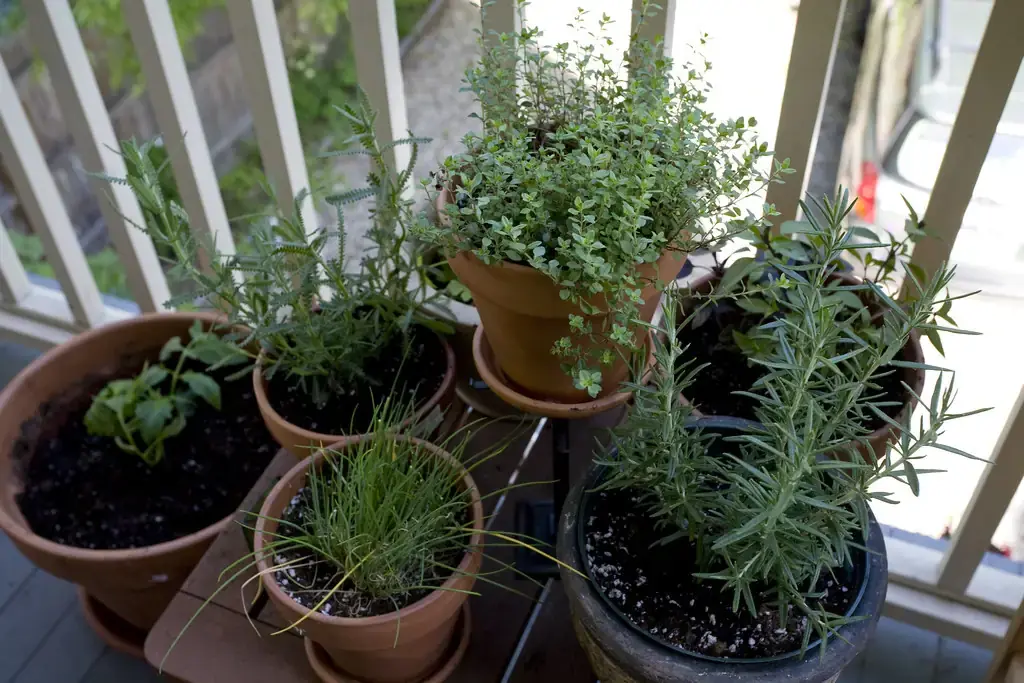
First, know your plant. Common thyme (Thymus vulgaris) is a woody, evergreen perennial in the mint family, native to south-western Europe, according to the NC State Extension Gardener Plant Toolbox. It forms a mound about 6–12 inches high and prefers dry, sandy or rocky soil, full sun and good drainage. University of Illinois Extension adds the detail that matters most indoors: poorly drained soil, especially over winter, shortens its useful life.
That’s the whole story in two lines. Indoors, thyme fails in one of two ways: it stretches toward weak light until it’s spindly and flavourless, or it sits in wet mix until the roots rot. Penn State Extension lists root rot, fungal diseases and spider mites as thyme’s main problems. Notice that two of the three are about moisture. Get light and drainage right and the rest is easy.
Numbers to Hold When You Grow Thyme Indoors
Here’s the cheat sheet. Every figure comes from the source in the right-hand column, and you’ll find full links at the end.
| What | Target | Source |
|---|---|---|
| Window light | 6+ hours of direct sun; a south-facing window | Penn State |
| Grow-light schedule | 14–16 h a day, 6–12 in (15–30 cm) above the plants (two 40-watt cool white fluorescent tubes) | Penn State; Cornell CCE |
| Day temperature | 65–70°F (18–21°C) | Penn State |
| Night temperature | 55–60°F (13–16°C) | Penn State |
| Pot size (one plant) | At least 15 cm (6 in) wide and 10 cm (4 in) deep, with plenty of drainage holes | RHS |
| Potting mix | Soil-based compost (e.g. John Innes No 2) with up to 25% horticultural grit by volume | RHS |
| Soil pH | About 6.3; neutral to alkaline is fine | Penn State; NC State |
| Watering | Let the mix dry slightly between waterings; keep on the dry side | Penn State; Illinois |
| Fertilizer | Low dose of water-soluble feed every 2 weeks, at most | Penn State |
| Seed germination | 14–21 days at 65–70°F (18–21°C) | Johnny’s |
| Cutting length | 4–6 in (10–15 cm) soft shoot tips | Penn State; Cornell CCE |
| Replace plant | Every 3–4 years as it turns woody | Johnny’s |
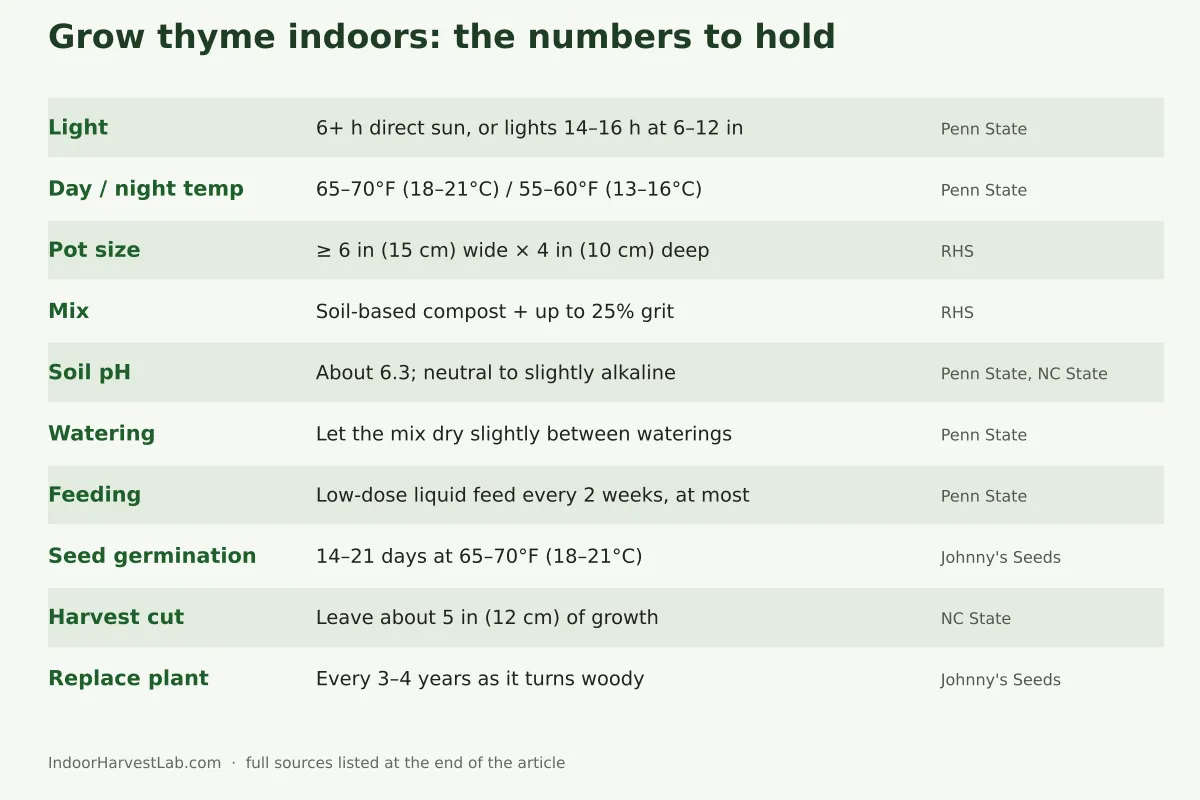
Two of these numbers are worth a second look. The temperature range is cooler than most living rooms in winter, and that’s deliberate: cooler air slows growth to match the weak light, so the plant doesn’t stretch. And the 6.3 pH figure isn’t something you need to chase with a meter. Any decent potting mix lands close enough, and thyme copes with slightly alkaline conditions anyway, according to NC State.
Four Ways to Start: Nursery Plant, Cuttings, Division or Seed
How you start decides how soon you eat. Illinois Extension says thyme can be grown from seed but is much easier from divisions or cuttings. The RHS warns that seed-grown thyme may take about a year to establish before you can start harvesting, and NC State notes that germination is uneven. Here’s how the options compare.
| Method | Time to first real harvest | Cost | Best for | Watch out for |
|---|---|---|---|---|
| Nursery or supermarket pot | Light snipping right away | Low | Anyone who wants thyme this month | Supermarket pots are often crowded and soft; repot into gritty mix |
| Stem cuttings | Roots in 1–6 weeks (herbs in general, Cornell CCE), then a few weeks of growth | Free | Copying a plant you already like | Rot if the mix stays soggy |
| Division of a garden plant | Weeks, once settled | Free | Gardeners with an established clump | Bringing pests indoors; inspect first |
| Seed | About 90–180 days to maturity depending on type (Delaware Extension); up to a year to establish (RHS) | Lowest per plant | Many plants, or unusual varieties | Slow, uneven germination |
Honestly, for one kitchen pot, buy a healthy plant or root a few cuttings. Save seed for when you want a whole tray.
Step by step: rooting thyme cuttings
Thyme is one of the herbs that Cornell Cooperative Extension lists as doing well from cuttings. Penn State recommends taking them from new growth, and the RHS suggests softwood cuttings in spring or early summer and semi-ripe cuttings in summer. Late autumn cuttings from an outdoor plant are slower, but the soft tips still root if you’re patient.
- Prepare the pot first. Use a small container with drainage holes, filled with moist, well-drained, sterile mix (Cornell) or plain sand (Penn State).
- Cut soft, non-flowering tips. Take 4–6 inch (10–15 cm) stems, cutting just below a node, where leaves join the stem.
- Strip the lower leaves. Leave foliage only on the top 1–2 inches. Buried leaves rot.
- Make a hole, then insert. Poke a hole with a pencil so you don’t scrape the stem, and firm the mix around it. Space cuttings an inch or two apart.
- Keep it bright and lightly moist. Check every couple of days. Cornell says herb cuttings take anywhere from a week to six weeks to root, so take several to allow for losses.
- Pot on once rooted. Gentle resistance when you tug, or new growth at the tip, means roots. Move each one into its own pot of gritty mix. Our guide to potting up seedlings covers the technique.
Step by step: growing thyme from seed
- Sow on the surface. Johnny’s recommends sowing on top of the mix and covering with only a thin layer.
- Hold 65–70°F (18–21°C). Expect seedlings in 14–21 days (Johnny’s). The RHS gives 15–20°C (59–68°F), with germination within a couple of weeks. Our seed germination temperature chart explains why a heat mat helps in a cold room.
- Give light as soon as they emerge. Seedlings stretch fast on a dim sill. Put them under lights straight away; see grow lights for seed starting.
- Prick out at four true leaves. Johnny’s says to move seedlings to individual containers at this stage; the RHS suggests about a 7.5 cm (3 in) pot of soil-based compost.
- Pinch upright types. Pinch the growing tips of upright varieties to make bushier plants (Johnny’s).
Bringing a garden plant inside
Illinois Extension says plants can be potted in the fall and grown all winter in a bright, sunny spot. If your clump is big, the RHS recommends division in spring or autumn. Pot a rooted piece, not the whole woody mound. Before it comes in, check the undersides of leaves for aphids and spider mites, which Delaware Extension lists among thyme’s common pests.
Light: The Make-or-Break Factor for Indoor Thyme
If you remember one thing about how to grow thyme indoors, make it this: thyme is a full-sun plant. Penn State Extension puts thyme in the group of herbs (with bay and rosemary) that do best in direct sunlight, and warns that herbs short of light become thin and spindly, produce smaller leaves and have reduced aroma. That last point surprises people. Low light doesn’t just make thyme look bad; it makes it taste of less.
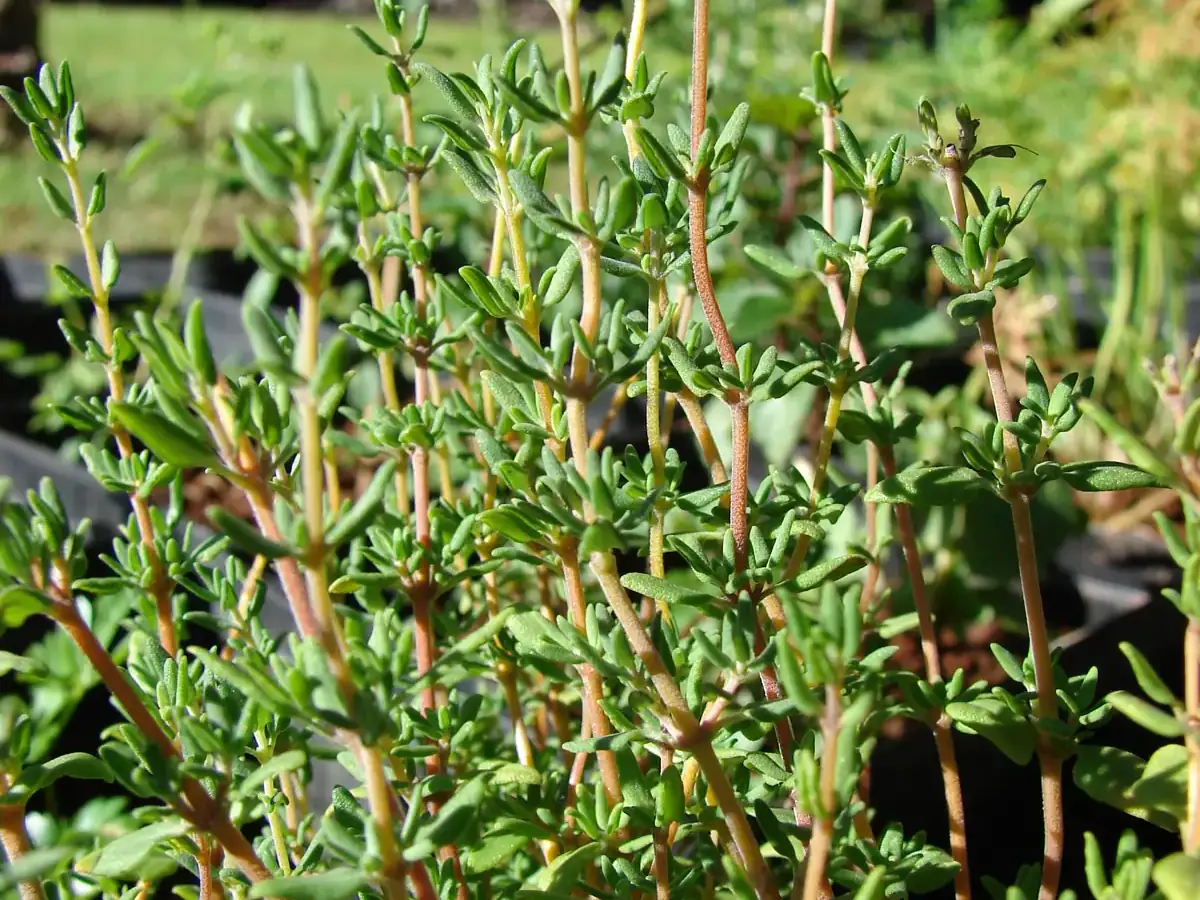
Research backs that up. In a 2025 study in PLOS One, Hashemifar and colleagues grew thyme under 20%, 50%, 70% and 100% of natural sunlight. As light increased, leaf count rose by 164.6% and biomass by 33.5%, while stem length and internode length fell. In plain terms, more light gave shorter, bushier plants with many more leaves. Essential oil and monoterpene content also rose with light, although thymol, the main flavour compound, peaked at 70% light (41.2% of the oil).
A south window in midwinter is nowhere near full sun, so most indoor thyme sits at the dim end of that experiment. That’s why a grow light pays off more for thyme than for shade-tolerant herbs such as chives.
How to set up a grow light for thyme
- Timer: 14–16 hours a day. Penn State and Cornell both give this range. Illinois Extension gives 12–14 hours under fluorescents; treat 14 as a sensible middle.
- Distance: 6–12 inches (15–30 cm) for fluorescent tubes. LED panels vary, so follow the maker’s guidance and watch the plant: pale, bleached tips mean too close; long gaps between leaf pairs mean too far.
- Rotate window pots. Penn State advises turning pots often so every side gets light.
- Think in daily totals. What a plant uses is its daily light integral (DLI), the total light over a day. The chart below shows how intensity and hours combine.
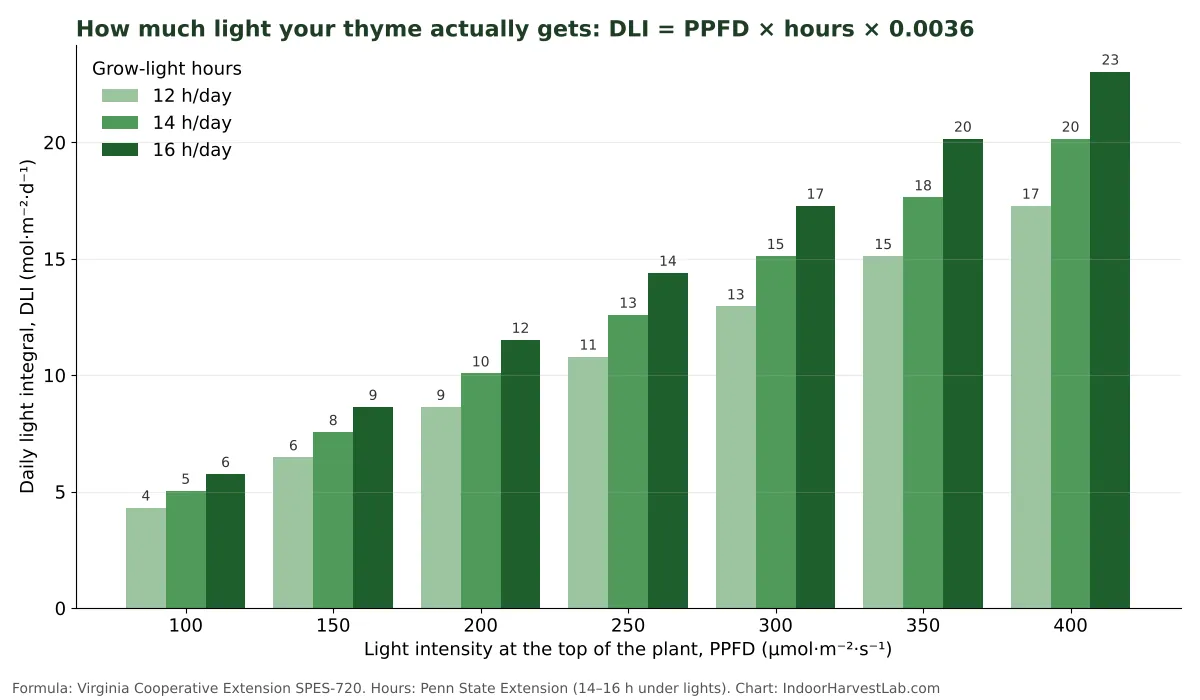
The maths is simple: DLI (mol·m⁻²·d⁻¹) = PPFD × hours × 0.0036, as Virginia Cooperative Extension explains. A light giving 200 µmol·m⁻²·s⁻¹ at the canopy for 14 hours supplies about 10 mol·m⁻²·d⁻¹; the same light for 16 hours gives about 11.5. Running a light longer is the cheapest way to add daily light. For a broader overview of lighting a windowsill herb collection, see our guide to growing herbs indoors in winter.
Pot, Mix, Watering and Feeding
This is where most attempts to grow thyme indoors fail, and almost always from kindness. Too much water, too rich a mix, too much fertilizer.
Choose a pot that drains fast
The RHS recommends a pot at least 15 cm (6 in) wide and 10 cm (4 in) deep for one plant, with plenty of drainage holes. Illinois Extension also suggests at least a 6-inch container with a drainage hole for indoor herbs. Unglazed terracotta is a good match because the clay wicks water out of the mix, so it dries faster between waterings. Never let the pot stand in a saucer of water.
Make the mix gritty
The RHS recipe is a soil-based compost such as John Innes No 2 with up to 25% horticultural grit by volume. Outside the UK, a good potting mix lightened with grit, perlite or coarse sand does the same job. The aim is a mix that holds a little moisture but never stays wet.
Water by checking, not by the calendar
Penn State says thyme (with rosemary, sage, oregano and bay) should dry out slightly between waterings, and Illinois says to keep the soil on the dry side. A simple test: push a finger into the mix. If the top inch is dry and the pot feels light, water thoroughly until it runs from the base, then let it drain. In a cool winter room that may be only every week or two.
Feed lightly, or not at all
Penn State suggests a low dose of water-soluble fertilizer every 2 weeks for indoor herbs, and warns that feeding more often may hurt aroma and taste. Illinois Extension says the same about over-fertilizing. For thyme, which Penn State says needs little fertilizer once established, a weak feed during active growth is plenty. If growth has stalled in the dark of December, skip feeding until the days lengthen.
Air and humidity
Thyme dislikes stagnant, humid air. A small fan in the room helps prevent disease, according to Illinois Extension. Keep pots away from heat vents, which dry plants unevenly. Penn State notes that forced-air heating creates the driest winter conditions; grouping pots helps, but thyme needs humidity less than basil does.
Harvesting and Pruning Indoor Thyme
Regular snipping is good for thyme, and it’s the reward for the effort it takes to grow thyme indoors, as long as you cut the right part. Johnny’s advises cutting only a few stems in the first year so a young plant can establish. On an established plant, snip soft green tips, taking a few inches at a time. The RHS warns that pruning hard into old wood is risky because those stems may not reshoot. Always leave green leaves below your cut.
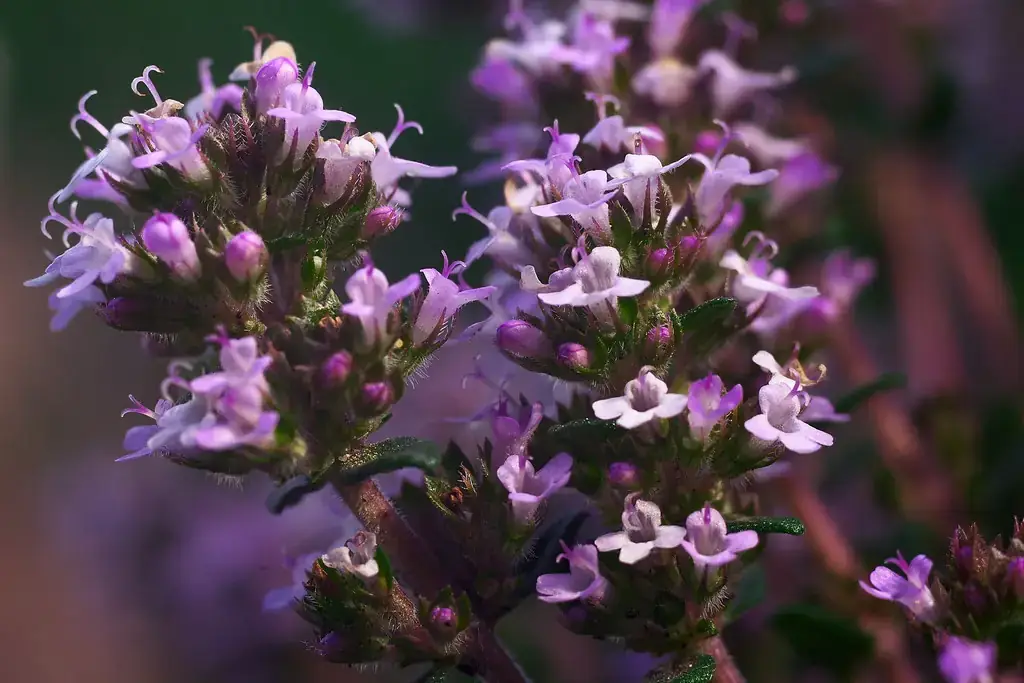
Flavour peaks just before flowering. NC State says the essential oil content of the leaves is at its highest then, and Penn State and Illinois both recommend harvesting at that stage. Indoors under long days a plant may try to flower. Pinch off flower buds if you want leaves, or take a bigger harvest and dry it.
Drying a bigger harvest
Penn State suggests stripping the bottom 2 inches of leaves, bundling stems with a rubber band, and hanging them upside down in a shady, dry, airy place. When the leaves are crisp, strip them and store them in airtight containers. Illinois adds that thyme’s flavour isn’t harmed by long, slow cooking, so dried thyme is perfect for stews and soups.
Renew old plants
Thyme gets woody with age. Johnny’s says it needs dividing or replacing after 3–4 years. Indoors, the simplest plan is to root a few cuttings each spring so a young plant is always ready to replace a tired one.
Indoor Thyme Problems: Symptoms and Fixes
Even when you grow thyme indoors carefully, a plant can stall. Use this table to read a struggling plant. Start with the most likely cause, which is usually light or water.
| What you see | Most likely cause | What to do |
|---|---|---|
| Long, thin stems with big gaps between leaves; weak smell | Not enough light (Penn State) | Move to the brightest window or add a grow light for 14–16 h |
| Lower leaves grey or brown; mix damp; plant wilting | Root rot from wet mix (Penn State lists root rot) | Unpot, trim brown mushy roots, repot in gritty mix, water less |
| Leaves dry and crisp all over; mix bone dry | Pot dried out completely, or heat vent nearby | Soak thoroughly, move away from vents, check more often |
| Fine webbing; speckled, dull leaves | Spider mites (Penn State; Delaware) | Rinse foliage, isolate the plant, remove the worst stems |
| Sticky leaves, small soft insects on tips | Aphids (Delaware) | Trim and bin infested tips (Penn State); rinse; repeat weekly |
| Grey fuzzy mould on dense growth | Botrytis (Delaware) | Remove affected stems, add airflow, thin crowded growth |
| Tiny black flies around the pot | Fungus gnats in damp mix | Yellow sticky traps and drier watering (Penn State); see our fungus gnat guide |
| Dark leaf spots | Alternaria leaf spot (Delaware) | Remove spotted leaves, keep foliage dry, improve airflow |
On pest sprays: Penn State recommends cultural and mechanical control first. It says soft products such as neem oil can be used in extreme cases, following the label, but this isn’t usually advised for herbs you harvest and eat. Wash leaves before cooking.
From the Lab Bench
Here’s how to read the evidence if you want to grow thyme indoors and are deciding where to spend effort.
Light and water are linked. A plant in dim light grows slowly, so it uses little water, so the mix stays wet for days, and that’s when root rot moves in. Adding light speeds growth, which dries the pot faster, which protects the roots. That’s why a grow light fixes two problems at once. If you can’t add light, water even less and keep the room cooler.
Flavour is a light story too. Thyme’s aroma comes from essential oils made in glandular hairs on the leaves. The PLOS One study found that essential oil and monoterpene content rose with light. The peak for thymol at 70% sun suggests a little shade isn’t a problem outdoors. Indoors, though, you’re almost always below that level, so for practical purposes more light means more flavour.
Cool is a feature, not a flaw. Penn State’s 55–60°F nights aren’t arbitrary. In low light, warmth drives stem growth that the plant can’t support with photosynthesis, which gives you stretched, floppy shoots. Cool nights slow that stretch. A cool bedroom windowsill often beats a warm kitchen.
Treat a supermarket pot as cuttings in disguise. They’re often a dense crowd of soft stems grown fast under ideal greenhouse conditions. Rather than nursing the whole pot, it can be smarter to split it into a few clumps in gritty mix, or to root the best tips. You’ll end up with sturdier plants that suit your conditions.
If you’re building a full indoor herb shelf, thyme sits happily next to rosemary, which wants the same bright, dry treatment. Keep it apart from moisture-lovers such as basil and chives, so you can water each group on its own schedule.
FAQ
Can thyme grow indoors all year?
Yes. Illinois Extension says thyme can be potted in the fall and grown all winter in a bright, sunny spot. Give it 6+ hours of direct sun or 14–16 hours under a grow light, a gritty, fast-draining mix, and cool rooms of about 65–70°F by day.
How much light does indoor thyme need?
Penn State Extension puts thyme among the herbs that do best in direct sunlight: at least 6 hours, ideally in a south-facing window. Under lights, give 14–16 hours a day with fluorescent tubes 6–12 inches above the plants.
How often should I water thyme indoors?
Water when the top inch of mix is dry and the pot feels light, then soak it and let it drain. Penn State says thyme should dry slightly between waterings. In a cool winter room this may be only every week or two.
Why is my indoor thyme dying?
The two common causes are too little light (thin, stretched stems with weak scent) and too much water (grey or brown lower leaves, damp mix, root rot). Move it to brighter light, water less and repot into gritty mix if the roots are brown and mushy.
Is it easier to grow thyme from seed or cuttings?
Cuttings. Illinois Extension says thyme is much easier from divisions or cuttings than seed. Seed germinates in 14–21 days at 65–70°F (Johnny’s), but the RHS says seed-grown plants may take about a year to establish.
Can you root thyme cuttings in water?
Extension sources recommend rooting thyme in a moist, well-drained mix or in sand rather than water. Take 4–6 inch soft tips, strip the lower leaves and keep the mix lightly moist; herb cuttings root in about one to six weeks.
How do you harvest thyme without killing it?
Snip soft green tips a few inches long and always leave green leaves below the cut. The RHS warns that cutting hard into old wood is risky because it may not reshoot. Take only a few stems from a first-year plant.
Sources
- Sánchez, E. S. and Kinley, E. (2024). Growing Herbs Indoors. Penn State Extension.
- Kagan, C. (2026). Herb Garden Plants: Thyme. Penn State Extension.
- University of Illinois Extension. Herb Gardening: Thyme.
- Haag, B. (2021). Herbs all winter: grow them indoors. University of Illinois Extension, Flowers, Fruits, and Frass blog.
- Royal Horticultural Society. How to grow thyme. RHS Grow Your Own.
- NC State Extension Gardener Plant Toolbox. Thymus vulgaris (common thyme).
- Judd, R. and Hermenau, G. (2024). Thyme. University of Delaware Cooperative Extension fact sheet.
- Johnny’s Selected Seeds. Thyme: Key Growing Information. Grower’s Library.
- Fernandez, L. (2026). Propagate herbs now to enjoy all winter. Cornell Cooperative Extension, Orleans County.
- Hashemifar, Z., Sanjarian, F., Naghdi Badi, H. and Mehrafarin, A. (2025). Impact of varying light intensities on morphology, phytochemistry, volatile compounds, and gene expression in Thymus vulgaris L. PLOS One.
- Stallknecht, E. (2025). Calculating and Using Daily Light Integral (DLI): An Introductory Guide. Virginia Cooperative Extension, SPES-720.