
You’ve just snipped your first tray of microgreens. The cut stubs are standing in neat green rows, the roots are still white and healthy, and the mix is still damp. It feels wasteful to throw it all on the compost. So you wonder: if I keep watering this, will it grow back?
Short answer: Most microgreens that regrow are the ones that keep a growing point below your cut. Pea shoots, chickpea shoots and wheatgrass can regrow when you cut above the lowest leaf node or growing zone, but each later cut is smaller. Radish, broccoli, kale, mustard, sunflower, basil, beet and most other microgreens are a one-cut crop: the scissors take the growing point with them, so the tray won’t come back. For those, re-sowing is faster than waiting.
This guide explains the plant biology behind that rule (it takes two minutes and makes the rule easy to remember), lists which crops regrow and which don’t, and shows what research says about how much smaller the second, third and fourth cuts get. You’ll also get a step-by-step method for cutting pea shoots so they come back, plus a quick troubleshooting table for regrowth trays that sulk or go mouldy.
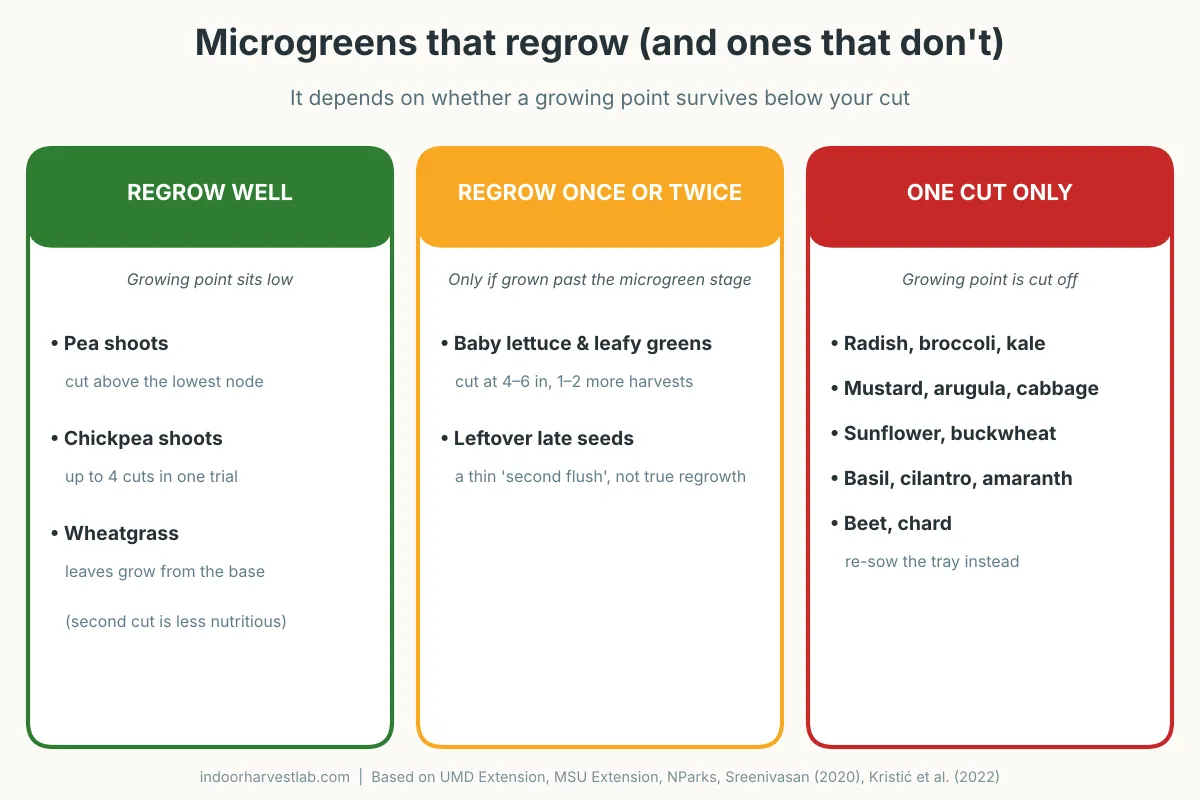
Microgreens that regrow: the quick answer by crop
Do microgreens regrow after cutting? Extension specialists are blunt about standard microgreens. The University of Maryland Extension’s indoor guide tells growers to wash and reuse the trays because “the seedlings will not regrow” (UMD Extension). Mississippi State University Extension calls microgreens “a one-cut process” and recommends succession sowing to keep a steady supply (MSU Extension).
But there are real exceptions, and they all share one feature: a bud or growing zone that sits below where you cut. Here’s how the common crops sort out.
| Crop | Regrows? | Why | What to expect |
|---|---|---|---|
| Pea shoots | Yes, usually 1–2 more cuts | Seed leaves stay in the seed; buds sit at the low nodes | Cut above the lowest node; later cuts are smaller (NParks: up to three harvests in total) |
| Chickpea shoots | Yes | Same pea-family growth habit, buds at the low nodes | Four cuts in one trial, each lighter than the last |
| Wheatgrass | Yes, once | Grass leaves grow from a zone near the base | Second cut 14 days after the first in one study, with lower phenol and vitamin C levels |
| Baby lettuce, baby leafy greens | Yes, 1–2 more harvests | Grown past the microgreen stage, with buds left on the stub | Cut at 4–6 inches; UMD’s second lettuce harvest came three weeks later |
| Radish, broccoli, kale, cabbage, mustard, arugula | No | Cut below the seed leaves removes the growing tip | Re-sow; a few late seeds may make a thin “second flush” |
| Sunflower, buckwheat | No | Same reason: the growing tip sits between the seed leaves | Re-sow |
| Basil, cilantro, amaranth, beet, chard | No (as microgreens) | Growing tip removed with the cut | Re-sow; grow a few on to full plants if you want repeat cuts |
If you only remember one thing, remember this: it isn’t about how tough the plant is, it’s about where its growing point sits when you cut. The next section shows why.
Why most microgreens don’t grow back: the growing point
Every shoot grows from a tiny cluster of dividing cells at its tip, called the apical meristem. Lose it, and the stem can’t get any longer. A plant can only replace it from a dormant bud, and buds sit at nodes: the points on a stem where leaves attach.
Cotyledon microgreens: the tip is cut off
Radish, broccoli, kale, sunflower and most other microgreens are harvested at the seed-leaf (cotyledon) stage, sometimes with the first true leaf just showing. UF/IFAS Extension describes harvest at the first true leaf stage, at about 2 inches tall, 7 to 21 days after seeding (UF/IFAS EDIS). In these crops the seed leaves are lifted above the mix, and the growing tip sits right between them.
When you cut the stem above the mix, as every extension guide recommends, you take the seed leaves, the growing tip and the buds at the seed-leaf node in one snip. What’s left is a bare stem with roots. It has no leaves to make food and no bud to make a new shoot, so it simply rots or dries out. That’s why the sunflower microgreens and radish microgreens guides on this site treat them as one-cut crops.
Peas and chickpeas: the seed leaves stay underground
Peas and chickpeas germinate differently. Their seed leaves stay inside the seed, at or below the surface, and the stem that pushes up carries small scale leaves at its lowest nodes, each with a bud. A paper on chickpea microgreens describes these “small growing buds at the base of the scale leaves and other growing points (nodes)” on the shoots (Sreenivasan, 2020).
So if you cut above the lowest node, buds are left behind on the stub. They wake up once the tip above them is gone and grow into new shoots. Cut flush with the mix and you remove those buds too, and the pea behaves like a radish.
Wheatgrass: the growing zone sits at the base
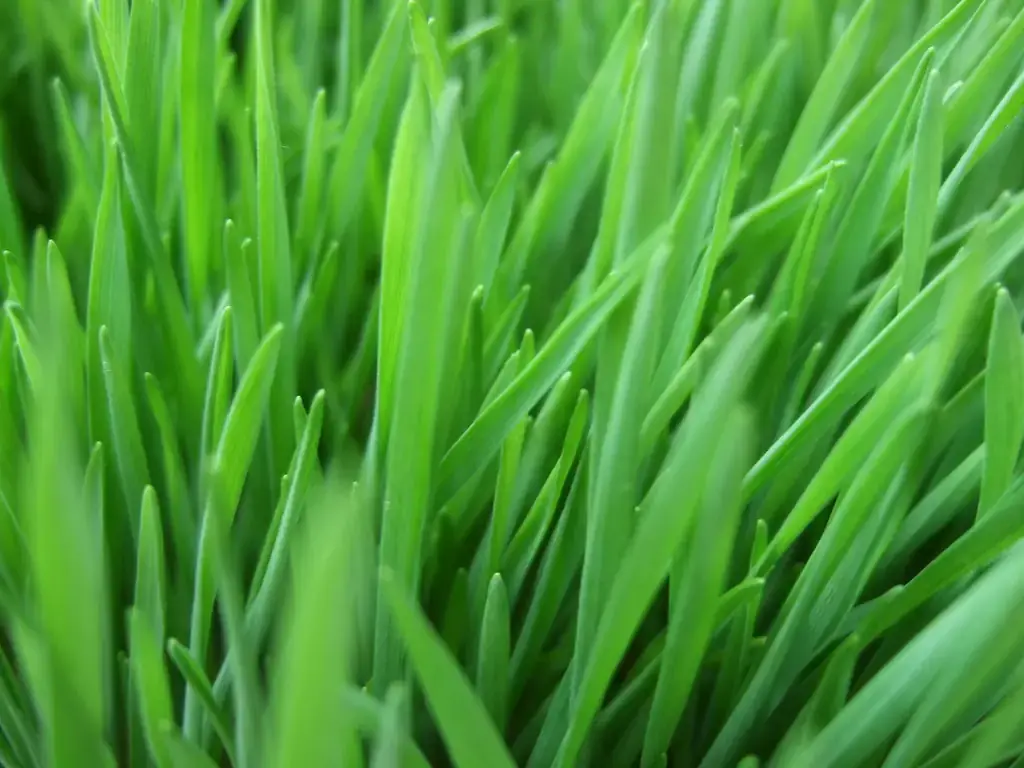
Grasses work a third way. Oregon State University’s forage program explains that grass leaves keep lengthening from an intercalary zone near their base, and that “if a leaf tip is removed, the intercalary cells continue to increase the leaf blade although the leaf tip will not regrow” (Oregon State Forage Information System). New shoots (tillers) also arise from buds at the base. Cutting wheatgrass a little above the mix leaves that machinery in place, which is why wheatgrass trays push up a second crop.
Numbers to hold for microgreens that regrow
Here are the figures that matter, each traced to its source. Treat them as starting points: home trays, seed lots and light setups vary.
| What | Number | Source |
|---|---|---|
| Grow temperature for microgreens | 70–75°F (21–24°C) | UMD Extension |
| Light for indoor microgreens | About 16 hours a day; lights 6–12 in (15–30 cm) above the foliage | UMD Extension |
| Normal microgreen harvest | 7–21 days after sowing, about 2 in (5 cm) tall at first true leaf | UF/IFAS EDIS; MSU Extension |
| Pea sprouts/shoots: harvest height | About 7 cm (2.75 in), as the tendrils emerge | NParks |
| Pea shoots: harvests per tray | Up to three, cutting above the lowest node | NParks |
| Pea shoots: daily light integral (DLI) for best quality | 8.1–9.8 mol/m²/day (winter greenhouse study) | Kong et al., 2018 |
| Chickpea shoots: drop in shoot weight from cut 1 to cut 4 | 0.165 g to 0.104 g per shoot (about 37% lower) | Sreenivasan, 2020 |
| Wheatgrass: cut timing | First cut day 12; second cut 14 days later (day 26) at 20°C (68°F), 12 h light | Kristić et al., 2022 |
| Baby greens: regrowth | Cut at 4–6 in (10–15 cm); 1–2 more harvests | UMD Extension |
If you grow under LEDs, the microgreens light requirements guide shows how to turn PPFD and hours into DLI so you can hit numbers like these.
Pea shoots and chickpeas: the most reliable microgreens that regrow
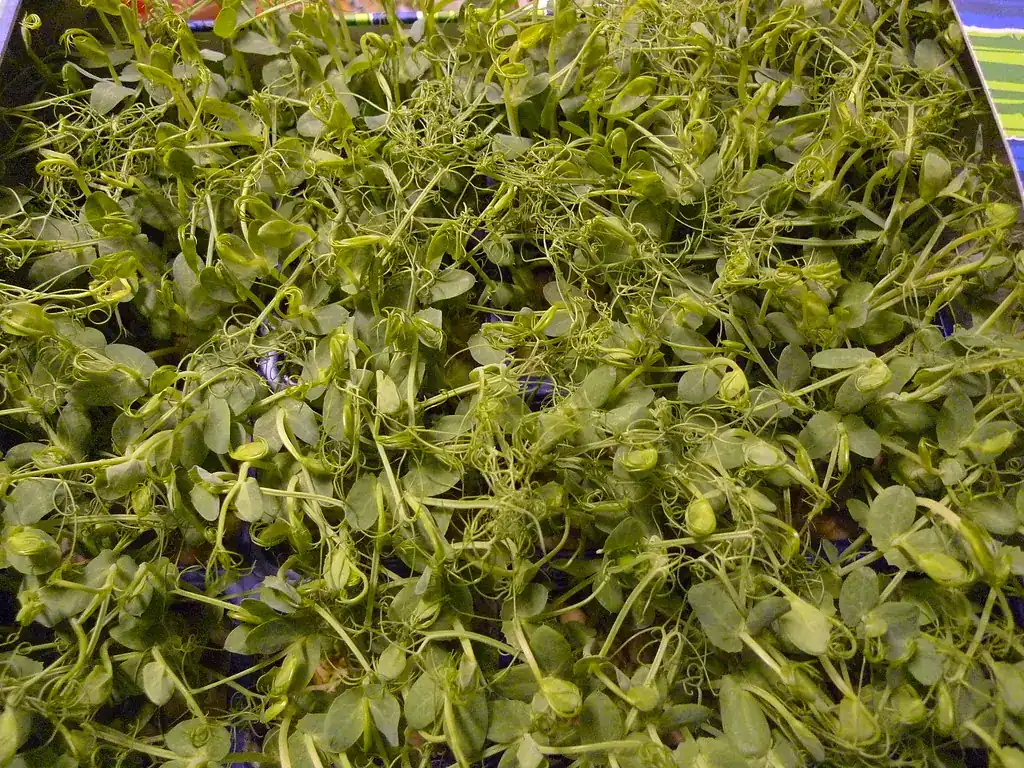
Of all the microgreens that regrow, pea shoots are the one most home growers succeed with. Singapore’s National Parks Board advises cutting “above the lowest node on the stem”, which “will allow new shoots to emerge for the next harvest”, and notes you can harvest each batch up to three times, though quality “may decline over time” (NParks).
Step 1: Let the first crop get tall enough
Wait until the shoots stand around 7 cm (about 3 inches) or more, so there’s room to cut above the lowest node and still take a useful harvest. MSU Extension puts pea shoots in its fastest group, ready 7 to 10 days after germination (MSU Extension).
Step 2: Find the lowest node
Look at the base of a few stems. Just above the mix you’ll see one or two tiny scale leaves or bumps. That’s the node with the bud you want to keep.
Step 3: Cut cleanly just above it
Use clean, sharp scissors and cut a few millimetres above that node. Leaving the stub a little long costs you a bit of the first harvest but gives the bud a fair chance. Don’t tear the stems; ragged wounds rot more easily.
Step 4: Keep light and water going
The stub has no leaves left, so it must live on the seed’s remaining reserves until new leaves open. Keep the tray under the same light, water from below, and don’t let the mix dry out. Light matters a lot for later cuts: in a Canadian winter greenhouse trial with five harvests, total pea shoot yield rose in step with supplemental LED light from 0 to 140 µmol/m²/s (Kong et al., 2018).
Step 5: Harvest again, then retire the tray
New shoots usually come from the side buds, so the second crop is thinner and often has more side branching. Take it when it reaches a useful height. After a second or third cut, quality drops, so compost the mat and re-sow. For the full sowing method, see how to grow pea shoots indoors.
Commercial growers push this much further, but with a different system. In an LED plant-factory study, pea plants were grown hydroponically, topped early, and then harvested every 4–6 days whenever shoots reached 10–15 cm (Liang et al., 2024). That’s a long-lived pea crop, not a seedling tray, so don’t expect the same from a 10×20 tray of soaked seed.
How much smaller is the second cut? What the research shows
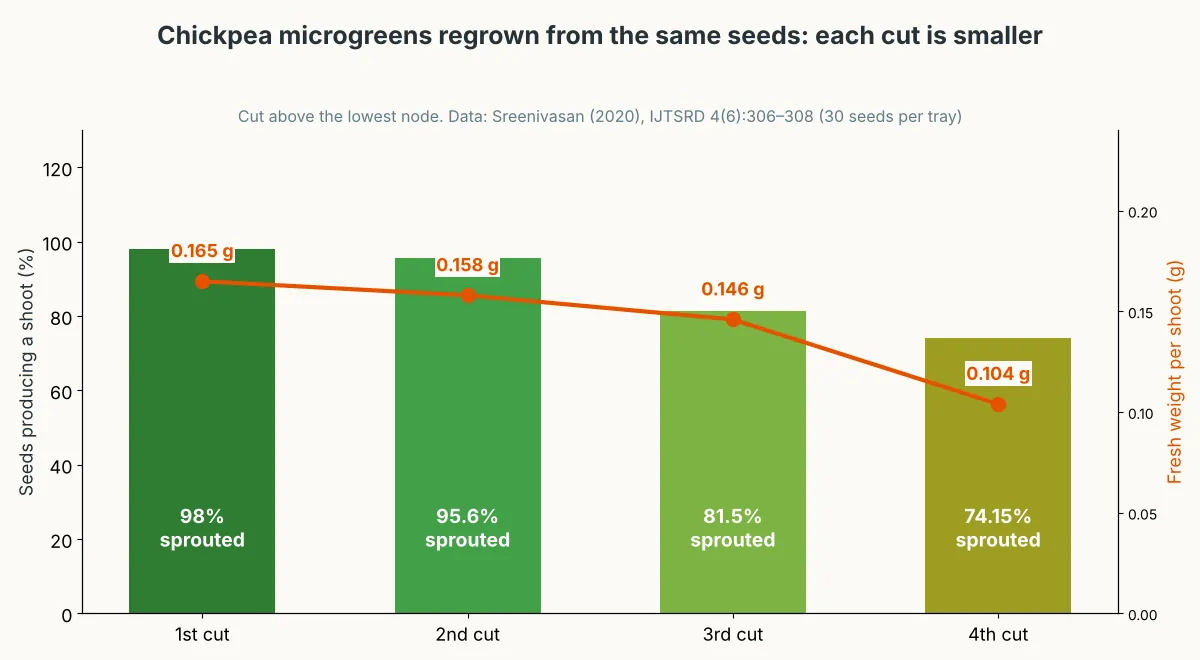
Here’s the honest catch with regrowing microgreens: every cut is a bit less than the one before. The clearest numbers come from a small chickpea microgreen trial in which the same seeds were cut four times above the lowest node.
| Cut | Seeds producing a shoot | Shoot length | Fresh weight per shoot |
|---|---|---|---|
| 1st | 98.0% | 8.34 cm | 0.165 g |
| 2nd | 95.6% | 7.90 cm | 0.158 g |
| 3rd | 81.5% | 7.25 cm | 0.146 g |
| 4th | 74.15% | 6.80 cm | 0.104 g |
Two things fall at once: fewer seeds send up a new shoot, and each shoot is lighter. Multiply them and the fourth cut gives a little under half the fresh weight of the first. It’s a preliminary study with 30 seeds per tray, and the author notes that similar studies hadn’t been reported, so read it as a trend, not a precise forecast (Sreenivasan, 2020).
Nutrition can drop too. In a Croatian study of two wheatgrass genotypes cut on day 12 and again 14 days later, juice from the second cut had 31–35% less total phenols and 25–41% lower antioxidant activity, depending on genotype. Average vitamin C fell from 6.2 to 2.6 µg/ml. The authors concluded that wheatgrass recultivation “cannot be recommended” if you’re growing it for those compounds (Kristić et al., 2022).
So a second cut is a bonus, not a free tray. If you sell microgreens or grow for nutrient density, a fresh sowing will nearly always beat a regrown one.
Wheatgrass, baby greens and the “second flush” trick
Wheatgrass: one more cut
Wheatgrass is the classic cut-and-come-again tray, and the biology backs it up: the growing zone sits at the base of each leaf, below a normal cut. Cut a little above the mix so the base and tiller buds stay intact, keep the tray watered, and you’ll usually get one more crop. In the Kristić study the second cut came 14 days after the first, at 20°C with 12 hours of light (Kristić et al., 2022). Expect it to be slower, thinner and, as above, lower in antioxidants.
Baby lettuce and leafy greens: grow them on, then cut
If you want true cut-and-come-again greens, let them grow past the microgreen stage. UMD Extension says baby greens cut at 4 to 6 inches “will regrow and can be harvested 1 to 2 more times”, and its photo of a lettuce tray shows a second harvest three weeks after the first (UMD Extension). By then the plants have true leaves and buds low on the stem, so cutting above the lowest leaves leaves something to grow from.
Baby greens need a deeper container, more light and a nutrient feed, because the seed’s reserves are long gone. Our guides to growing lettuce indoors and growing arugula indoors cover that setup.
The “second flush”: why radish trays seem to regrow
You may have seen growers report a decent second harvest from radish or broccoli trays. In most cases that’s not regrowth at all. When seed is sown thickly, some seeds germinate late and sit under the canopy. Once the tall plants are cut, those late seedlings get light and size up. The chickpea paper describes exactly this: a “second harvest” from “ungerminated seeds and sprouts” left behind after the main cut (Sreenivasan, 2020).
When re-sowing beats regrowing
A second flush is usually patchy and uneven, and it sits among rotting stubs. That’s a poor trade. Here’s how the options compare for a home grower.
| Option | Time to next harvest | Yield vs first cut | Mould risk | Best for |
|---|---|---|---|---|
| Re-sow a fresh tray | 7–21 days, by crop (MSU, UF/IFAS) | Full | Low (clean start) | Radish, broccoli, sunflower and all one-cut crops |
| Regrow pea or chickpea shoots | Shorter than a new sowing; buds are already there | Smaller each time (see chickpea data) | Medium | Pea shoots, chickpea shoots |
| Second cut of wheatgrass | About 14 days in one study | Thinner, lower in phenols and vitamin C | Medium | Wheatgrass for pets or juice, if you accept lower quality |
| Wait for a “second flush” | A few days, if any late seeds remain | Patchy | Higher: rotting stubs | Not recommended |
| Grow on to baby greens and cut again | About 3 weeks between lettuce cuts (UMD) | Good for 1–2 more cuts | Low to medium | Lettuce, arugula, kale in deeper containers |
Honestly, for most crops, the smartest move is succession sowing: start a new tray every few days, just as MSU recommends, and you’ll never wait on a stubborn stub. Pea shoots are the one tray worth keeping for a second round.
Troubleshooting regrowth trays
Even microgreens that regrow well can fail on the second round. A cut tray is a perfect home for mould: damp mix, still air and hundreds of fresh wounds. If you’re keeping one for a second harvest, watch for these problems.
| What you see | Likely cause | What to do |
|---|---|---|
| No new shoots after a week (peas) | Cut below the lowest node, or seed reserves used up | Check a few stubs for green buds; if none, compost and re-sow |
| White fuzz on stubs or mix | Mould on decaying cut stems in wet, still air | Remove affected areas, add airflow, water from below; discard if it spreads (see microgreens mould) |
| Sour or rotten smell | Stubs and dead roots decomposing | Discard the tray; don’t eat from it |
| Pale, stretched regrowth | Too little light for the new shoots | Lower the light toward 6–12 in above the foliage or add hours (UMD) |
| Thin, patchy second crop of radish or broccoli | Late seeds, not regrowth | Harvest what’s there and re-sow |
| Wheatgrass second cut tastes bitter or tough | Older, slower-growing leaves | Use it for pets or compost; start a new tray |
One food-safety note: microgreens are eaten raw. If a regrowth tray smells off or shows mould you can’t clear quickly, it’s not worth the risk. A fresh tray costs a handful of seed.
From the lab bench
When people ask which microgreens regrow, they’re really asking a developmental biology question: where is the meristem at harvest, and does my cut leave it behind? Once you see it that way, you can predict a crop you’ve never grown. Epigeal crops lift their seed leaves above the soil and carry the shoot tip up with them, so a cut at the mix line removes everything that could grow. Hypogeal crops such as pea and chickpea leave their seed leaves below ground and lift a stem with low, bud-bearing nodes. Grasses keep their growing zone tucked near the base. Those last two groups are the microgreens that regrow.
The second principle is energy. A microgreen tray runs mostly on seed reserves; it’s harvested before its own leaves have paid back much. Cut it, and the regrowth draws on whatever reserve is left plus a little photosynthesis from the new leaves. That’s why every dataset here slopes downward, and why light becomes more important, not less, for the second cut. The pea shoot work from Canada and China both point the same way: more light, more regrowth.
A practical rule of thumb from this literature: regrow pea shoots once, maybe twice, under good light; give wheatgrass one more cut if it’s for the cat; and re-sow everything else. You’ll get more food per week, cleaner trays and fewer surprises. Check our guide on how to harvest microgreens for clean-cut technique, which matters even more when you plan to keep the stubs.
FAQ
Do microgreens regrow after you cut them?
Most don’t. Radish, broccoli, kale, mustard, sunflower and similar microgreens lose their growing point when you cut below the seed leaves, so the tray won’t come back. Pea shoots, chickpea shoots and wheatgrass are the main exceptions, and their later cuts are smaller.
Which microgreens regrow after cutting?
Pea shoots and chickpea shoots regrow if you cut above the lowest leaf node, and wheatgrass regrows from the base of its leaves. Baby lettuce and other leafy greens grown to 4–6 inches can also be cut again 1–2 times.
Do pea shoots regrow?
Yes. Cut above the lowest node on the stem and buds there grow into new shoots. NParks says a batch can be harvested up to three times, though quality declines with each cut.
Do radish microgreens regrow after cutting?
No. Cutting radish microgreens removes the seed leaves and growing tip, so the stems can’t regrow. Any second crop you see comes from late-germinating seeds, which is usually thin and patchy. Re-sowing is better.
Do broccoli microgreens regrow?
No. Like other cabbage-family microgreens, broccoli carries its growing tip between the seed leaves, and the harvest cut removes it. Start a new tray instead.
Is a second cut of microgreens as nutritious?
Not always. In one study, second-cut wheatgrass juice had 31–35% less total phenols and markedly less vitamin C than the first cut. Regrown chickpea shoots were also smaller and lighter with each cut.
How many times can you harvest pea shoots?
Usually two or three times from one tray. Each later cut is smaller, so most home growers take one or two regrowth harvests, then compost the mat and re-sow.
Sources
- Traunfeld, J. Growing Microgreens and Baby Greens Indoors. University of Maryland Extension (revised 2026).
- Bachman, G. R. Growing Microgreens for the Mississippi Gardener (Publication 2857). Mississippi State University Extension Service, 2025.
- Treadwell, D. D., Hochmuth, R., Landrum, L. and Laughlin, W. Microgreens: A New Specialty Crop (HS1164). UF/IFAS Extension, 2010.
- Lim, J. H. and Ho, P. Pea Sprouts: Easy to Grow, and Tasty Too. National Parks Board (NParks) Singapore, NParks Buzz, 2010.
- Sreenivasan, E. (2020). Preliminary Report on Multiple Harvests of Microgreens from Chickpea (Cicer arietinum) Seeds. International Journal of Trend in Scientific Research and Development, 4(6), 306–308.
- Kristić, M. et al. (2022). The Influence of Variety and Cutting on the Wheatgrass (Triticum aestivum L.) Functional Properties. Poljoprivreda, 28(2), 35–43. doi:10.18047/poljo.28.2.5
- Kong, Y., Llewellyn, D. and Zheng, Y. (2018). Response of growth, yield, and quality of pea shoots to supplemental light-emitting diode lighting during winter greenhouse production. Canadian Journal of Plant Science, 98(3), 732–740.
- Liang, J., Ji, F. and He, D. (2024). Higher Light Intensity Combined with Early Topping Improves the Yield and Quality of Pea Shoots in LED Plant Factory. Horticulturae, 10(6), 650.
- Oregon State University Forage Information System. Mechanisms for Growth (grass regrowth).