
You sowed a pot of parsley three weeks ago, kept it moist, set it on the sunniest sill you have… and nothing. Bare soil. Meanwhile the basil you planted the same weekend is already on its second set of leaves. It’s easy to decide the seed was dead and give up.
Short answer: You can grow parsley indoors all year, but you have to work with its biology. Soak the seed for up to 24 hours, sow it shallowly in soil kept around 68–77°F (20–25°C), and expect sprouts in about two weeks, not two days. Then give the plants 12–16 hours under a grow light (or a bright south window), cool-to-moderate room temperatures, and harvest the outer stems at the base so the center keeps producing.
Parsley is one of the most rewarding herbs to keep indoors because it’s a cut-and-come-again plant that tolerates lower light than rosemary or thyme. The catch is a slow, uneven start and a two-year life cycle that trips people up. By the end of this guide you’ll know exactly how long to wait for germination, how much light and warmth parsley really needs, how to feed it in soil or hydroponics, and how to keep one pot producing for months.
Can You Grow Parsley Indoors? What to Expect First
Yes. Iowa State University Extension lists parsley among the herbs that grow well indoors over winter, and notes that parsley, mint and chives tolerate less light than sun-lovers like rosemary, thyme and bay (Iowa State Extension). That makes it one of the easiest herbs for a kitchen windowsill or a small grow-light shelf.
Two facts shape everything else, so it’s worth knowing them before you buy seed:
- It’s slow to sprout. Parsley seed takes two to five weeks to germinate depending on how fresh it is (University of Minnesota Extension), and often 14–28 days even under ideal conditions (Mid-Atlantic Commercial Vegetable Production Recommendations, Parsley).
- It’s a biennial. Parsley grows leaves in its first year and flowers in its second, but it’s normally grown as an annual. Second-year growth is more bitter than first-year growth (UMN Extension), so a fresh sowing every year gives the best flavor.
If you grow parsley indoors expecting a slow start and a long, steady harvest afterward, it is very forgiving. If you expect basil-speed results, it will feel like failure.
Curly vs flat-leaf parsley indoors
Both types grow indoors, but they don’t behave the same on a shelf. Pick the one that suits your space and your cooking.
| Type | Botanical name | Typical height | Indoor notes | Example cultivars |
|---|---|---|---|---|
| Curly parsley | Petroselinum crispum | 8–14 in (20–35 cm) | Compact; best for shallow shelves and small grow-light setups | Moss Curled II, Forest Green, Darki |
| Italian flat-leaf | P. crispum var. neapolitanum | 2–3 ft (60–90 cm) outdoors | Stronger flavor; needs more headroom, so keep it cut back | Gigante d’Italia (Giant of Italy), Wega, Peione |
| Hamburg (root) parsley | P. crispum var. tuberosum | Not given | Grown for its root; not a good indoor choice | Hamburg |
Heights are from UMN Extension; cultivar names are from the Mid-Atlantic recommendations. ‘Giant of Italy’ is also the flat-leaf cultivar used in the university trials cited below, so the numbers in this guide are especially relevant if you grow it.
Numbers to Hold When You Grow Parsley Indoors
Most indoor parsley problems come from one of four things: cold soil at sowing, too little light, too much fertilizer, or overwatering. This table puts the targets in one place, each with its source.
| What | Target | Source |
|---|---|---|
| Seed soak before sowing | Warm water, up to 24 hours | UMN Extension; Purdue HO-202 |
| Sowing depth | 1/8 in (3 mm); no deeper than 1/4 in (6 mm) | UMN; Purdue |
| Soil temperature for germination | 65–85°F (18–29°C); minimum 40°F (4°C), maximum 95°F (35°C) | UC ANR Master Gardeners |
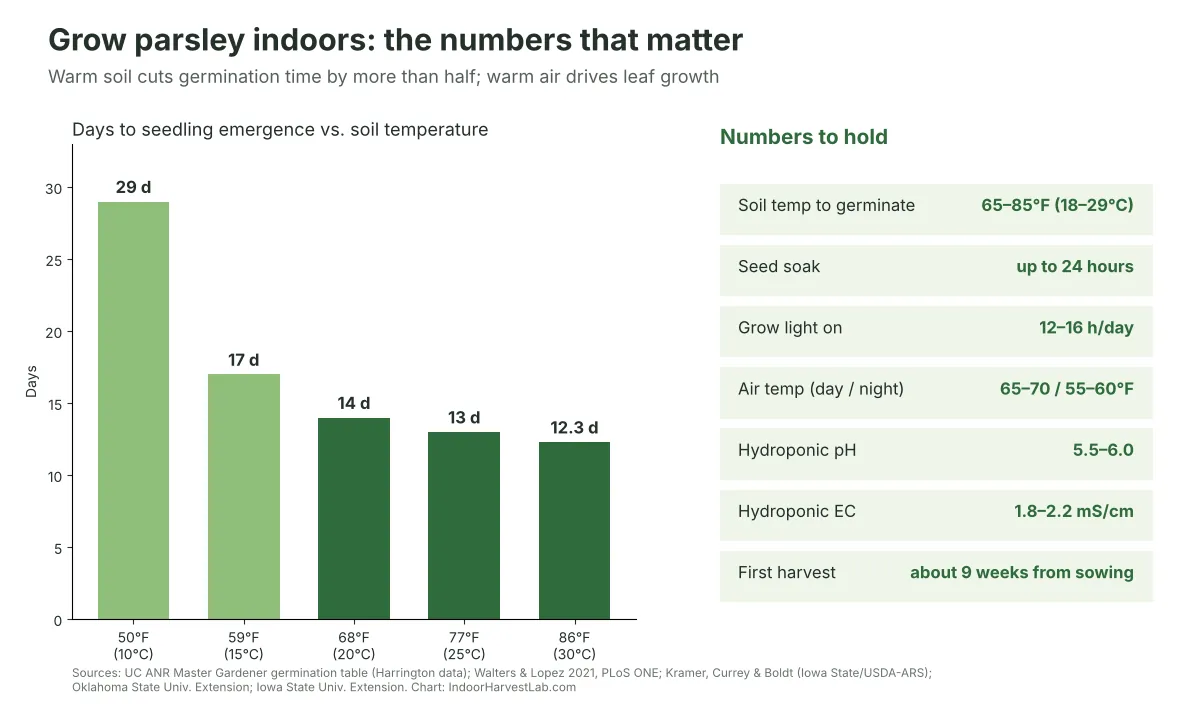
| Days to emergence | 29 days at 50°F, 17 at 59°F, 14 at 68°F, 13 at 77°F, 12.3 at 86°F | UC ANR (Harrington data) |
| Thin or transplant | When seedlings are 2–3 in (5–8 cm) tall | UMN |
| Grow-light photoperiod | 12–16 hours per day on a timer | Iowa State; UVM Extension |
| Window light | About 4–6 hours of direct sun (south or west window) | Iowa State; UVM |
| Room temperature | 65–70°F (18–21°C) day; 55–60°F (13–16°C) night | UVM Extension |
| Soil pH | 6.0–7.0 | UMN |
| Hydroponic pH | Optimum 5.5 (suitable 5.0–6.0); OSU lists 6.0–6.5 | Kramer, Currey & Boldt; Oklahoma State |
| Hydroponic EC | 1.8–2.2 mS/cm | Oklahoma State Extension |
| Fertilizer in pots | Liquid feed at half strength every 4–6 weeks indoors | UMN |
| Time to first harvest | About 9 weeks from sowing (5 weeks to transplant + 4 weeks) in controlled trials | Walters & Lopez 2021 |
The two hydroponic pH figures don’t fully agree, and that’s normal: they come from different methods. Kramer and colleagues tested parsley directly across pH 4.5–7.0 in deep water culture, so for a home system aiming for 5.5–6.0 keeps you inside both comfort zones. More on that below.
How to Grow Parsley Indoors From Seed, Step by Step
Starting from seed is cheaper than buying a pot, and it gives you plants that are already used to indoor life. Here’s the sequence that works with parsley’s slow start instead of against it.
Step 1: Soak the seed
Soak seed in warm water for up to 24 hours before sowing to speed germination (UMN Extension). Purdue’s commercial guide notes the same practice and mentions that seed priming is an active area of research (Purdue HO-202). Drain the seed and sow it the same day; don’t let soaked seed dry out again.
If your packet is more than a year old, run a quick test first. The Mid-Atlantic guide recommends placing seeds on moist paper towels in a sealed bag and counting how many sprout after one to two weeks, then sowing more thickly if the rate is low (UMD). Our paper towel germination guide walks through the method.
Step 2: Sow shallowly in a deep pot
Fill a pot with a fine, well-drained seed-starting or potting mix and make sure it has drainage holes. Scatter 5–8 seeds per pot and cover them with about 1/8 inch of mix (UMN). Parsley is a carrot-family plant, and like its relatives it puts down a long central root, so a deeper pot is a better home than a shallow tray.
Sowing directly in the final pot avoids disturbing that root later.
Step 3: Keep the soil warm, not hot
This is the step that decides whether you wait two weeks or a month. UC Master Gardener data show parsley needs 29 days to emerge at 50°F (10°C) but only 13–14 days at 68–77°F (20–25°C) (UC ANR). A cold windowsill in October can easily sit near the slow end of that range.
A seedling heat mat set to around 70–75°F solves this. Cover the pot with a clear dome or plastic bag to hold moisture, and remove it as soon as you see green. For other crops, our seed germination temperature chart lists the same kind of data.
Step 4: Give light the day seedlings appear
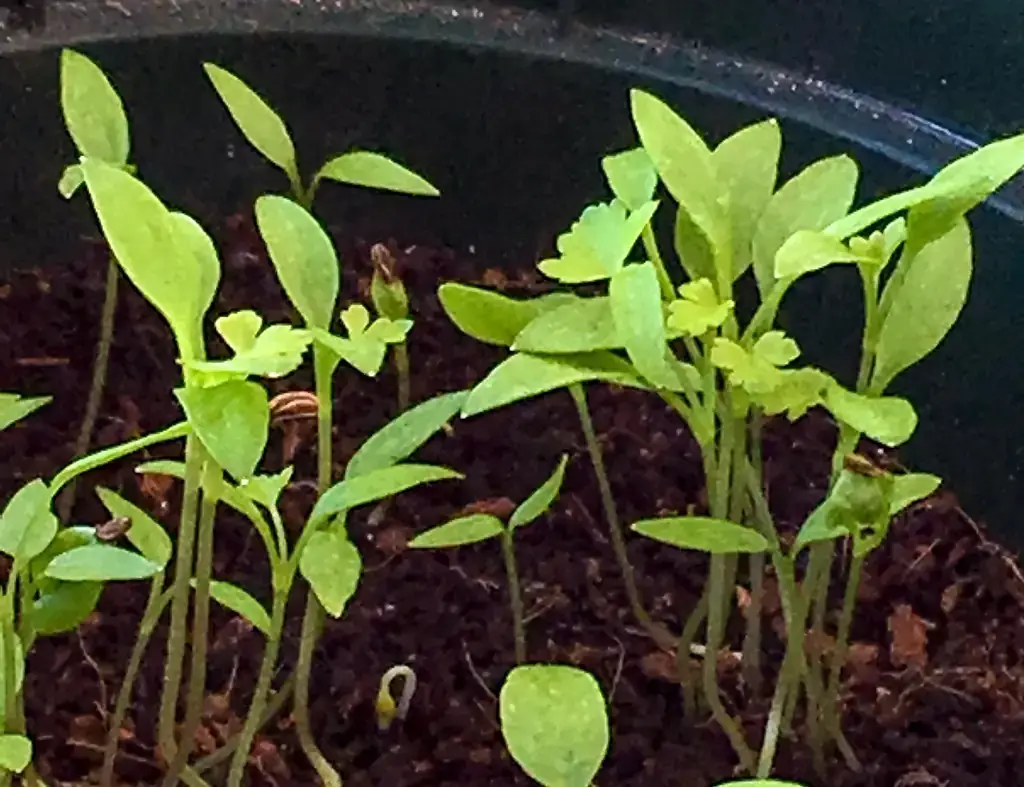
As soon as the first seedlings break the surface, move them under a light. Parsley’s first two leaves (the cotyledons) are long and grass-like; the frilly true leaves come after. Seedlings that stretch tall and pale between those stages are telling you they need more light.
Step 5: Thin to the strongest plants
When seedlings reach 2–3 inches tall, thin them (UMN). Snip the extras at soil level with scissors rather than pulling them, so you don’t disturb the roots of the keepers. UMN spaces garden plants 10–12 inches apart, which is a useful guide indoors: a pot about that wide comfortably supports one mature plant, or two or three if you plan to harvest hard.
Daily Care to Grow Parsley Indoors: Light, Warmth, Water and Food
How much light indoor parsley needs
Light is usually the main limit for herbs indoors (Iowa State Extension). Indoor parsley often grows spindly because of low light (UMN), and in winter even a south window delivers far less than an outdoor bed.
| Setup | What the sources say | When it works | When it fails |
|---|---|---|---|
| South or west window | About 4–6 hours of direct sun is ideal (Iowa State); about 6 hours (UVM) | Spring to early autumn, or sunny winter climates | Short, gray winter days; north or east windows |
| Grow light on a timer | 12–16 hours per day (Iowa State); 14–16 hours with fluorescents 6–12 in above plants (UVM) | Any time of year, any room | Light hung too high, or left on irregularly |
A small full-spectrum LED on a timer is the most reliable way to grow parsley indoors in winter. Start with the light fairly close to the canopy and raise it if leaves bleach or curl. Our guides to grow light distance and hours of light for seedlings explain the setup in more detail.
Light vs temperature: what the research says
Here’s a surprise. In a study published in PLoS ONE, Walters and Lopez grew hydroponic ‘Giant of Italy’ parsley at daily light integrals (DLIs) of about 6.6 to 17.1 mol·m⁻²·d⁻¹. Within that range, DLI had no measurable effect on parsley fresh mass; temperature drove the yield (Walters & Lopez 2021, PLoS ONE).
That doesn’t mean light doesn’t matter. It means that once parsley gets a moderate amount of light, extra light gives smaller returns than getting the temperature right. For a home grower, the practical takeaway is: provide steady, moderate light for 12–16 hours, and spend your effort on temperature next.
Temperature
In the same study, parsley fresh mass rose about 13-fold as mean daily temperature climbed from 10.0°C (50°F) to 22.4°C (72°F), then fell 29% between 22.4°C and 27.1°C (81°F) (Walters & Lopez 2021). UVM Extension recommends indoor herbs at 65–70°F by day and 55–60°F at night, and advises keeping them away from radiators and heat vents (UVM).
Put those together and the sweet spot to grow parsley indoors is a normal, comfortable room: around 65–72°F (18–22°C) in the daytime. A cold sill pressed against winter glass slows growth sharply; a spot above a heater dries the plant out and pushes it past its best range.
Watering
Water when the top of the mix feels dry to the touch and before the plant wilts (Iowa State), using room-temperature water (UVM). Parsley likes steady moisture, but soggy mix in a cool room is exactly what invites root rot and fungus gnats. Empty saucers after watering.
Humidity
Dry winter air from heating can brown leaf edges. UVM suggests standing pots on a tray of pebbles kept topped up with water, without letting water reach the drainage holes. Grouping plants raises humidity too, but reduces air movement, so leave a little space between pots (UVM).
Feeding in potting mix
Herbs need less fertilizer than most plants (Iowa State). University of Minnesota Extension recommends a liquid fertilizer at half the label rate every four to six weeks for indoor parsley (UMN). UVM’s general indoor-herb advice is more frequent, roughly every two weeks (UVM), so a sensible approach is to start at the gentler UMN rate and only feed more often if growth is pale and slow under good light.
Overfeeding gives soft, lush growth that’s more attractive to aphids, and salts build up fast in a small pot. Flush the pot with plain water every month or two if you see a white crust on the soil surface.
Feeding in hydroponics
Parsley does well in simple systems like Kratky and deep water culture. Iowa State and USDA-ARS researchers grew ‘Giant of Italy’ in deep water culture across pH 4.5–7.0 and found 5.5 was optimal, with a suitable range of 5.0–6.0 (Kramer, Currey & Boldt, via Produce Grower). Oklahoma State Extension lists parsley at EC 1.8–2.2 mS/cm and pH 6.0–6.5 (Dunn & Singh, OSU).
For a home reservoir, aim for pH 5.5–6.0 and EC around 1.8–2.2, then watch the plants. Our hydroponic EC chart shows how this compares with other herbs and greens.
Harvesting Indoor Parsley So It Keeps Producing
Good harvesting is what turns one pot into months of parsley. The rule is simple: take from the outside, leave the center alone.
- Cut the outer stalks at the base. UMN recommends snipping stalks near the ground, starting with the outer ones (UMN). UVM adds that for carrot-family herbs you should cut each leaf stalk at the base of the plant rather than trimming just the leaf blades (UVM).
- Protect the crown. New leaves grow from the center of the plant. Commercial growers cut at least 1–1¼ inches above the crown when they want regrowth (Purdue HO-202).
- Don’t strip it. Leave most of the leaves in place each time, so the plant has enough leaf area to keep growing under indoor light.
- Start when it’s established. In controlled university trials, plants were ready about nine weeks from sowing (Walters & Lopez 2021). Indoors in winter, expect your first light harvest around that point or a little later.
Storing what you cut
Parsley is very sensitive to ethylene, so keep it away from ethylene-producing fruit like apples and bananas in the fridge (Mid-Atlantic recommendations). Commercially it keeps up to 2–2½ months at 32°F (0°C) and 95–100% humidity, which is colder and more humid than a home fridge, so a bagged bunch at home lasts much less. Dried or frozen parsley should be used within a year (UMN).
Troubleshooting: Why Indoor Parsley Struggles
When you grow parsley indoors, most problems have a short list of causes. Match what you see with the likely fix.
| What you see | Most likely cause | What to do |
|---|---|---|
| No seedlings after 3 weeks | Cold soil, old seed, or sown too deep | Use a heat mat (68–77°F soil), sow 1/8 in deep, test old seed on paper towels |
| Seedlings collapse at soil level | Damping-off (Pythium and other soil fungi) | Use fresh sterile mix, avoid soggy soil, add airflow; see our damping-off guide |
| Tall, pale, floppy stems | Not enough light | Move under a grow light for 12–16 h/day; lower the light |
| Yellow outer leaves | Normal aging, or underfeeding | Harvest the oldest stems; feed at half strength if new growth is also pale |
| Slow growth in a sunny spot | Cold room or cold window glass | Move to a warmer spot around 65–72°F; keep away from drafts |
| Brown, crispy leaf edges | Dry air near heating, or salt buildup | Pebble tray, move away from vents, flush the pot with plain water |
| Tiny insects on stems, sticky leaves | Aphids | Rinse with water or wipe off; check new pots before bringing them in |
| Small black flies around the pot | Fungus gnats from wet mix | Let the top of the mix dry; see our fungus gnats guide |
| Tall flower stalk, bitter leaves | Second-year bolting | Harvest what you can, then sow fresh seed |
Aphids are on the pest lists for parsley in both Purdue and Mid-Atlantic guides, and Purdue names Pythium and other soil fungi as the cause of damping-off.
Why parsley bolts (and why you can’t stop it forever)
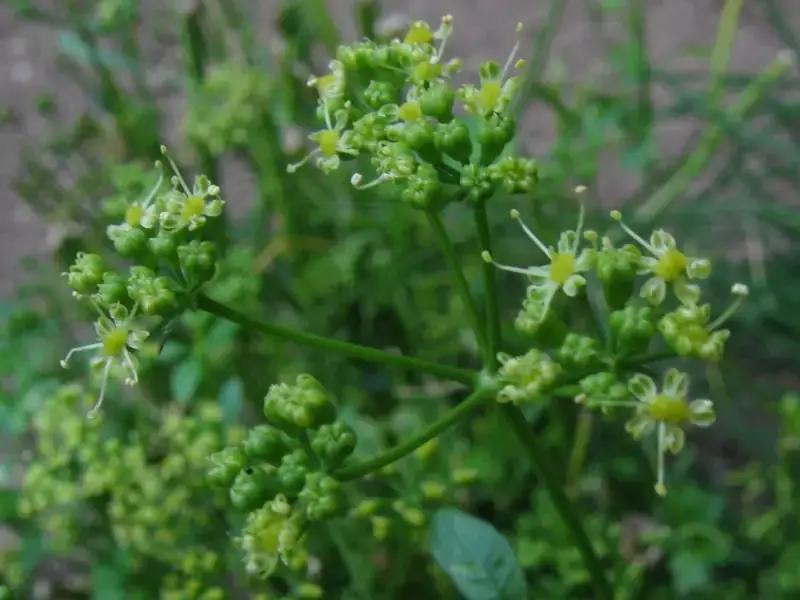
Because parsley is a biennial, a plant that has lived through one season eventually sends up a flower stalk, and UMN advises harvesting until the plant does so and dies (UMN). Plants dug from the garden in autumn and brought indoors are already in their first season, so they’re more likely to bolt in late winter or spring than a pot you sowed indoors this autumn. If you want a steady supply, sow a new pot every few months, the way commercial growers stagger seedings to harvest from April through December (Purdue).
From the Lab Bench: Why Parsley Rewards Patience
When you look at the research on parsley as a whole, a clear pattern shows up: this is a crop limited by temperature at both ends of its life. Germination nearly halves in time when soil goes from 50°F to 68°F, and leaf growth in the Walters and Lopez trial climbed steeply with warmth up to about 72°F, while extra light beyond a moderate level added little. For an indoor grower, that’s good news. Room temperature is something most homes already provide; high light is the expensive part.
So the order of priorities is worth stating plainly. First, warm the seed tray, because that’s where most indoor parsley attempts fail. Second, keep the plant in a steady 65–72°F room, off cold glass and away from heaters. Third, provide moderate, consistent light on a timer. Only then think about pushing light harder or fine-tuning fertilizer.
The pH data deserve a note too. Parsley’s suitable hydroponic range (5.0–6.0) is narrower than basil’s (4.5–6.5) in the Iowa State work (Kramer et al.). In practice, that means parsley is less tolerant of pH drift, so check it more often than you would for basil in the same system. If you’re running both together, 5.5–6.0 keeps both happy.
Finally, treat parsley as a rotation, not a single plant. Its biennial habit is built in, and no amount of good care stops a second-year plant from bolting. One new pot every two to three months is a simple, reliable way to always have young, sweet leaves.
FAQ
How long does it take to grow parsley indoors?
Germination takes about two to five weeks depending on seed freshness and soil temperature. In controlled university trials, parsley was ready to harvest about nine weeks after sowing. Indoors in winter, plan on two to three months before regular harvests.
Can you grow parsley indoors in winter?
Yes. Parsley tolerates lower light than many herbs, but winter windows are often too dim. A grow light on a timer for 12–16 hours a day and a room around 65–72°F give steady growth through winter.
Does parsley need full sun indoors?
Not full sun, but plenty of light. About 4–6 hours of direct sun from a south or west window works, or a grow light for 12–16 hours a day. Without enough light, indoor parsley grows tall, pale and floppy.
Why won’t my parsley seeds germinate?
The usual causes are cold soil, old seed or sowing too deep. Soak seed up to 24 hours, cover it with only about 1/8 inch of mix, and keep the soil near 68–77°F, where emergence takes about 13–14 days instead of 29 at 50°F.
Can you grow parsley indoors in water?
Parsley grows well in hydroponics such as Kratky or deep water culture with a nutrient solution, not plain water. Research supports a pH around 5.5–6.0 and EC around 1.8–2.2 mS/cm. Plain water alone has no nutrients for long-term growth.
How do you harvest parsley without killing it?
Cut whole outer stalks at the base of the plant and leave the center crown untouched, since new leaves grow from there. Take only part of the plant at a time so it keeps enough leaves to regrow.
How long does an indoor parsley plant last?
Parsley is a biennial. It produces leaves for its first season, then sends up a flower stalk, and second-year leaves taste more bitter. Sow a fresh pot every few months for a continuous supply.
Sources
- University of Minnesota Extension. Growing parsley in home gardens.
- Purdue University Cooperative Extension Service. Parsley (Commercial Vegetable Production, HO-202).
- University of California Agriculture and Natural Resources, Master Gardener Program. Seed germination temperature and timing (after J. F. Harrington, UC Davis).
- Walters, K. J., & Lopez, R. G. (2021). Modeling growth and development of hydroponically grown dill, parsley, and watercress in response to photosynthetic daily light integral and mean daily temperature. PLoS ONE, 16(3), e0248662.
- Kramer, H. L., Currey, C. J., & Boldt, J. K. pH optima: Determining the optimal pH for hydroponic herb production in controlled environments. Produce Grower.
- Dunn, B., & Singh, H. Electrical conductivity and pH guide for hydroponics. Oklahoma State University Extension.
- University of Vermont Extension Master Gardener Program. Indoor herb gardening.
- Iowa State University Extension and Outreach, Yard and Garden. Can I grow herbs indoors over winter?
- Mid-Atlantic Commercial Vegetable Production Recommendations, Chapter F: Parsley (University of Maryland Extension).
Related reading: growing herbs indoors in winter, how to grow basil indoors and how to grow cilantro indoors. Browse more guides in our indoor herbs category.