
It’s November, the kitchen window gets a thin slice of sun for maybe three hours, and the basil you brought inside last month is stretching toward the glass like it’s trying to escape. The rosemary has stopped growing. The cilantro, oddly, is trying to flower. You bought a grow light, plugged it in… and now you’re staring at the timer wondering what number to set.
Short answer: how many hours of light do herbs need? On a sunny windowsill, most culinary herbs need at least 6 hours of direct sun, and 8 or more is better. Under a grow light, run the timer for 12 to 16 hours a day, with the light 6 to 12 inches above the leaves (Iowa State University Extension). Sun-lovers like basil and rosemary belong at the long end of that range; cilantro and dill, which bolt under long days, do better near 12 hours.
Here’s the catch: hours only matter because they add up to a daily dose of light, and that dose is what your herbs respond to. Understand that, and you can fix a weak light by running it longer and stop cilantro bolting on you. By the end of this guide you’ll have a timer setting for each common herb, a simple way to convert window sun into grow-light hours, and a symptom table that tells you whether your plants are getting too little or too much.
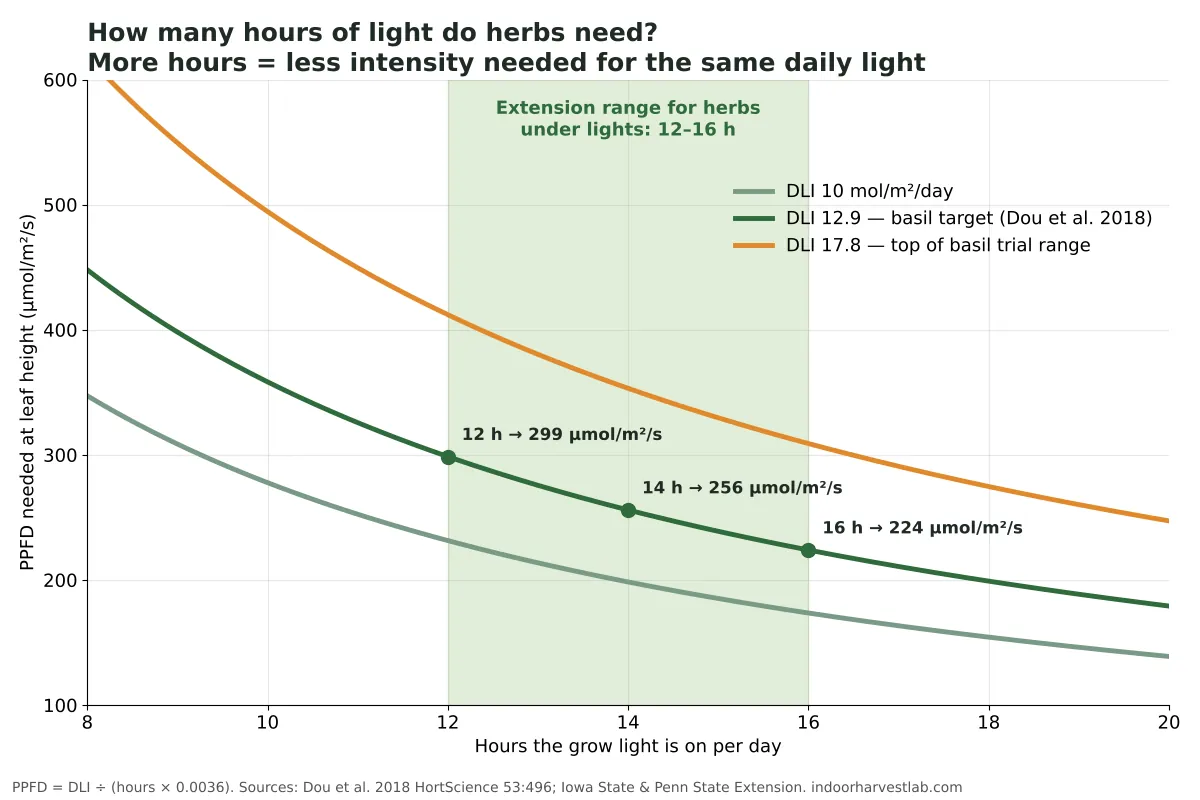
How many hours of light do herbs need? The numbers to hold
Extension services agree on a fairly tight range, and the research on basil gives us a real target for the daily dose. Here are the figures worth writing on a sticky note next to your grow shelf.
| What you’re measuring | Target | Source |
|---|---|---|
| Direct sun on a windowsill (most herbs) | 6 h minimum; 8 h or more preferred | Iowa State, Penn State |
| Direct sun for low-light-tolerant herbs (chives, lemon balm, cilantro) | 2–6 h | Penn State Extension |
| Grow-light timer for herbs | 12–16 h per day | Iowa State Extension |
| Fluorescent tubes (two 40-W cool white) | 14–16 h per day | Penn State, Illinois Extension |
| Light distance above leaves | 6–12 in (15–30 cm) | Iowa State, Penn State |
| Daily light integral (DLI) for sweet basil | ≈12.9 mol/m²/day suggested; gains level off above ≈16.5 | Dou et al. 2018 |
| PPFD to hit 12.9 DLI over 16 h / 14 h / 12 h | ≈224 / 256 / 299 µmol/m²/s | Calculated: DLI ÷ (hours × 0.0036) |
| Room temperature for herbs | 65–70°F (18–21°C) day, 55–60°F (13–16°C) night | Penn State Extension |
Notice the gap between the windowsill numbers (6–8 hours) and the grow-light numbers (12–16 hours). That isn’t a typo. Illinois Extension puts it plainly: supplemental light isn’t equal to natural light, so a rough rule is about 2 hours under lights for every 1 hour of natural sun. Even a modest midday sun delivers far more photons per second than a typical shelf light, which is why the lamp has to make up the difference with time.
Why hours alone don’t tell the whole story: meet DLI
Here’s the mistake almost everyone makes: they treat hours as the goal. Plants don’t count hours. They count photons. The total number of photosynthetic photons that land on a leaf in a day is called the daily light integral (DLI), measured in moles per square metre per day (mol/m²/day). Hours are just one of the two dials that set it.
The math is simple: DLI = PPFD × hours × 0.0036, where PPFD is the light intensity at leaf level in µmol/m²/s. Double the hours and you double the dose. Double the intensity and you also double the dose. If you want the full conversion table, our PPFD chart for indoor crops walks through it crop by crop.
What the basil research actually found
The cleanest numbers come from a Texas A&M study by Dou, Niu, Gu and Masabni (2018). They grew ‘Improved Genovese Compact’ basil for 21 days under five DLIs from 9.3 to 17.8 mol/m²/day. Compared with plants at 9.3, shoot fresh weight was 54.2% higher at 12.9, 78.6% higher at 16.5, and 77.9% higher at 17.8. Antioxidant capacity at 17.8 was 73% higher than at 9.3. The authors suggested 12.9 mol/m²/day as the sweet spot for keeping yield and quality high without wasting electricity.
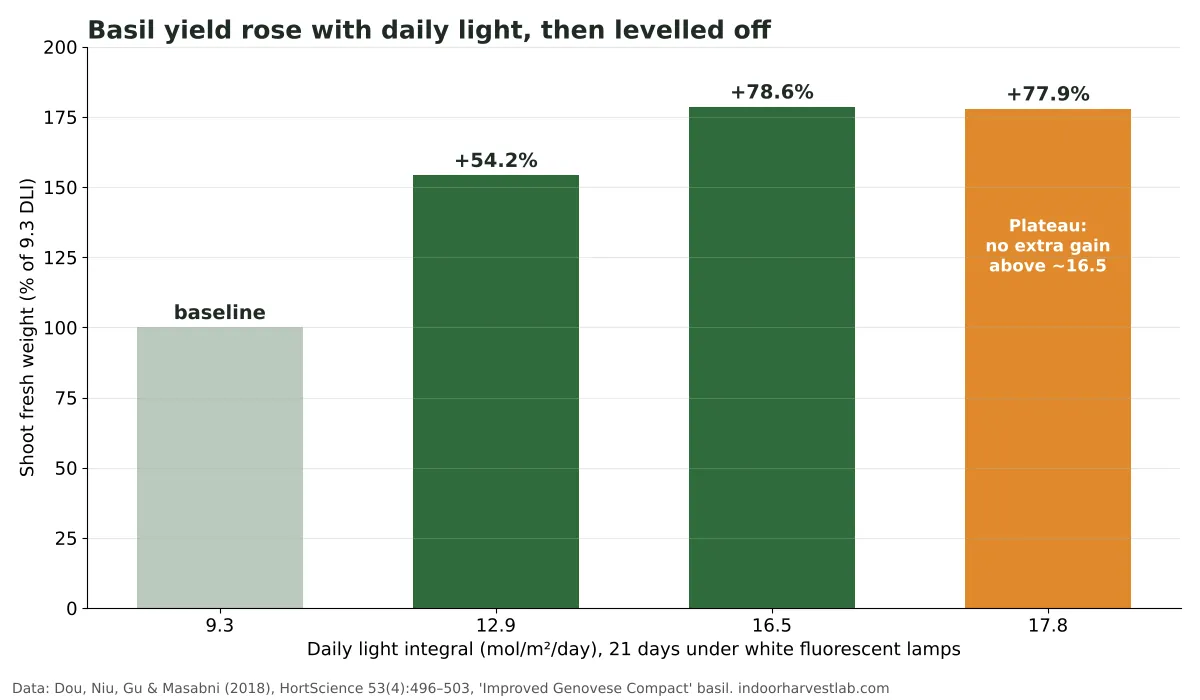
Look at the last two bars. Going from 16.5 to 17.8 bought nothing extra. That plateau is the most practical finding for home growers: past a point, more light is just a bigger power bill.
A vertical-farming trial by Ciriello et al. (2023) points the same way: basil at a DLI of 15 mol/m²/day out-yielded basil at 7.5 at the first cut, across 14-, 16- and 18-hour photoperiods. So the honest scientific answer to how many hours of light do herbs need is: enough hours, at your light’s intensity, to reach a basil-style dose in the low-to-mid teens.
Same daily dose, different hours: longer and gentler wins
So if 12.9 mol/m²/day is the target, does it matter whether you get there with a bright light for a short day or a dim light for a long one? It does. Eghbal et al. (2024) held DLI constant at 12.96 mol/m²/day and delivered it three ways: 200 µmol/m²/s for 18 hours, 300 for 12 hours, or 400 for 9 hours. The short, intense 9-hour treatment generally hurt basil growth and gave the lowest antioxidant activity. Their recommendation for basil in controlled environments was low intensity with a long photoperiod.
Good news if you own a modest LED panel: running it longer is what the research favours.
But round-the-clock light is a waste for mature herbs
The opposite extreme doesn’t pay either. When d’Aquino et al. (2024) grew basil to full size, raising intensity from 250 to 380 µmol/m²/s at 16 hours nearly doubled fresh weight (260.6 g versus 144.9 g), but stretching the 380 µmol/m²/s light from 16 to 24 hours did not raise yield. In other words, intensity mattered and the extra 8 hours of electricity didn’t.
Grow light hours for herbs: a herb-by-herb chart
Not every herb wants the same day. Some are sun-worshippers, some tolerate shade, and a few read long days as a signal to flower. The table below groups common kitchen herbs using what extension services and trials report, then gives a starting timer setting inside the 12–16 hour extension range.
| Herb | What the evidence says | Starting timer setting* | Watch for |
|---|---|---|---|
| Basil | Yield climbed with DLI up to about 16.5 mol/m²/day (Dou 2018); long, gentle days beat short, intense ones (Eghbal 2024) | 14–16 h | Stretching and small leaves when light is weak |
| Rosemary, thyme, bay | Do best in direct sunlight (Penn State) | 16 h, brightest spot on the shelf | Slow, sparse growth in winter windows |
| Sage, spearmint | Branch number rose as DLI rose from about 5–6 to 18–19 mol/m²/day, more so at ~23°C (Walters et al. 2023) | 14–16 h | Few side shoots under dim light |
| Parsley | Fresh mass responded to temperature, not DLI, across 6.2–16.9 mol/m²/day (Walters & Lopez 2021) | 12–14 h | Slow growth in a cold room even with good light |
| Chives, lemon balm | Tolerate low light; 2–6 h direct sun (Penn State) | 12–14 h | Floppy leaves if light is very low |
| Cilantro | Long-day plant (WSU Extension); bolts in long, hot days (Oregon State) | 12 h, cooler spot | Flower stalks and feathery leaves |
| Dill | Long-day plant (WSU Extension); more light raised mass only when warm (Walters & Lopez 2021) | 12–14 h | Early flowering; weak growth in cold rooms |
If you grow everything under one light on one timer (most of us do), set it to 14 hours. That’s long enough for basil and mint, and still short enough that cilantro isn’t pushed hard toward flowering. Put rosemary and thyme dead centre under the fixture where intensity is highest, and keep cilantro and dill at the cooler outer edge. For herb-specific care, see our guides to growing basil indoors, rosemary and cilantro.
Why cilantro and dill want shorter days
This is where many indoor herb gardens go wrong, and it’s a surprise to most people. Cilantro and dill are classed as long-day plants: they flower as days stretch past about 12 hours (WSU Extension). Indoors, your timer is the day length. Set it to 16 hours and, from the plant’s point of view, it’s midsummer.
Oregon State University Extension notes that both temperature and day length drive cilantro flowering. In the warm, long days of mid-summer it typically bolts and sets seed within four to six weeks, while in the cooler, shorter days of spring or fall the plants keep producing leaves for weeks or months before flowering. Indoors you control both levers: a 12-hour day and a cooler spot away from heat vents.
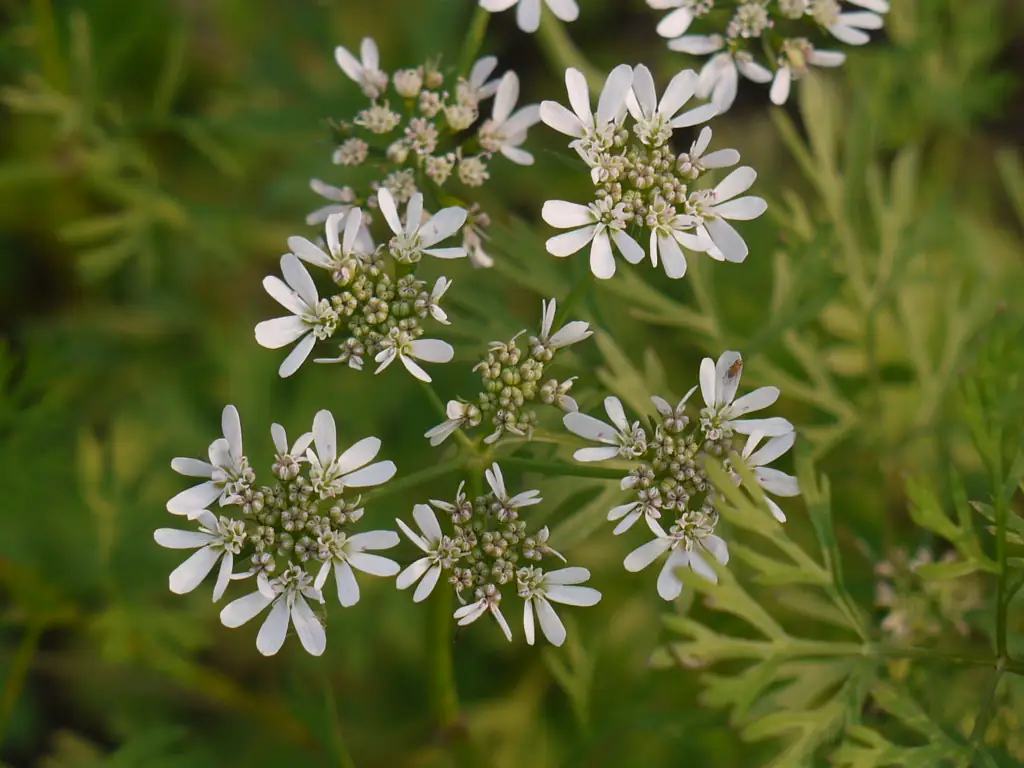
Once cilantro sends up a flower stalk, the leaves get finer and the plant winds down. Sowing a small pot every 3–4 weeks keeps the harvest going, which our guide to growing herbs indoors in winter covers in more detail.
Window light vs grow lights: how much light do herbs need indoors?
A south-facing window can work, but in winter it often falls short. Iowa State Extension says most herbs grown indoors need around eight hours of direct light a day, and that providing enough light is especially difficult in winter when days are shorter. A bright east or west window can also work, but anything less usually means leggy, pale plants.
Use this quick decision table to work out what you actually need.
| Your situation | What to do | Timer setting |
|---|---|---|
| South window with 6–8 h of direct sun | Grow on the sill; rotate pots every few days so they don’t lean | No light needed |
| Window with 3–5 h of direct sun (typical in winter) | Add a light to top up; run it through the morning and evening | Lamp on so total day reaches 12–14 h |
| North window or no direct sun | Treat the light as the only source | 14–16 h |
| Interior room, shelf, or kitchen counter | Grow-light only; put fixture 6–12 in above leaves | 14–16 h |
| Cilantro or dill under any of the above | Keep the day near 12 h and the spot cool | ≈12 h |
One honest aside: a light 3 feet away on the ceiling doesn’t count. Intensity drops quickly with distance, which is why every extension source above specifies 6–12 inches. Our article on grow light distance explains why, and the same rule applies to herbs.
How to set up your herb light schedule, step by step
Step 1: Pick the hours based on your toughest herb
If you’re growing basil, rosemary or thyme, start at 14–16 hours. If cilantro or dill share the shelf, start at 14 hours and move those two to the edge, or give them a separate 12-hour light. Use a plug-in timer; human memory is a terrible photoperiod controller.
Step 2: Set the light height
Hang the fixture 6–12 inches above the tops of the plants (Iowa State). Weaker fixtures, like fluorescent tubes or small LED bars, belong at the close end. Raise the light as the herbs grow so the gap stays the same.
Step 3: Check the dose, not just the hours
If you have a PAR meter or a phone app with a calibration, measure PPFD at leaf height. For basil, aim for roughly 224 µmol/m²/s at 16 hours, or about 256 at 14 hours, to land near the 12.9 mol/m²/day target from Dou et al. (2018). If your light only manages 150 µmol/m²/s, 16 hours gives about 8.6 mol/m²/day, so expect slower, softer growth and keep the light as close as it allows.
Step 4: Ramp up gradually for new plants
Seedlings and freshly potted herbs don’t need the full day from the start. A 2026 study by Akter et al. raised basil from 14 to 16 to 18 hours while also raising intensity from 200 to 300 to 400 µmol/m²/s, and got 9% more dry weight and light use efficiency than a constant 300 µmol/m²/s for 16 hours at the same average DLI. You don’t need to copy their exact steps; the lesson is that young plants can start shorter and dimmer, then get more as they size up. Our guide to hours of light for seedlings covers the early stage.
Step 5: Watch the plants for two weeks, then adjust
Leaves tell you more than any chart. Change one thing at a time: hours first, then height.
Too little or too much light? Symptom triage
| What you see | Likely cause | Fix |
|---|---|---|
| Thin, spindly stems; small leaves; weak aroma | Not enough light (Penn State) | Lower the light toward 6 in; extend to 16 h |
| Plants leaning toward the window | One-sided light (Illinois Extension) | Rotate pots every few days or add an overhead light |
| Purple basil turning green | Low daily light; purple colour was strongest at DLI 18.7 vs 5.0 at ~25°C (Walters et al. 2023) | Increase hours or intensity |
| Cilantro or dill sending up flower stalks | Long days plus warmth (Oregon State, WSU) | Cut the day to ~12 h; move to a cooler spot; resow |
| Mint or sage with few side shoots | Low DLI, especially in cool rooms (Walters et al. 2023) | Increase light; pinch tips to force branching |
| Basil slow even under a bright light run 8–9 h | Short, intense day; same DLI did worse at 400 µmol for 9 h (Eghbal 2024) | Dim the light if you can and run it 14–18 h |
| Parsley sluggish under good light | Room too cold; parsley responded to temperature, not DLI (Walters & Lopez 2021) | Move to a warmer spot (65–70°F) |
From the lab bench
When you strip away the product marketing, the light question for herbs comes down to one number and one exception.
The number is the daily dose. Basil is the best-studied kitchen herb, and the trials agree on a shape: yield climbs steeply from a dim day to roughly 13 mol/m²/day, keeps rising a little to about 16, then flattens. That curve is typical of photosynthesis saturating at the whole-plant level, and it tells you where your electricity buys the most leaves. For most home setups, the realistic bottleneck is intensity, not hours, which is exactly why extension services push the timer up to 14–16 hours. Time is the cheapest way to make a weak light behave like a stronger one.
The trials also suggest a second, subtler principle: for a fixed dose, spreading light over a longer day tends to work better than cramming it into a short one. A leaf can only use photons so fast; at very high intensity, more of the light is wasted, so a gentler, longer day converts more of it into growth. That fits the Eghbal et al. (2024) result and the slight edge for gradual ramps in Akter et al. (2026).
The exception is photoperiod-sensitive herbs. For cilantro and dill, day length isn’t just a dose; it’s a calendar. Long days tell them it’s time to flower. That’s why a single “best” number for all herbs doesn’t exist, and why a 14-hour compromise, with cilantro and dill parked at the cool edge, is the most practical setting for a mixed shelf.
Finally, don’t ignore temperature. Several of the herb models from Michigan State (Walters & Lopez 2021; Walters et al. 2023) show that light and temperature interact: extra light helped dill only when it was warm, and parsley barely responded to light at all. If your herbs sit in a cold window, more hours won’t fully rescue them.
FAQ
How many hours of light do herbs need under a grow light?
Iowa State Extension recommends running a grow light 12 to 16 hours a day for herbs, with the fixture 6 to 12 inches above the leaves. Start at about 14 hours for a mixed shelf, 16 hours for basil, rosemary and thyme, and about 12 hours for cilantro and dill.
How many hours of direct sunlight do herbs need?
Most herbs need at least 6 hours of direct sun and do better with 8 or more, according to Iowa State and Penn State Extension. Chives, lemon balm and cilantro tolerate lower light, about 2 to 6 hours of direct sun.
Can herbs get too much light?
Yes, in two ways. Long days push cilantro and dill to flower early because they are long-day plants. And for basil, a short, intense day did worse than a long, gentle one delivering the same daily light (Eghbal et al. 2024).
Should I leave a grow light on 24 hours for herbs?
It isn’t worth it for mature herbs. In d’Aquino et al. (2024), extending light from 16 to 24 hours did not increase basil yield. One study on basil microgreens did find higher yield under continuous light, but for full-sized herbs a 14–16 hour timer is the better use of electricity.
Do herbs need darkness at night?
Herbs grow well with a normal night: the extension-recommended 12–16 hour range leaves 8–12 hours of darkness. For cilantro and dill, a longer night helps delay flowering because they respond to day length.
How much light does basil need indoors?
Dou et al. (2018) suggested a daily light integral of about 12.9 mol/m²/day for basil. That equals roughly 224 µmol/m²/s for 16 hours or 256 µmol/m²/s for 14 hours at leaf level.
Is a sunny window enough for herbs in winter?
Often not. Iowa State Extension notes that most indoor herbs need around eight hours of direct light and that winter’s shorter days make this hard. If your window gets only 3 to 5 hours of sun, add a grow light to extend the day to 12–14 hours.
Sources
- Steil, A. (2024). How can I provide more light for my herbs indoors? Iowa State University Extension and Outreach, Yard and Garden.
- Iowa State University Extension and Outreach. Growing herbs indoors. Yard and Garden.
- Penn State Extension. Growing herbs indoors.
- University of Illinois Extension (2017). Grow herbs and lettuce indoors this winter. Good Growing blog.
- Dou, H., Niu, G., Gu, M., & Masabni, J. (2018). Responses of sweet basil to different daily light integrals in photosynthesis, morphology, yield, and nutritional quality. HortScience 53(4): 496–503. doi:10.21273/HORTSCI12785-17
- Eghbal, E., Aliniaeifard, S., Mehrjerdi, M.Z., et al. (2024). Growth, phytochemical, and phytohormonal responses of basil to different light durations and intensities under constant daily light integral. BMC Plant Biology 24: 935. doi:10.1186/s12870-024-05637-w
- d’Aquino, L., Cozzolino, R., Malorni, L., et al. (2024). Light flux density and photoperiod affect growth and secondary metabolism in fully expanded basil plants. Foods 13(14): 2273. doi:10.3390/foods13142273
- Ciriello, M., Formisano, L., Rouphael, Y., De Pascale, S., & Kacira, M. (2023). Effects of daily light integral and photoperiod with successive harvests on basil yield, morpho-physiological characteristics, and mineral composition in vertical farming. Scientia Horticulturae 322: 112396. doi:10.1016/j.scienta.2023.112396
- Akter, N., Ahamed, M.S., Taylor, G., & Cammarisano, L. (2026). Gradual increases in light intensity and photoperiod enhance light use efficiency and dry matter in indoor basil. Frontiers in Plant Science 17: 1861031. doi:10.3389/fpls.2026.1861031
- Walters, K.J., & Lopez, R.G. (2021). Modeling growth and development of hydroponically grown dill, parsley, and watercress in response to photosynthetic daily light integral and mean daily temperature. PLoS ONE 16(3): e0248662. doi:10.1371/journal.pone.0248662
- Walters, K.J., Tarr, S., & Lopez, R.G. (2023). Modeling purple basil, sage, spearmint, and sweet basil responses to daily light integral and mean daily temperature. PLoS ONE 18(11): e0294905. doi:10.1371/journal.pone.0294905
- Fayezizadeh, M.R., Ansari, N.A., Sourestani, M.M., & Hasanuzzaman, M. (2024). Variations in photoperiods and their impact on yield, photosynthesis and secondary metabolite production in basil microgreens. BMC Plant Biology 24: 712. doi:10.1186/s12870-024-05448-z
- Oregon State University Extension Service. How to grow cilantro for leaves — or coriander seeds.
- Wolfe, K. (2012). Day length and vegetable gardens. WSU Extension, Skagit County.
Related reading: browse all of our indoor herb guides.