
You top up the reservoir, stir in the nutrients, dip your pen and it says 6.2. Ten minutes later it says 6.6. Then 5.9. Is the water drifting, or is the meter? If you can’t trust the number, every pH adjustment you make is a guess, and in a reservoir a guess can lock out iron or calcium within days.
Short answer: a good pH meter for hydroponics is a digital meter with a replaceable glass electrode, automatic temperature compensation and two-point calibration. Calibrate it with fresh pH 7.01 and 4.01 buffers, store the probe wet in KCl storage solution (never distilled water), and check your solution daily at the same time. Treat the probe as a consumable: when it stops holding calibration after a proper clean, replace it.
This guide is a buyer’s guide and a how-to in one. You’ll see how the main meter types compare, which features are worth paying for, the target numbers to hold, a six-step calibration routine, and a troubleshooting table for drifting or stuck readings. We haven’t hands-on tested specific brands; everything here comes from university extension guidance, the EPA’s standard pH method and probe manufacturers’ technical manuals, so you can judge any meter on the shelf yourself.
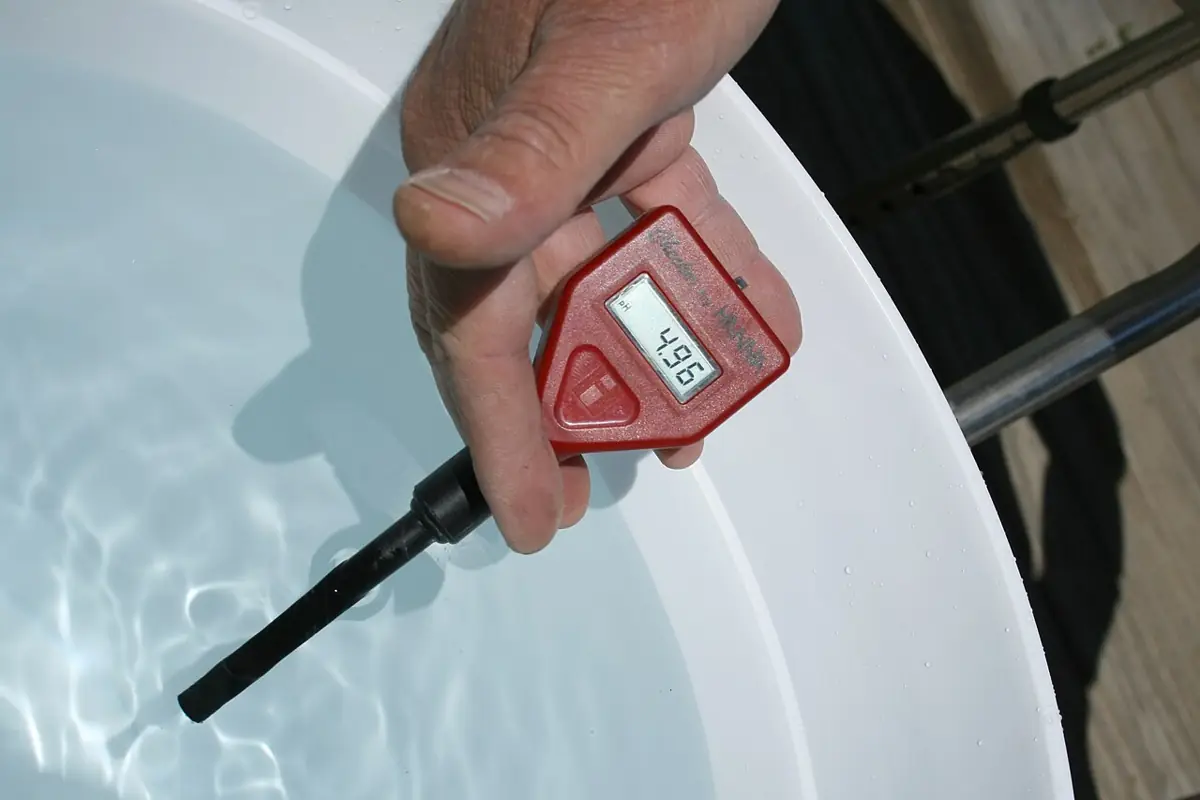
What a pH Meter for Hydroponics Measures, and Why Strips Fall Short
pH is a log scale. A solution at pH 6.0 is ten times more basic than one at pH 5.0, as Michigan State University Extension reminds growers in its guide to calibrating pH and EC meters. So a reading that is “only” half a unit out is a big chemical difference at the root surface.
In soil, that error is cushioned by the substrate. In hydroponics there’s almost no buffer. Oklahoma State University Extension recommends nutrient solutions sit at a pH between 5 and 6 (usually 5.5), and warns that source water with alkalinity above 75 ppm will push pH up over time (OSU HLA-6722). That’s why its fact sheet tells growers to check pH and EC daily, at the same time of day.
A pH meter for hydroponics works with a glass electrode. A thin glass bulb develops a tiny voltage that changes with hydrogen-ion activity, and the meter converts that voltage to a pH number using the slope it learned during calibration. That’s the whole reason calibration matters: the meter only knows what the buffers taught it.
Test strips and liquid drops still have a place as a back-up. But they give you a colour band rather than a number, the colour can be hard to read in a tinted nutrient solution, and you can’t track small daily drift with them. If you’re running a deep water culture bucket or an NFT channel, a digital meter is the tool that lets you spot a slow upward creep before your plants do.
Types of pH and EC Meters Compared
Most home growers end up choosing between four formats. The difference isn’t the electronics so much as how easy the probe is to look after and replace, and whether the meter also reads EC and temperature.
| Type | What you get | Strengths | Watch-outs | Best fit |
|---|---|---|---|---|
| Test strips or liquid drops | Colour match against a chart | Cheap, no calibration, good as a cross-check | Coarse colour bands; hard to read in tinted solution | Back-up check, occasional growers |
| Pocket pH pen | Probe and display in one sealed body | Small, simple, usually waterproof | On many pens the probe can’t be replaced, so the whole pen ages out together | One small Kratky or DWC system |
| Handheld meter with separate probe | Display unit plus a cabled, replaceable electrode | Swap only the probe when it wears; often 2–3 point calibration | More parts to keep clean and dry | Several systems, serious hobby growers |
| Combination pH / EC / temperature meter | One probe or two probes on one unit | Fewer devices; temperature on screen helps judge readings | If one sensor fails you may lose both | Growers who check pH and EC together daily |
| Continuous monitor or controller | Probe sits in the reservoir and logs or doses | Hands-off trend data, alarms | Still needs regular cleaning and calibration; OSU puts automated systems at $500–$4,000 | Larger setups, greenhouses |
Oklahoma State’s fact sheet puts quality pH and EC meters in the $100–$500 range each (OSU). Cheaper pens exist, and they can be perfectly usable, but whatever you spend, budget for buffers and storage solution too. A meter you can’t calibrate is a random-number generator.
If you grow more than one crop, you’ll want the EC side as well. Our hydroponic EC chart explains what the EC number means for each crop, and the ppm to EC conversion guide shows why a “ppm” meter on a 500 scale and one on a 700 scale disagree on the same water.
How to Choose a pH Meter for Hydroponics: 7 Features That Matter
Marketing copy on meter boxes leans on resolution (“0.01 pH!”). That’s the number of decimal places on the display, not how right the reading is. These are the features that actually change your results.
1. Automatic temperature compensation (ATC)
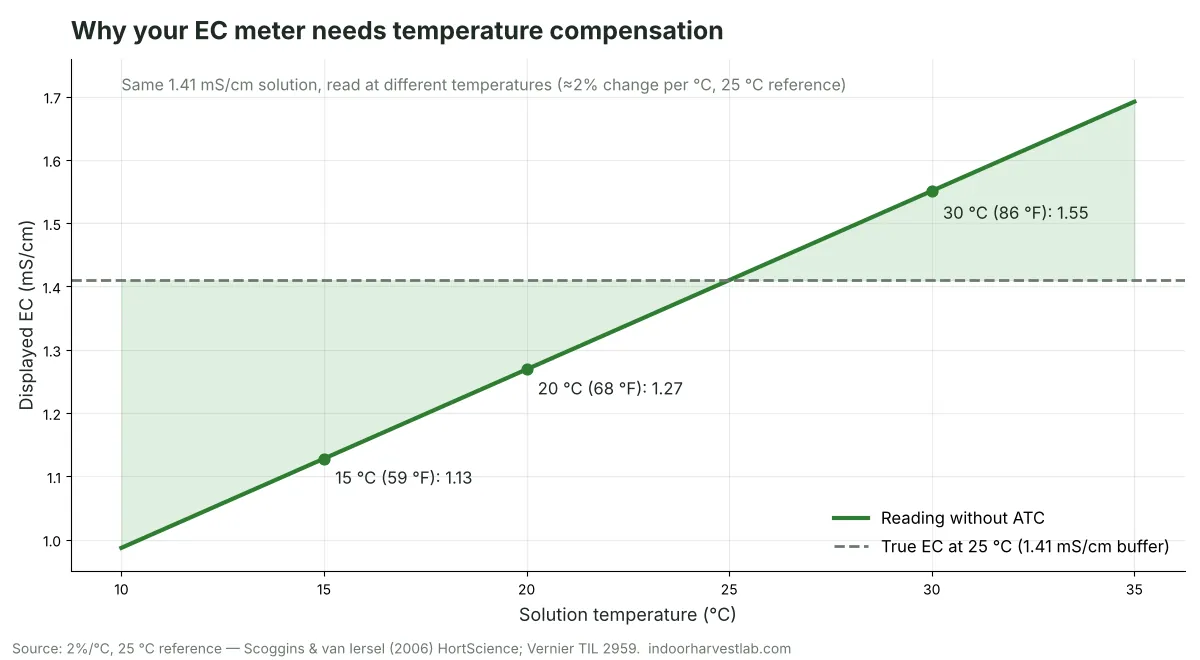
Temperature moves both readings. For EC it’s large: the standard correction used across the industry is about 2% per °C, referenced to 25 °C, and HortScience research found that standard correction worked well for compensated probes while an uncompensated probe’s reading more than doubled across 10–38 °C (Scoggins and van Iersel, 2006; Vernier). For EC, ATC is non-negotiable. For pH, the effect is smaller near pH 7, but the EPA method still requires you to compensate or calibrate at sample temperature whenever buffers and sample differ by more than 2 °C (EPA Method 9040C).
2. A replaceable electrode
The glass bulb is the part that wears out. Manufacturers note that an electrode’s responsiveness declines with age and that the cure for one that won’t calibrate or hold calibration after restoration is replacement (PASCO). On a meter with a separate probe you replace a probe; on a sealed pen you replace everything.
3. Two- or three-point calibration
You need at least two points. The EPA’s standard method calibrates at a minimum of two buffers that bracket the expected sample pH and sit about three units or more apart (EPA 9040C). For nutrient solutions that means pH 7.01 and pH 4.01. A third point at pH 10 is only useful if you also test alkaline water.
4. Easy-to-buy buffers and storage solution
Check that the brand’s pH 4.01, pH 7.01, EC 1.41 mS/cm (1413 µS/cm) and storage solutions are easy to find in sachets. Single-use sachets help you follow MSU’s advice: never dip the probe into the stock bottle, and don’t keep using the same bottle for years (MSU Extension).
5. A stability indicator
A meter that flags when the reading has stopped moving saves guesswork. The EPA method treats a reading as stable when drift is under 0.1 pH units (EPA 9040C).
6. Water resistance and a protective cap
Reservoir work is wet work. A sealed body and a cap that holds a few drops of storage solution over the bulb keep the electrode hydrated between checks.
7. EC and temperature on the same screen
OSU’s routine is to set EC first and then adjust pH (OSU). A combination meter makes that one dip instead of two, and seeing temperature alongside reminds you why a reading may look odd on a cold morning.
Numbers to Hold: pH, EC and Calibration Targets
Print this table and keep it next to the reservoir. Every figure links back to the source in the Sources list.
| What | Target / value | Source |
|---|---|---|
| Nutrient solution pH (general) | 5.0–6.0, usually 5.5 | OSU HLA-6722 |
| Calibration buffers | pH 7.01 then pH 4.01 (two points ~3 units apart, bracketing your samples) | MSU Extension; EPA 9040C |
| EC calibration standard | 1.41 mS/cm ≈ 1413 µS/cm | MSU Extension; OSU |
| Buffer vs sample temperature | Within 2 °C (3.6 °F), or use ATC | EPA 9040C |
| EC temperature correction | ≈2% per °C, referenced to 25 °C (77 °F) | Scoggins & van Iersel 2006; Vernier |
| Stable reading | Drift under 0.1 pH units | EPA 9040C |
| Probe re-wetting after storage | Soak ≥1 hour in storage solution | MSU Extension |
| Probe that was stored dry | Soak ≥8 hours in pH 4 buffer/KCl | Vernier PH-BNC manual |
| How often to check pH and EC | Daily, at the same time of day | OSU HLA-6722 |
| Reservoir water temperature | 72–75 °F (22–24 °C) | OSU HLA-6722 |
| Full nutrient solution change | Every two weeks | OSU HLA-6722 |
| Source-water alkalinity that drives pH up | Above 75 ppm | OSU HLA-6722 |
Crop targets vary more than many charts admit. Here are selected values from Oklahoma State’s crop table; use them as a starting range and adjust to what your plants show you.
| Crop | EC (mS/cm) | pH |
|---|---|---|
| Basil | 1.0–1.6 | 5.5–6.0 |
| Lettuce | 1.2–1.8 | 6.0–7.0 |
| Spinach | 1.8–2.3 | 6.0–7.0 |
| Parsley | 1.8–2.2 | 6.0–6.5 |
| Strawberry | 1.8–2.2 | 6.0 |
| Peppers | 0.8–1.8 | 5.5–6.0 |
| Tomato | 2.0–4.0 | 6.0–6.5 |
| Cucumber | 1.7–2.0 | 5.0–5.5 |
When the reading is outside range, our step-by-step guides on how to lower pH in hydroponics and raise pH in hydroponics cover the products and the dosing approach.
How to Calibrate and Use a pH Meter: Step by Step
Calibration takes a few minutes. Skipping it is the most common reason a meter “lies”. Here’s a routine that pulls together MSU Extension’s greenhouse guidance, the EPA’s laboratory method and probe manufacturers’ manuals.
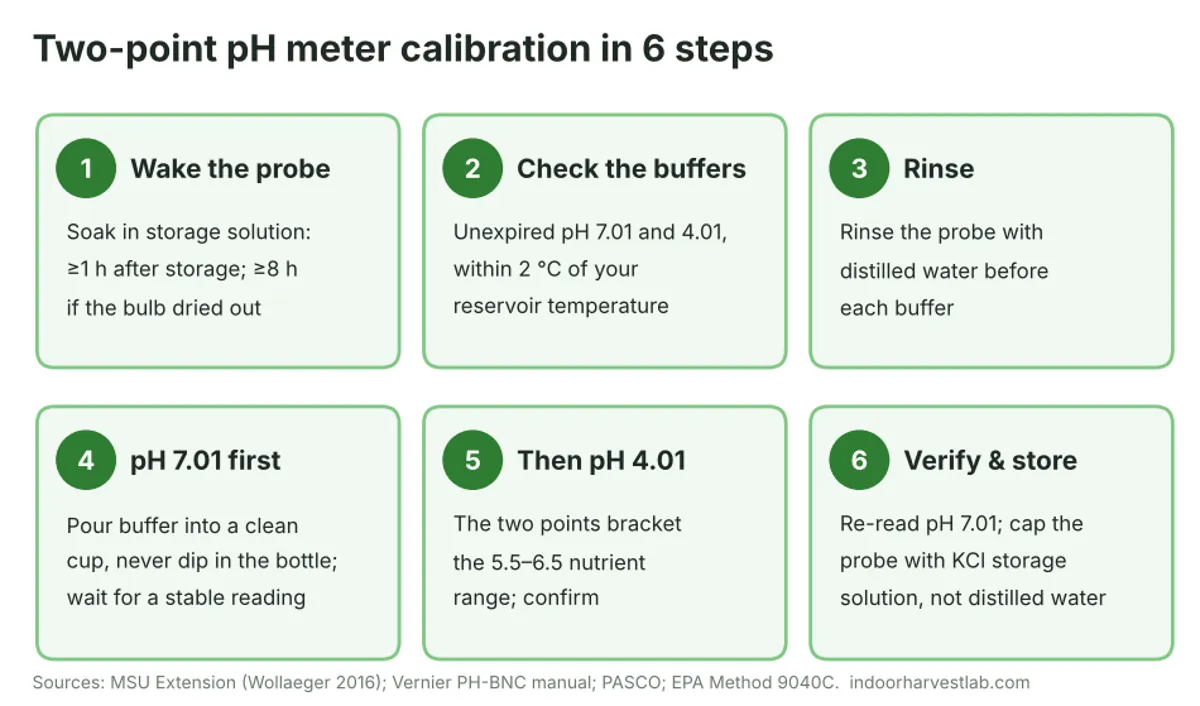
Step 1: Wake up the probe
If the meter has sat unused, assume the bulb has dried. MSU Extension describes soaking a probe in storage solution for at least an hour before calibrating (MSU). If the electrode was stored completely dry, Vernier’s manual calls for a minimum of eight hours in pH 4 buffer/KCl storage solution (Vernier).
Step 2: Check your buffers and their temperature
Use pH 7.01 and pH 4.01 buffers that are in date. Let them reach the same temperature as your reservoir, or at least within 2 °C, because the pH of buffers shifts with temperature (EPA 9040C; MSU).
Step 3: Rinse
Rinse the electrode with distilled water before each buffer and between buffers, then shake or blot off the excess so you don’t dilute the next solution (MSU).
Step 4: Calibrate at pH 7.01, then pH 4.01
Pour a little buffer into a clean, dry cup, or insert the probe straight into a sachet. Never dip into the stock bottle, because you’ll contaminate it (MSU). Calibrate at 7.01 first, wait for a stable reading and confirm, rinse, then repeat at 4.01. Throw the used buffer away.
Step 5: Verify
Rinse and read the pH 7.01 buffer again. The EPA method adjusts until the meter reads within 0.05 units of the buffer value (EPA 9040C). If yours is noticeably off, re-run the calibration; if it still won’t settle, jump to the troubleshooting table below.
Step 6: Measure the reservoir the right way
Follow OSU’s order: mix your nutrients, set EC first, then check and adjust pH (OSU). Stir, put the probe in mid-depth rather than at the surface, and give the reading a couple of minutes to stabilise. Test at the same time each day so you’re comparing like with like, and record pH, EC and temperature together, as the EPA method does.
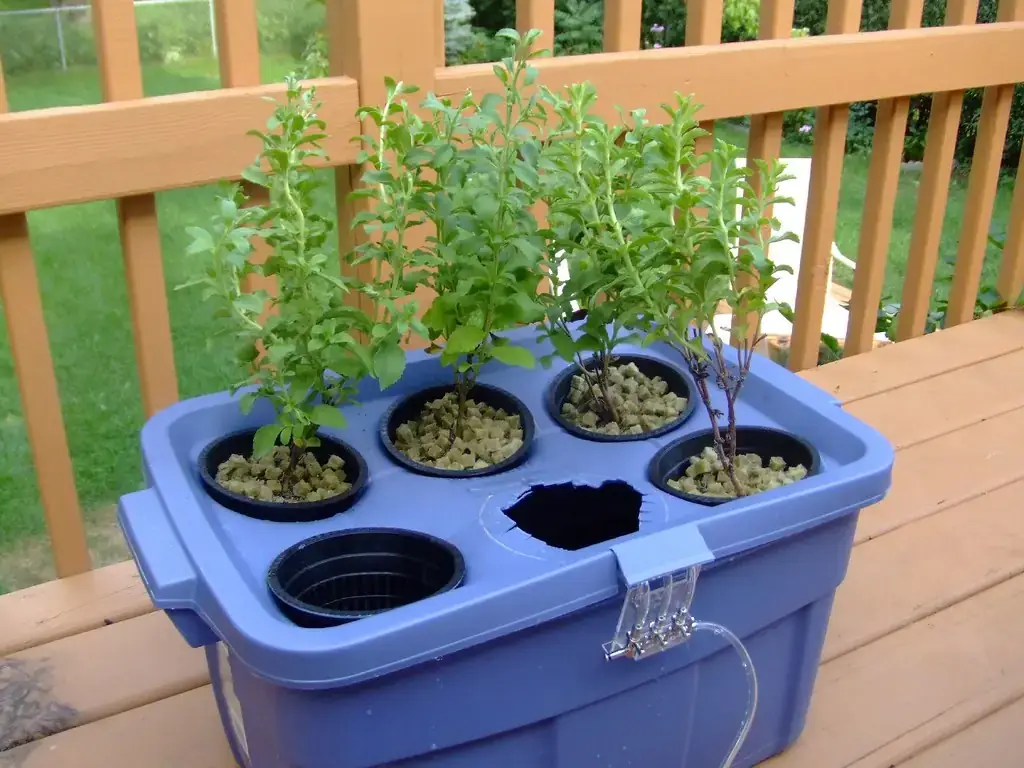
A word on distilled water: don’t use it to “test” your meter. Pure water has almost no ions and absorbs carbon dioxide from air, so readings are erratic and typically land anywhere from about 5.5 to 7.0 (Vernier). Check against a buffer instead. And if your tap water is drifting your pH, our guide to tap water for hydroponics explains how alkalinity and chlorine play in.
Probe Care, Cleaning and Storage (Plus Troubleshooting)
Most “broken” meters are dirty or dried-out probes. Look after the electrode and it keeps responding; neglect it and no amount of calibration will help.
Store it wet, in the right solution
Keep a few drops of KCl storage solution in the cap. Both PASCO and Vernier are blunt about this: do not store a pH electrode in distilled water, because it shortens the electrode’s life (PASCO; Vernier). For short breaks up to 24 hours, Vernier allows pH 4 or pH 7 buffer. If you run out of storage solution, Vernier’s homemade version is 10 g of potassium chloride dissolved in 100 mL of pH 4 buffer.
Clean it for what’s actually on it
Nutrient reservoirs coat probes with biofilm, algae and mineral scale. PASCO’s maintenance guide matches the cleaner to the deposit: warm water with a little dish detergent for oils and general grime, diluted bleach for algae and bacteria, and dilute hydrochloric acid for limescale (PASCO). Most hydroponic meter brands sell a ready-made probe cleaning solution, which is the simpler option at home. Rinse thoroughly, soak in storage solution, and recalibrate after any cleaning.
If algae keeps fouling your probe, the real fix is in the reservoir; see our guide to algae in hydroponics.
Troubleshooting table
| Symptom | Likely cause | What to do |
|---|---|---|
| Reading keeps drifting and never settles | Dried bulb, coated glass or a big temperature gap | Soak in storage solution (≥1 h), clean, let buffers reach reservoir temperature, recalibrate |
| Very slow response | Biofilm or scale on the glass | Clean with probe cleaner or the PASCO deposit-specific method, soak, recalibrate |
| Won’t accept calibration | Contaminated or expired buffer, or an aged electrode | Fresh sachets; if it still fails, run the manufacturer’s restoration routine, then replace the probe |
| Different reading on every distilled-water test | Normal: pure water has almost no ions | Test against a pH 7.01 buffer instead |
| EC jumps between morning and afternoon | Solution temperature changed and the meter lacks ATC | Use an ATC meter, or measure at the same temperature and time daily |
| pH creeps up day after day | Real drift from alkaline source water or plant uptake | Not a meter fault; check source-water alkalinity and adjust pH; see the raise/lower pH guides |
| Reading jumps when you stir or touch the cable | Loose connector or damaged cable | Check the connector; replace the probe if the cable is damaged |
When to replace the probe
PASCO’s restoration routine is a sequence of short soaks in dilute sodium hydroxide and hydrochloric acid, then pH 7 buffer, followed by calibration at pH 4 and 10. If the electrode still won’t calibrate or won’t hold calibration after that, it’s time for a new one (PASCO). These are lab chemicals; wear gloves and eye protection, or skip straight to a replacement probe if you’re not comfortable handling them.
From the Lab Bench
Here’s a useful way to think about a meter: you’re not buying accuracy, you’re buying the ability to be accurate. The glass electrode is a chemical sensor that ages, dries and fouls. Accuracy comes from the routine around it: fresh buffers, matched temperatures, wet storage and a reading taken the same way every day.
That’s also why resolution is the wrong headline spec. A display that shows 6.03 is no use if the slope the meter learned last month no longer matches the glass. In a recirculating system, where OSU’s targets give you only about a one-unit window, a meter you calibrate weekly with sachets will outperform a fancier one you calibrate “when it seems off”.
Think about EC and pH as a pair, too. EC tells you how much fertiliser is in the water; pH tells you how available it is. Setting EC first, as OSU recommends, makes sense chemically: acid and base additions shift EC a little, and nutrient additions shift pH a lot. Adjust in that order and you’ll make fewer corrections.
Finally, log your readings. A notebook or spreadsheet with date, time, temperature, pH and EC turns a meter into a diagnostic tool. A steady upward pH trend points at source-water alkalinity; a sudden jump with no change in EC points at the probe. If the trend drifts despite calibration, it’s often time for a full nutrient solution change.
FAQ
What is the best type of pH meter for hydroponics?
For most home growers, the best pH meter for hydroponics is a digital meter with a replaceable glass electrode, automatic temperature compensation and two-point calibration (pH 7.01 and 4.01). If you also manage EC, a combination pH/EC/temperature meter saves a second dip.
How often should I calibrate my hydroponic pH meter?
Calibrate before any important reading, after cleaning or storing the probe, and whenever a check in pH 7.01 buffer is off. Because Oklahoma State Extension advises checking pH and EC daily, many growers calibrate weekly and verify against a buffer in between.
Can I store my pH probe in distilled or tap water?
Not in distilled water: probe manufacturers PASCO and Vernier both warn it shortens electrode life. Store the electrode wet in KCl storage solution. For short breaks under 24 hours, pH 4 or pH 7 buffer is an acceptable stand-in.
Why does my pH meter give a different reading every time?
The usual causes are a dried or dirty electrode, buffers at a different temperature from your sample, or not waiting for a stable reading. Soak the probe in storage solution, clean it, calibrate at matching temperature and wait until drift is under 0.1 pH units.
Do I need an EC meter as well as a pH meter for hydroponics?
Yes, if you mix your own nutrients. EC tells you nutrient strength and pH tells you availability. Oklahoma State Extension recommends setting EC first and then adjusting pH, and checking both daily.
What does ATC mean on a pH or EC meter?
ATC is automatic temperature compensation. The meter measures temperature and corrects the reading, typically referencing EC to 25 °C using about a 2% per °C correction. Without ATC, the same solution reads higher when warm and lower when cold.
How do I know when to replace my pH probe?
Replace the electrode when it responds slowly or won’t calibrate or hold calibration even after cleaning and the manufacturer’s restoration routine. Fresh buffers should be the first thing you rule out.
Sources
- Singh, H. and Dunn, B. Electrical Conductivity and pH Guide for Hydroponics. Fact Sheet HLA-6722. Oklahoma State University Extension.
- Wollaeger, H. (2016). Calibrate your pH and EC meter in your greenhouse. Michigan State University Extension.
- U.S. Environmental Protection Agency (2004). Method 9040C: pH Electrometric Measurement, Revision 3. SW-846.
- Scoggins, H.L. and van Iersel, M.W. (2006). In situ probes for measurement of electrical conductivity of soilless substrates: effects of temperature and substrate moisture content. HortScience 41(1): 210–214.
- Vernier Science Education (2024). pH Electrode BNC User Manual (Rev. 12/27/2024).
- PASCO scientific. pH Electrode Maintenance. Knowledge Base.
- Vernier Software & Technology (2019, updated 2023). How is the temperature compensation calculated on my conductivity probe? Technical Information Library 2959.