
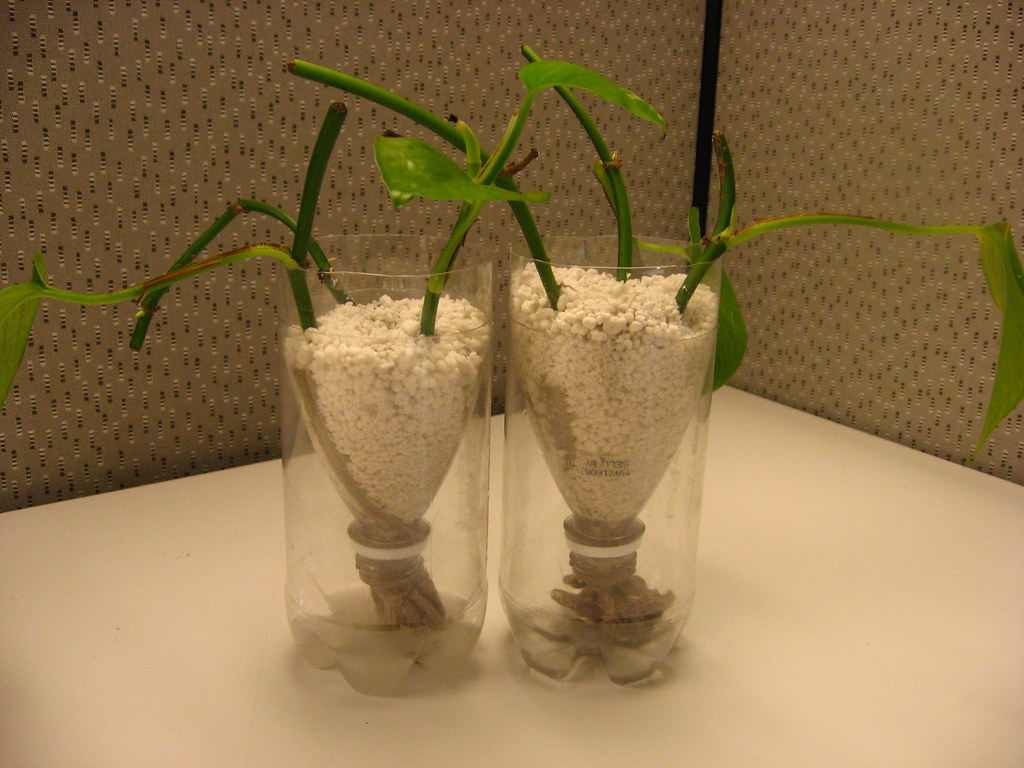
Short answer: a wick system hydroponics setup works well for small, light-feeding plants such as lettuce, leafy greens, herbs and houseplant cuttings in containers up to a few litres. It uses no pump: an absorbent wick pulls nutrient solution up into a moist medium such as coconut coir, perlite or vermiculite. It is a poor choice for tomatoes, peppers and other large, fruiting crops, because a wick system cannot move enough water and nutrients for them, and salts build up in the medium unless you flush it regularly.
This guide explains how a wick system works, which plants and media suit it, how to build one from a bottle or a tote, and the limits that published research and university extension services point to. If you want another pump-free method, compare it with the Kratky method, where roots hang directly in the solution instead of in a wicked medium.
Table of Contents
How a wick system works
A wick system has four parts: a reservoir of nutrient solution at the bottom, a growing container above it filled with an absorbent medium, one or more wicks that connect the two, and the plant. Water climbs the wick by capillary action, the same force that pulls coffee up a paper towel, and spreads into the medium around the roots. As the plant uses water and some evaporates from the surface, more is drawn up.
Oklahoma State University Extension calls the wick system “by far the simplest type of hydroponic system” in its fact sheet Hydroponics (HLA-6442), and advises using “a wick and growing media with high capillary action.” The Illinois Extension home hydroponics handout describes it as a passive, non-recovery system “with no pump and no moving parts,” and lists its main drawback plainly: it “keeps growing medium quite wet.”
A 2018 review of capillary irrigation in Horticulturae (Semananda, Ward and Myers) summarises the mechanism: the wick keeps a steady moisture level in the medium, and the rate of water movement follows the plant’s water loss. That self-regulating behaviour is why a wick system is so forgiving for beginners, and also why it cannot keep up once a plant gets large.
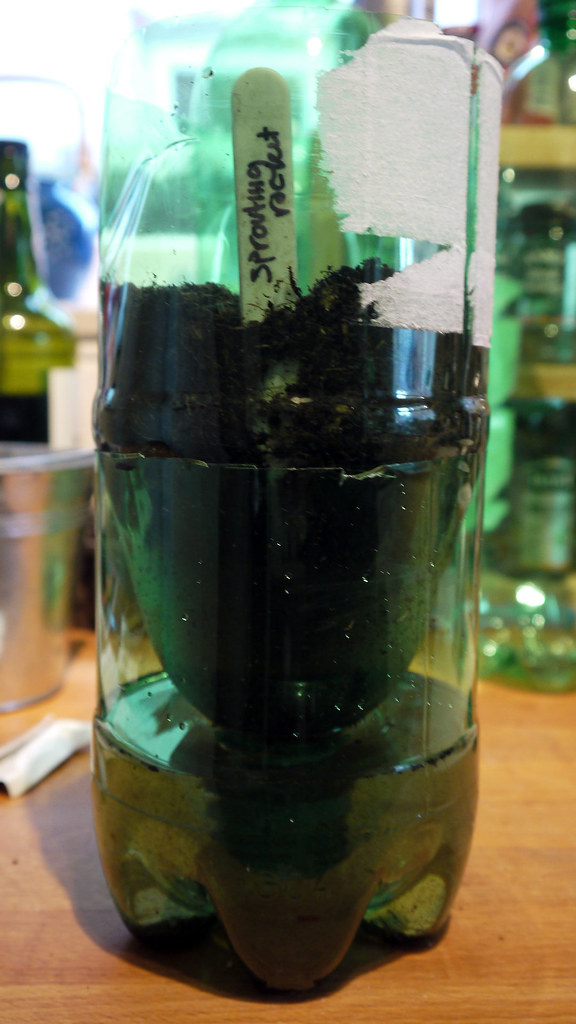
Wick system pros and cons at a glance
| Feature | Wick system | What it means for you |
|---|---|---|
| Power | None (a small air pump is optional) | Works through power cuts; silent; good for classrooms and windowsills |
| Cost | Very low (bottle, rope, medium) | A reasonable first project before buying equipment |
| Water delivery | Limited by wick size, material and height | Fine for small plants; falls behind for big, thirsty ones |
| Root-zone moisture | Constantly wet | Suits leafy greens; can suffocate roots of plants that like to dry out |
| Salt build-up | Salts rise and concentrate in the medium | Needs flushing with plain water every week or two |
| Best crops | Lettuce, greens, herbs, cuttings | Not tomatoes, peppers, cucumbers or squash |
Which plants grow well in a wick system
The same Horticulturae review states that capillary wick systems “tend to be limited to supporting small pot sizes or small non-fruiting crops,” and that they “cannot deliver sufficient nutrients for heavy-feeding crops, such as tomatoes.” That matches the extension advice: Colorado State University Extension’s soda-bottle wick system instructions suggest rosemary, lettuce and greens.
| Good fit | Possible, with care | Poor fit |
|---|---|---|
| Loose-leaf and butterhead lettuce, arugula, mizuna, pak choi | Basil, parsley, mint (use bigger containers and 2+ wicks) | Tomatoes, peppers, cucumbers, squash |
| Chives, cilantro seedlings, green onions | Strawberries (one plant per pot, frequent flushing) | Large, long-season plants in small containers |
| Pothos and other cuttings rooting in perlite | Rosemary (keep the medium less wet) | Plants that need the medium to dry between waterings |
For crops in the right-hand column, a deep water culture bucket or an ebb and flow tray will give far better results, because both deliver water and oxygen on demand rather than at the slow pace of a wick.
Wick materials, number of wicks and media
The wick is the whole engine of a wick system, so its material matters. The Horticulturae review notes that “cotton, nylon, and polyester are widely used,” and that studies found “significant difference in capillary rise depending on material, width, and weave.” More wick cross-section means more water: substrate water content rose with wick width. Colorado State’s instructions list fibrous rope, rayon rope, yarn, felt, nylon rope, strips of fabric or old blankets.
Choosing a wick
- Cotton or rayon rope and felt strips: wick quickly, but natural fibres can rot over a long crop. Replace them between crops.
- Nylon or polyester: last longer than natural fibres. Whatever you choose, soak the wick before you assemble the system so capillary flow starts straight away.
- Width over length: a thick, short wick moves more water than a long, thin one. Keep the gap between the water surface and the bottom of the medium as small as you can.
- Number of wicks: use one for a seedling cup, and two or more for a pot holding a mature herb or a full lettuce head.
Research on wick number shows the trade-off. In a 2022 study in Plant Science Today, lettuce grown with 5 mm cotton strips was compared with one, two and three wicks and hand watering; one wick used water most efficiently, and the authors stressed that this did not mean it gave the highest yield. Fewer wicks save water; more wicks protect a large plant on a hot day.
Choosing a medium
Wicks only work with a medium that pulls water sideways and upward. Coconut coir, vermiculite and perlite (or a coir and perlite mix) are the standard choices; the Illinois handout also mentions sand and perlite–vermiculite mixes. Clay pebbles and rockwool cubes on their own wick poorly across a whole pot, which is why a wick system rarely uses them. If you want to compare media in detail, see our hydroponic systems guides.
What the research says about wick system yields
The most useful controlled trial for home growers is by Ferrarezi and Testezlaf, published in the Journal of Plant Nutrition (2016, 39:150–164). They grew lettuce in wick-fed troughs filled with either coconut coir or pine bark and compared both with an NFT system. Lettuce yielded 4.08 kg per m² in the coir wick system, 3.84 kg per m² in pine bark, and 1.63 kg per m² in NFT under that trial’s conditions.
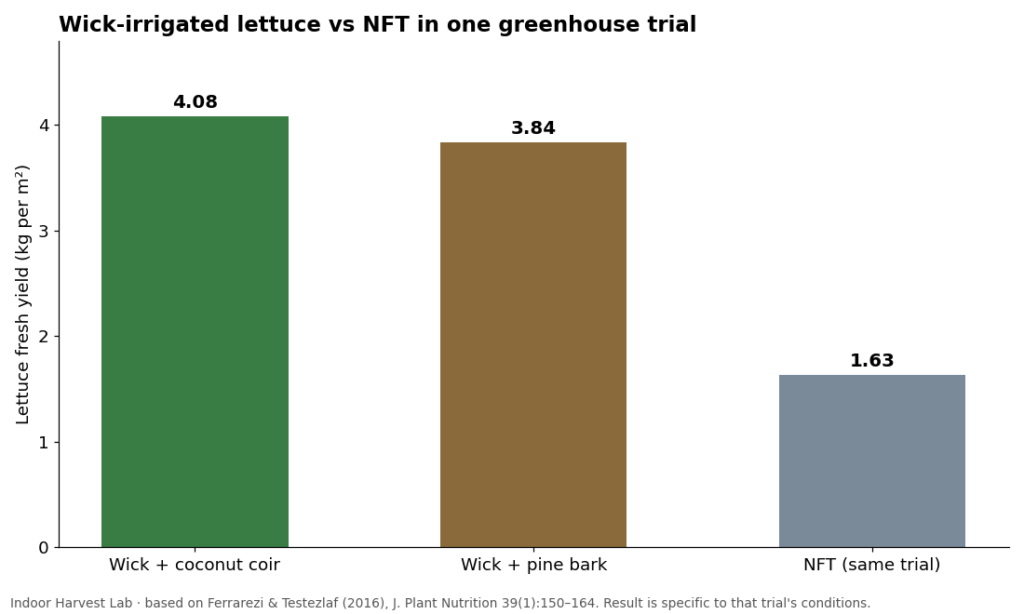
Two cautions keep that result in proportion. First, NFT under good management usually grows lettuce very well, so the gap says more about that particular setup than about NFT in general; our NFT hydroponics guide covers the slope and flow rates that make it work. Second, the same study found salts building up in the media, especially pine bark, and the researchers had to leach the substrate with tap water whenever EC climbed too high.
Water use is where a wick system shines. The Horticulturae review cites work by Yeager and Henley (2004) in which capillary wick irrigation “reduced water use an average 86% and 81%” compared with overhead watering and capillary mats, with no runoff.
How to build a bottle wick system (step by step)
This version follows the Colorado State University Extension soda-bottle design and fits a windowsill or a shelf under a grow light.
- Cut the bottle. Take a clean 2-litre plastic bottle and cut it about 8 inches (20 cm) from the top. Tape the cut edges.
- Block light. Paint or wrap the lower half dark. Light reaching the solution feeds algae.
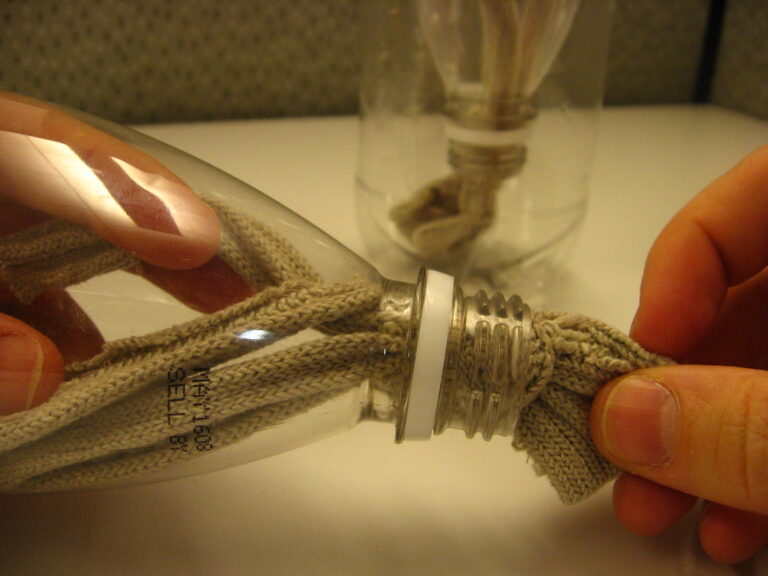
- Make the wick hole. Drill or punch a hole in the cap and thread a pre-soaked wick through it, with roughly half above and half below the cap.
- Fill the medium. Turn the top half upside down, spread the upper end of the wick through the neck, and fill with moist coco coir, perlite or vermiculite.
- Mix the solution. Use a complete hydroponic fertiliser at the label rate for leafy greens (see our nutrient solution guide). Colorado State fills the base to about 4 inches (10 cm) below the rim.
- Assemble. Set the inverted top into the base so the cap sits above the solution and the wick hangs freely into it.
- Plant. Sow seeds or set a rooted seedling in the medium and water it once from the top so the wick and medium are fully wet.
- Maintain. Top up as the level falls, and flush the medium with plain water about every 2 weeks, as Colorado State recommends.
Scaling up to a tote
For several plants, stack a net-pot lid or perforated tray of medium over a lidded storage tote, with two or more wicks per plant hanging into the solution. The same rules apply: keep the gap short, block light, and flush regularly. The Illinois Extension handout describes the wick system as easy and inexpensive, which is the point of a tote build.
Managing nutrients, EC and pH in a wick system
Because a wick system is passive, the medium above the wick acts like a salt trap. Water evaporates from the surface and leaves minerals behind, so the EC of the medium can rise well above the EC of the reservoir. In the Ferrarezi and Testezlaf trial, substrate EC ranged from 0.68 to 3.67 dS/m in coir and from 0.95 to 7.57 dS/m in pine bark.
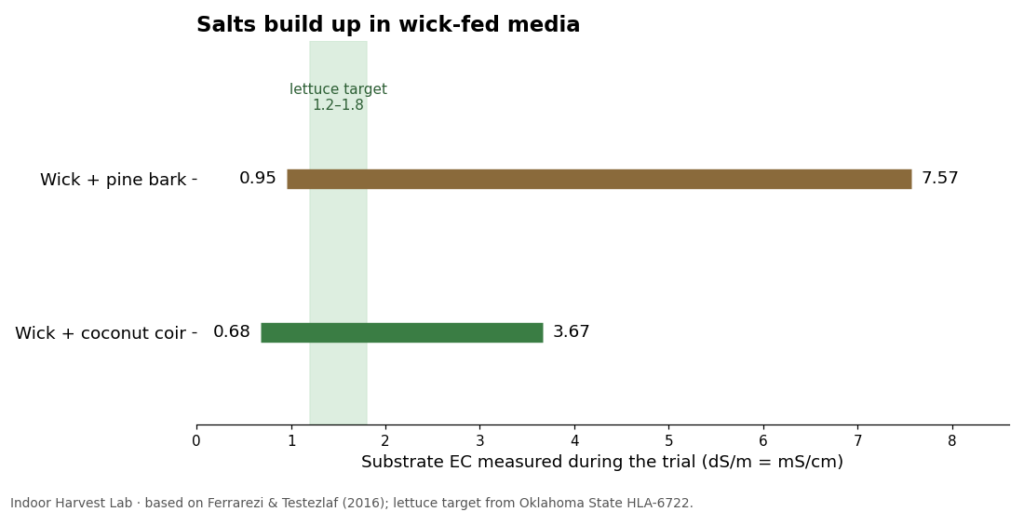
Oklahoma State’s EC and pH guide (HLA-6722) lists lettuce at an EC of 1.2 to 1.8 and basil at 1.0 to 1.6, so a medium that drifts to 3 or more is far outside the range these crops prefer. Practical rules:
- Mix the reservoir at the low end of the crop’s range; the medium will run higher.
- Check the reservoir EC and pH weekly (our hydroponic EC chart lists targets by crop).
- Flush the medium with plain water every 1–2 weeks, and replace the reservoir rather than only topping it up.
- Watch the surface: a white crust on coir or perlite is a sign that salts are accumulating.
Wick system limits: mistakes to avoid
- Growing big fruiting crops. A tomato in a wick system will wilt on warm days and stay stunted. Use a larger active system.
- Using a medium that doesn’t wick. Clay pebbles alone leave dry pockets around the roots.
- A long gap between water and medium. Capillary rise weakens with height. As the reservoir drops, the gap grows and delivery falls; top up before it gets low.
- Too few or too thin wicks. Add wicks as the plant grows, or move it to a bigger system.
- Never flushing. Salts build up in the medium even when the reservoir reads fine.
- Clear containers. Light in the reservoir means algae, which competes for nutrients and clogs wicks.
- Keeping it too wet for dry-loving herbs. Rosemary and thyme prefer a coarser, more perlite-rich mix and a shorter wick.
Where a wick system makes sense
A wick system is a good match when you want a few pots of greens or herbs, have no reliable power at the growing spot, are teaching children how hydroponics works, or are rooting cuttings. Indoors under a grow light, where temperatures stay moderate, a wick system keeps up with lettuce and herbs more easily than on a hot sunny windowsill, where evaporation and plant demand outpace the wick. In warm, dry rooms, expect to top up and flush more often. If you want larger harvests, faster growth or fruiting crops, move to deep water culture, the Kratky method for single heads of lettuce, or ebb and flow.
Wick system FAQ
Is a wick system good for beginners?
Yes for small leafy plants and herbs. It has no pump to fail and costs almost nothing. The two things beginners must learn are flushing the medium and keeping the water level close to the medium.
Do you need an air pump in a wick system?
Not usually. Oklahoma State’s diagram shows an air stone in the reservoir, but the roots sit in a moist medium with air spaces rather than in the water, so most small wick setups run without one.
How often should you change the water?
Top up as needed, flush the medium with plain water every 1–2 weeks, and replace the reservoir with fresh solution at the same time. Our guide on how often to change hydroponic water gives intervals by system size.
Wick system vs Kratky: which is better?
In Kratky, roots sit directly in the solution with an air gap above, which suits single heads of lettuce. A wick system keeps roots in a medium, which suits herbs, cuttings and plants that dislike standing water. Both are passive and cheap; pick by crop.
Sources
- Dunn, B. (2025). Hydroponics, HLA-6442. Oklahoma State University Extension.
- Illinois Extension. Home Hydroponics handouts. University of Illinois.
- Colorado State University Extension, Gilpin County. Simple gardening at home: hydroponics wicking soda bottle system.
- Semananda, N.P.K., Ward, J.D. and Myers, B.R. (2018). A semi-systematic review of capillary irrigation: the benefits, limitations, and opportunities. Horticulturae 4(3): 23.
- Ferrarezi, R.S. and Testezlaf, R. (2016). Performance of wick irrigation system using self-compensating troughs with substrates for lettuce production. Journal of Plant Nutrition 39(1): 150–164.
- Growth and yield assessment of lettuce: an economic feasibility and performance evaluation of capillary wick irrigation system (2022). Plant Science Today 9(1).
- Oklahoma State University Extension. Electrical Conductivity and pH Guide for Hydroponics, HLA-6722.
Featured image: “Passive Hydroponics” by Qfamily, CC BY 2.0.