
It’s November, the farmers’ market has packed up, and the plastic clamshell of “wild rocket” in your fridge has turned to green slime two days after you bought it. Meanwhile, a packet of arugula seed costs less than that clamshell and sits in a drawer. The good news: of all the salad crops you could bring indoors this winter, arugula may be the one that suits a cool house best.
Short answer: You can grow arugula indoors from seed in a pot or a simple hydroponic setup and cut your first baby leaves in about four weeks. Keep it cool (roughly 50–65°F / 10–18°C), give it 14–16 hours a day under an LED grow light at about 150–250 µmol/m²/s, sow thickly, thin to 4–6 inches, and harvest the outer leaves so the plant keeps producing. Heat, crowding and drought stress are what make it bolt.
By the end of this guide on how to grow arugula indoors, you’ll know exactly which arugula to buy, how to set up a light and container, the numbers to hold for temperature, light and hydroponic EC, and how to keep the harvest coming all winter instead of watching your plants shoot up into bitter flower stalks.
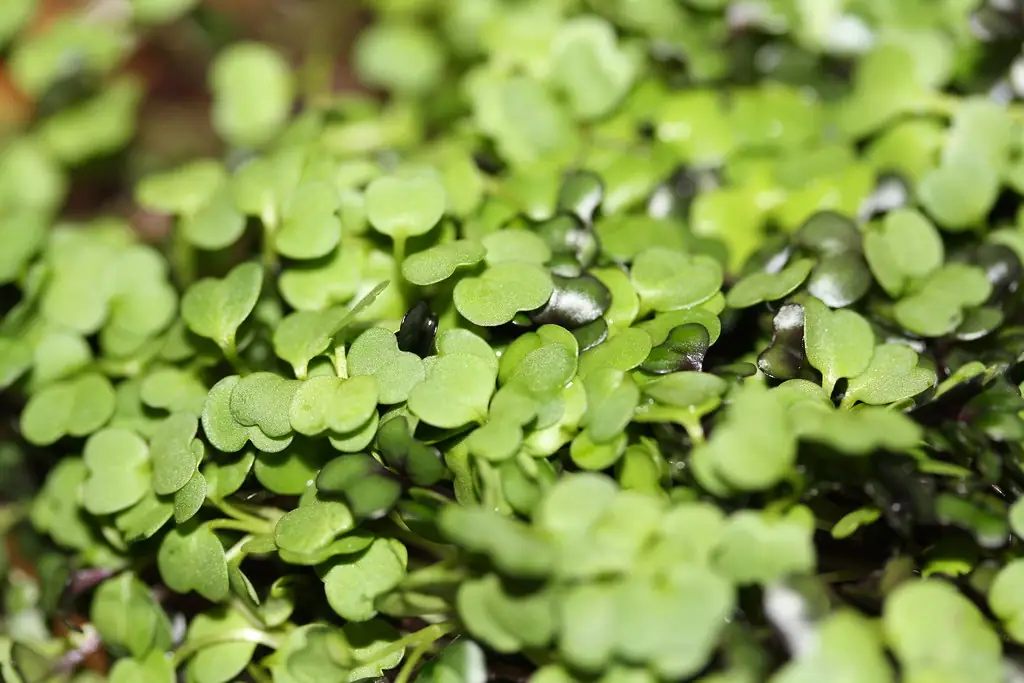
Can You Grow Arugula Indoors? Why It’s an Ideal Winter Crop
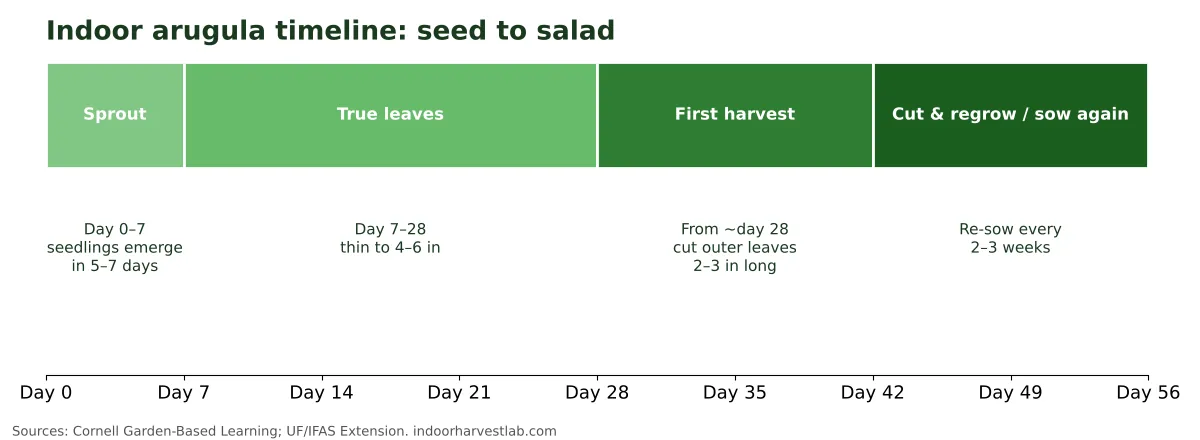
Yes, and arguably more easily than lettuce. Arugula is a cool-season member of the cabbage family (Brassicaceae). Cornell Garden-Based Learning notes that its seed “germinates quickly even in cold soil,” seedlings emerge in 5 to 7 days, and leaves are often ready to harvest as early as 4 weeks after seeding.
Its favourite temperatures also happen to match a typical heated home in winter. UF/IFAS Extension says arugula grows best between 50°F and 65°F (10–18°C) and will bolt (flower and go to seed) quickly in hot weather. A cool spare room, a basement shelf or a bright spot away from the radiator is close to perfect.
Three more traits make arugula a great indoor crop:
- It’s fast. You eat baby leaves, not a mature head, so the crop is in and out of the pot in weeks.
- It’s compact. A 1–2 gallon container is enough for a plant (UF/IFAS), and a window box or a shallow tray will feed one person salad several times a week.
- It’s strong-flavoured. A small handful of peppery leaves goes a long way, so a modest indoor patch actually feels productive.
If you already grow spinach indoors or kale indoors, arugula slots into the same shelf and light. It’s quicker than both.
Choose the Right Arugula: Salad Rocket vs Wild Rocket
Before you buy seed, know that “arugula” on a seed rack can mean two different plants. They behave differently indoors, so pick on purpose.
| Trait | Salad arugula (Eruca vesicaria / E. sativa) | Wild arugula, ‘Sylvetta’ (Diplotaxis tenuifolia) |
|---|---|---|
| Growth speed | Fast; baby leaves from ~4 weeks | Slower growing |
| Plant size | Taller, broader leaves | About half as tall |
| Leaves | Wide, rounded lobes, mild to peppery | Smaller, more deeply lobed |
| Flavour | Nutty-peppery | More pungent |
| Bolting | Bolts quickly in heat or stress | Slower to bolt |
| Best indoors for | Quick harvests, hydroponics, succession sowings | Longer-lived pots, warmer rooms |
Cornell describes ‘Sylvetta’ as “slower growing, half as tall, and slower to bolt,” with smaller, more deeply lobed leaves and a more pungent taste. West Coast Seeds adds that wild arugula keeps producing when salad arugula has gone to seed in hot weather.
Which to choose? For a first indoor crop, plain salad arugula is the easy win: it germinates fast and you’ll be eating within a month. If your growing space runs warm (a sunny room or a tent with a hot light), wild arugula’s bolt resistance is worth the slower start. Honestly, many growers sow both: salad rocket for volume, Sylvetta for a pot that keeps going.
The Numbers to Hold for Indoor Arugula
Here’s the cheat sheet. Every figure comes from an extension service or a peer-reviewed trial listed in the Sources at the end. Where research grew arugula in a greenhouse or a container farm rather than a living room, treat the number as a target, not a law.
| Factor | Target | Source / note |
|---|---|---|
| Germination temperature | 40–55°F (4–13°C); germinates in cool soil | Cornell |
| Days to emergence | 5–7 days | Cornell |
| Growing temperature | 50–65°F (10–18°C) | UF/IFAS; the Ohio State/USDA trial ran ~65°F (18.5°C) day, ~62°F (16.8°C) night |
| Heat warning | Bolts quickly in hot weather; shade above 85°F (29°C) | UF/IFAS |
| Light intensity (PPFD) | 150–250 µmol/m²/s at leaf level | Recommendation cited by Rebolledo et al. 2026 |
| Photoperiod | 16 hours | Rebolledo et al. 2026; Yang et al. 2021 |
| Daily light integral (DLI) | ~11–17 mol/m²/day | 11.1–14.9 in a container-farm study; ~17 in a greenhouse NFT trial |
| Hydroponic EC | 1.5–1.8 mS/cm (dS/m) | Yang et al. 2021 (Ohio State / USDA-ARS) |
| Hydroponic pH | ~5.8 (held there in the trial) | Yang et al. 2021 |
| Seed depth | ¼ inch (about 5 mm) | Cornell; West Coast Seeds |
| Final spacing | 4–6 in (10–15 cm) | West Coast Seeds; Cornell thins to 6 in |
| First harvest | ~4 weeks from seeding; leaves 2–3 in long | Cornell; UF/IFAS |
| Succession sowing | Every 2–3 weeks | Cornell |
A quick DLI check, so you can sanity-test your own light: DLI = PPFD × hours × 0.0036. At 200 µmol/m²/s for 16 hours you get about 11.5 mol/m²/day; at 250 µmol/m²/s you get about 14.4. Both sit inside the range used in the studies above. Our guide to light hours for seedlings explains the maths in more detail.
Light: How Much Grow Light Arugula Really Needs
When people try to grow arugula indoors and fail, light is usually the culprit, and the reason is simple: a winter windowsill gives far less light than it looks. UF/IFAS asks for 4–6 hours of partial to full sun for outdoor and container arugula. A north-facing or shaded window in December won’t come close, and the result is pale, floppy, stretched seedlings.
What the research says
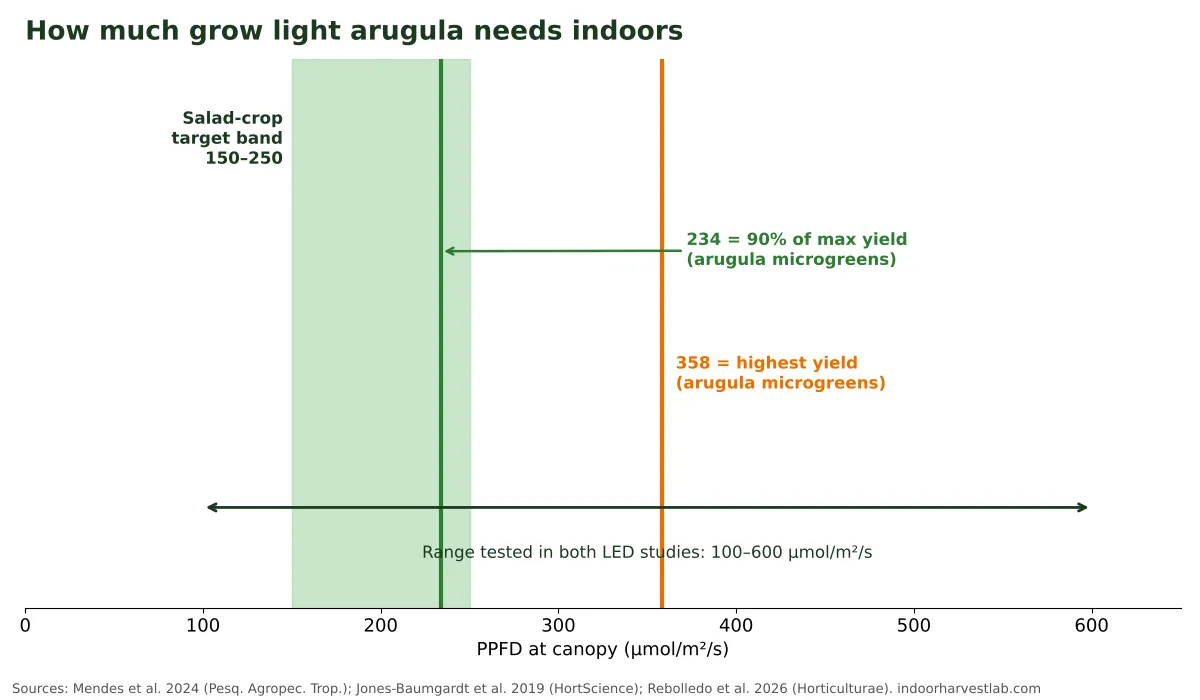
Two LED studies give us useful boundaries. A 2024 study on arugula microgreens under white LEDs at 100–600 µmol/m²/s found the highest yield at 358 µmol/m²/s, and 90% of that maximum at just 234 µmol/m²/s. An earlier University of Guelph trial in HortScience raised light from 100 to 600 µmol/m²/s and saw arugula microgreen fresh weight rise by 0.71 kg/m² (76%), with shorter, sturdier stems at higher light.
For full-size baby-leaf arugula, a 2026 vertical-farm study in Horticulturae cites a recommended 16-hour photoperiod, a DLI of 14 mol/m²/day and a PPFD of 150–250 µmol/m²/s. In that trial, plants grown at 193–258 µmol/m²/s (DLI 11.1–14.9) were harvested 22 days after transplanting, and the brightest treatment (a white LED 20 cm above the canopy) gave the most fresh weight and polyphenols.
How to translate that to your shelf
- Use a full-spectrum white LED. The 2026 study found white LED close to the plants did best, though the authors caution that distance and intensity were not tested separately.
- Aim for 150–250 µmol/m²/s at leaf level. Most shop-light-style LED bars reach this only when they’re a few inches above the leaves. If you don’t own a PAR meter, watch the plants: long pale stems mean more light or a lower fixture.
- Run the light 14–16 hours a day on a timer. Sixteen hours is what the trials used. A plug-in timer costs little and removes the guesswork.
- Keep the light from overheating the plants. Arugula hates warmth more than it hates modest light. If leaves feel warm under the fixture, raise it a little.
If your seedlings stretch anyway, see our fix-it guide on leggy seedlings. It’s the same physics.
How to Grow Arugula Indoors in Pots, Step by Step
This is the soil method most people use to grow arugula indoors. It needs a container, potting mix, seed and a light, and nothing else.
Step 1: Pick a container with drainage
Use a pot, window box or tray at least 4–6 inches deep with drainage holes. UF/IFAS suggests a 1–2 gallon container per transplanted plant. For cut-and-come-again baby leaves, a wide, shallow window box sown in a band works better than a deep single pot.
Step 2: Fill with a free-draining mix
UF/IFAS recommends well-draining soil with organic matter and advises against heavy clay. Indoors that means a bagged potting mix, not garden soil. Mix in a balanced slow-release fertiliser at planting, as UF/IFAS suggests, because baby greens grow fast and run through the nutrients in a peat mix quickly.
Step 3: Sow shallow and cool
Sow ¼ inch deep, about 1 inch apart, or broadcast across the surface and cover lightly (Cornell). Water gently and keep the surface moist until seedlings appear in 5–7 days. You don’t need a heat mat: germination is happiest at 40–55°F, so a cool room is an asset, not a problem. Compare that with the warmer needs in our seed germination temperature chart.
Step 4: Light from day one
Put the tray under the grow light as soon as you see the first green hooks. Arugula seedlings stretch within a day or two if they come up in dim light.
Step 5: Thin to 4–6 inches
When seedlings have their first true leaves, thin them. West Coast Seeds recommends 4–6 inches (10–15 cm) between plants and warns that “overcrowded plants will bolt earlier.” Cornell suggests eating the thinnings, so nothing goes to waste.
Step 6: Water when the top inch is dry
UF/IFAS says to water when the top inch of soil is dry to the touch and notes arugula “prefers slightly drier conditions compared to other greens.” Constantly soggy mix also invites fungus gnats, the most common indoor pest on salad pots.
Step 7: Sow again every 2–3 weeks
Cornell recommends new sowings every 2 to 3 weeks for a continuous supply. Indoors, two or three small pots at different ages give you steady salad instead of a glut followed by a gap.
Growing Arugula Hydroponically: EC, pH and Timing
If you’d rather grow arugula indoors without soil, it’s a natural fit for small hydroponic systems such as the Kratky method or a countertop deep-water culture bucket. It’s quick, light-feeding and doesn’t need support.
The most useful data come from an Ohio State University and USDA-ARS trial published in Agronomy in 2021. The researchers grew arugula ‘Standard’ in an NFT system at four nutrient strengths (EC 1.2, 1.5, 1.8 and 2.1 dS/m) with the pH held at about 5.8. Seedlings were transplanted at 3 weeks old and harvested 4 weeks later.
| Solution EC (dS/m = mS/cm) | What happened to arugula |
|---|---|
| 1.2 | Lowest yield; leaf yellowing (chlorosis); lower photosynthesis |
| 1.5–1.8 | Shoot fresh yield 136–139% higher than at 1.2; recommended range |
| 2.1 | Fresh weight tended to drop; chlorosis returned; highest nitrate |
There’s a second reason not to overfeed: the same study found leaf nitrate built up rapidly as EC rose. That’s why the authors settled on 1.5–1.8 rather than “more is better.”
Practical setup: start seedlings at a gentle EC (the trial used 1.0–1.2 for propagation), move to 1.5–1.8 once plants are established, and keep pH near 5.8. Use our hydroponic EC chart to convert if your meter reads in ppm.
Harvesting and Keeping Arugula From Bolting
Harvest is where indoor arugula pays you back, and it’s also where you control how long the plants last.
Cut-and-come-again harvesting
UF/IFAS suggests starting when leaves are about 2–3 inches long and picking the outer leaves first. Leave the small central leaves and the growing point, and the plant pushes out new leaves for another cut. With a pair of scissors, you can take a few leaves from each plant every few days.
Why indoor arugula bolts, and how to slow it
Bolting is arugula’s way of saying it’s under stress. Cornell says to slow it “by reducing heat and moisture stress,” West Coast Seeds blames crowding, and UF/IFAS flags hot weather. Indoors, that gives you a clear checklist:
| Bolting trigger | Indoor cause | Fix |
|---|---|---|
| Heat | Pot near a heater, hot light too close, sunny summer window | Keep it at 50–65°F; raise the light; move away from vents |
| Drought stress | Small pot drying out under a light | Check daily; water when the top inch is dry |
| Crowding | Unthinned seedlings competing | Thin to 4–6 inches |
| Age | Plants simply mature after several weeks of cutting | Re-sow every 2–3 weeks so young plants are always coming |
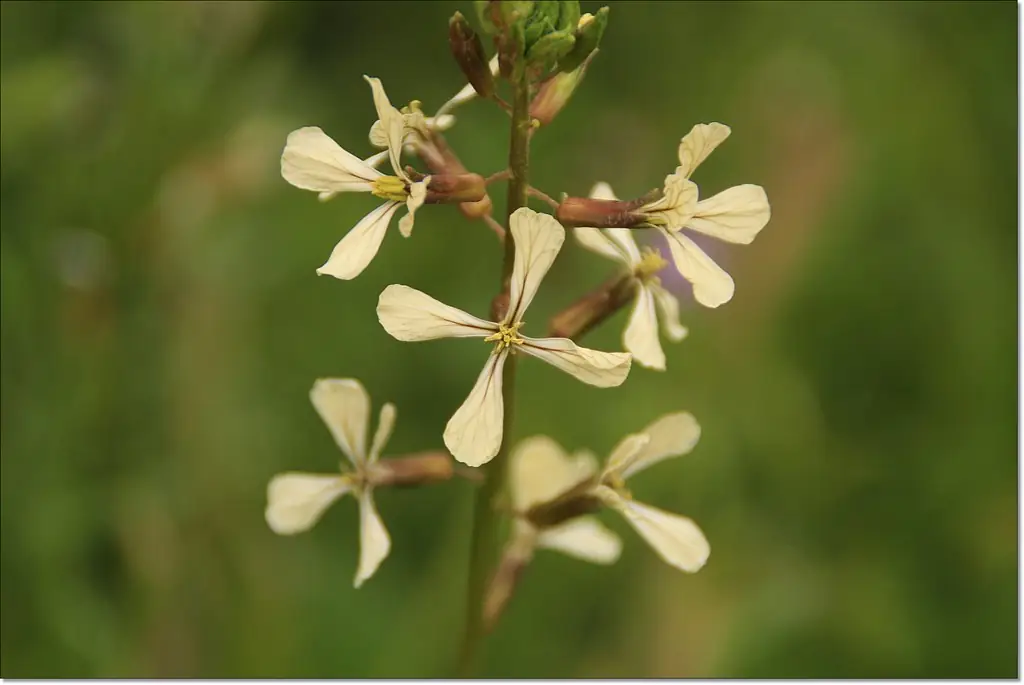
Once a flower stalk appears, leaves turn tougher and sharper. You can still eat them, and the white flowers are edible too, but it’s time to pull the plant and start a fresh pot.
Indoor Arugula Problems: Quick Troubleshooting
Most problems indoors come down to light, water or warmth. Use this table to diagnose what you see.
| What you see | Likely cause | What to do |
|---|---|---|
| Tall, pale, floppy seedlings | Too little light | Lower the LED or add light; aim for 150–250 µmol/m²/s |
| Sudden flower stalk | Heat, drought or crowding stress | Cool the room, water evenly, thin; re-sow |
| Leaves very bitter or hot | Plant bolting or stressed | Harvest younger leaves; keep temperatures cool |
| Yellowing lower leaves (hydroponics) | EC too low (or too high) | Bring EC into 1.5–1.8 range; check pH ~5.8 |
| Tiny gnats over the soil | Fungus gnats from wet mix | Let the surface dry; use sticky traps |
| Clusters of small soft insects | Aphids (UF/IFAS) | Rinse off; neem oil per label |
| Small round shot-holes in leaves | Flea beetles (mainly an outdoor pest) | Rarely indoors; check plants brought in from outside |
| Fuzzy grey-purple growth under leaves | Downy mildew (Cornell lists it) | Improve air flow; avoid wetting leaves; remove affected leaves |
UF/IFAS stresses good air circulation to prevent fungal disease. A small clip-on fan on low, pointed across the shelf, helps dry leaf surfaces in a still indoor room.
From the Lab Bench
Here’s how to read the evidence if you want to grow arugula indoors well and only remember a few things.
Temperature is your main control knob. The research on light and nutrients is useful, but notice what the extension services keep repeating: heat and stress make arugula bolt. In a home, the biggest gains usually come from choosing a cool spot. The Ohio State trial that produced such strong yields ran at about 18.5°C by day and 16.8°C at night, which is roughly a cool living room in winter.
You don’t need maximum light; you need enough. The microgreen studies show yield keeps climbing up to 358–600 µmol/m²/s, but 90% of the maximum came at 234. For a home grower, that last 10% costs electricity and heat, and heat is the thing arugula dislikes. The 150–250 band is the sensible sweet spot.
Feed moderately in hydroponics. The jump from EC 1.2 to 1.5 more than doubled fresh yield; going higher brought more nitrate and no extra growth. That’s a classic plateau. Pick the low end of 1.5–1.8 if you’re nervous about nitrate in a leafy crop you eat raw.
Plan for turnover. Arugula is a sprinter, not a marathon runner. Treat each pot as a 6–8 week crop and keep a younger one coming behind it. That one habit fixes most complaints about indoor arugula going bitter.
Want more ideas for a winter salad shelf? See our guides to growing lettuce indoors and growing herbs indoors in winter.
FAQ
How long does arugula take to grow indoors?
Seedlings emerge in about 5–7 days, and you can usually start cutting baby leaves about 4 weeks after sowing, according to Cornell. In a hydroponic trial, plants were harvested 4 weeks after transplanting 3-week-old seedlings.
Can arugula grow on a windowsill without a grow light?
It can in a bright, cool, south-facing window, but winter light is often too weak. UF/IFAS asks for 4–6 hours of sun; if your seedlings get tall and pale, add an LED grow light running 14–16 hours a day.
Does arugula grow back after cutting?
Yes. Pick outer leaves when they are 2–3 inches long and leave the centre intact, and the plant will keep producing until it starts to bolt. Re-sow every 2–3 weeks for a steady supply.
Why is my indoor arugula so bitter?
Bitterness and extra heat usually mean the plant is stressed or starting to bolt. Keep it at 50–65°F, water evenly, thin crowded plants and harvest younger leaves.
What EC and pH does hydroponic arugula need?
An Ohio State/USDA trial found EC 1.5–1.8 mS/cm gave the best yield, with pH held at about 5.8. Lower EC caused yellowing; higher EC raised leaf nitrate.
How many hours of light does arugula need indoors?
Research trials used a 16-hour photoperiod at roughly 150–250 µmol/m²/s, giving a daily light integral of about 11–15 mol/m²/day.
Is wild arugula better for growing indoors?
Wild arugula (Diplotaxis tenuifolia, ‘Sylvetta’) is slower to bolt and half as tall, so it suits warmer rooms and longer-lived pots. Salad arugula is faster for quick harvests.
Sources
- Cornell Garden-Based Learning, Cornell Cooperative Extension. “Arugula growing guide.” gardening.cals.cornell.edu
- Jameson, M. (2023). “Arugula: Planting and Care.” UF/IFAS Extension Leon County, 9 Nov 2023. blogs.ifas.ufl.edu
- Yang, T., Samarakoon, U., Altland, J., & Ling, P. (2021). Photosynthesis, biomass production, nutritional quality, and flavor-related phytochemical properties of hydroponic-grown arugula (Eruca sativa Mill.) ‘Standard’ under different electrical conductivities of nutrient solution. Agronomy, 11(7), 1340. doi:10.3390/agronomy11071340
- Rebolledo, P., Urrestarazu, M., Fuentes-Peñailillo, F., Vendruscolo, E. P., & Carrasco, G. (2026). Effects of LED lighting configurations on the growth and quality of arugula (Eruca sativa Mill.) in a vertical NFT system. Horticulturae, 12(5), 592. doi:10.3390/horticulturae12050592
- Mendes, F. Q., Purquerio, L. F. V., Carvalho, R. F., & Cecílio Filho, A. B. (2024). White light intensities for maximum yield and quality of arugula microgreens. Pesquisa Agropecuária Tropical, 54. doi:10.1590/1983-40632024v5479951
- Jones-Baumgardt, C., Llewellyn, D., Ying, Q., & Zheng, Y. (2019). Intensity of sole-source light-emitting diodes affects growth, yield, and quality of Brassicaceae microgreens. HortScience, 54(7), 1168–1174. doi:10.21273/HORTSCI13788-18
- West Coast Seeds. “How to Grow Arugula.” westcoastseeds.com