
You set up the system, dropped in a few lettuce seedlings and started checking them every morning. Two weeks later they look… fine, but nowhere near the heads in the photos. So you start wondering whether something is wrong, or whether lettuce is just slower than everyone says.
Short answer: hydroponic lettuce growing time is about 35 days from seed to a 5–6 oz head under research-grade conditions: roughly 11 days as a seedling and 24 days after transplanting, at a daily light integral (DLI) of 17 mol·m⁻²·d⁻¹ (Cornell CEA). Most home setups land between 5 and 9 weeks, because they give less light or run cooler. Halve the light and the grow-out stage takes about twice as long.
By the end of this guide you’ll know what a realistic timeline looks like for your setup, the light and temperature numbers that set the pace, how lettuce type changes the count, and a step-by-step schedule for getting the fastest crop your system can manage. You’ll also be able to work out why a slow crop is slow.
Hydroponic lettuce growing time, stage by stage
Lettuce growing time is easier to manage when you split it into stages. Each stage has its own clock, and each one can stall for a different reason. The table below combines the Cornell Controlled Environment Agriculture (CEA) program’s research schedule with the University of Kentucky’s 2026 hydroponic lettuce crop profile.
| Stage | Optimal timing (Cornell) | Typical range (UK Extension) | Ready to move on when… |
|---|---|---|---|
| Germination | About 1 day at 68°F (20°C) | About 3 days | Root tip and seed leaves visible; dome comes off about 2 days after sowing |
| Seedling | Days 1–11 | About 10 days of seedling growth; transplant 14–21 days after sowing | 3–4 true leaves and roots showing at the bottom of the plug |
| Grow-out (after transplant) | 24 days at DLI 17 | 21–35 days to harvest (UK); 30–40 days in UK’s timeline figure | Head reaches target size, about 100–210 g (3.5–7.5 oz) |
| Total, seed to harvest | 35 days | About 5–8 weeks | — |
Notice that the University of Kentucky gives two grow-out ranges in the same guide. That isn’t a mistake. It reflects how much time depends on the season, the cultivar and the light. A winter crop under weak light needs the longer end.
If you start seeds in a cube or plug, our lettuce seed germination guide covers why lettuce stalls in warm rooms. That’s the first place a crop loses days.
Why published timelines run from 35 to 66 days
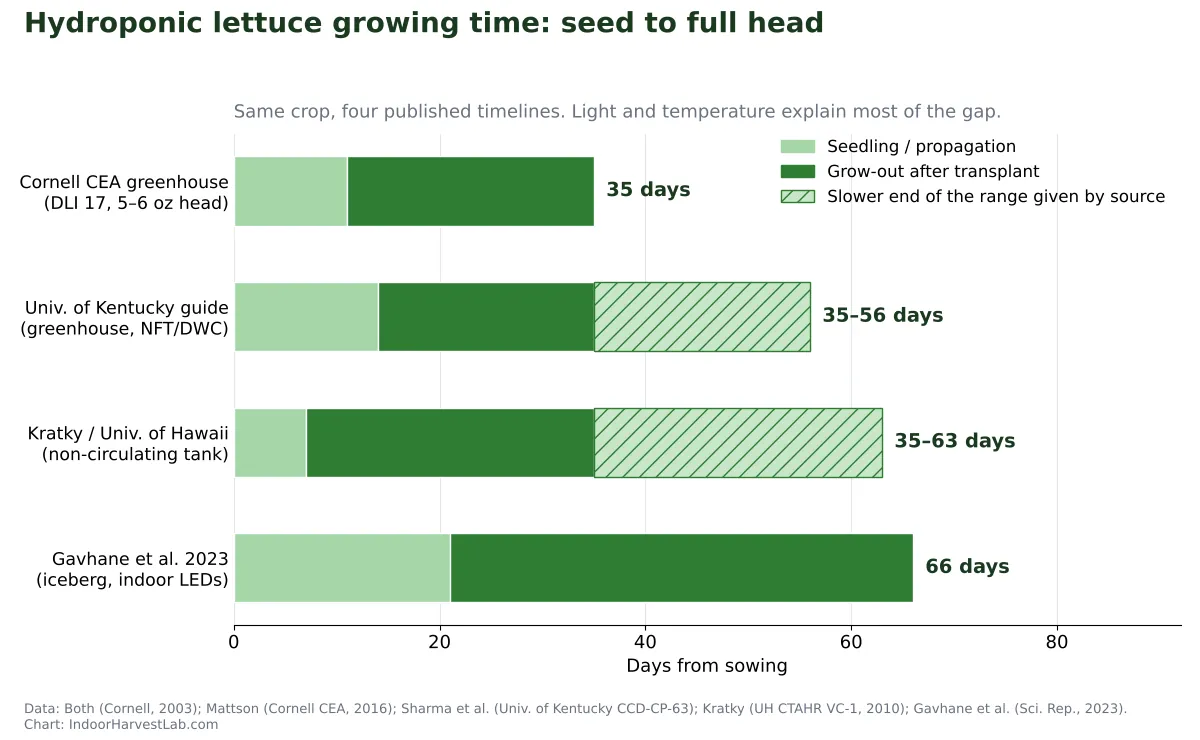
Search for hydroponic lettuce growing time and you’ll find answers from “30 days” to “two months”. Both can be true. The chart at the top of this page lines up four published timelines, and the comparison below shows what each one assumed.
| Source | System and conditions | Seedling stage | After transplant | Seed to harvest |
|---|---|---|---|---|
| Cornell CEA (Both 2003; Mattson 2016) | Greenhouse, DWC/NFT, DLI 17, 75/66°F day/night | 11 days | 24 days | 35 days (about 150 g head) |
| University of Kentucky CCD-CP-63 | Greenhouse NFT/DWC, commercial guide | 14–21 days | 21–35 days | About 35–56 days |
| Kratky, University of Hawaii (VC-1, 2010) | Non-circulating tank, rain shelter | 1–3 weeks | 4–6 weeks (winter takes longer) | About 5–9 weeks |
| Kratky 5-gallon bucket handout | Bucket, seeds sown in the net pot | Included | Included | About 5–7 weeks |
| Gavhane et al. 2023 (Scientific Reports) | Iceberg ‘Glendana’, NFT vertical system, LEDs at 200 µmol·m⁻²·s⁻¹ | About 3 weeks | 45 days | About 66 days |
The pattern is clear. The Cornell crop was pushed with plenty of light, warm days, cool nights and heavily oxygenated water. The Kratky systems run on whatever light a shelter gets, and the iceberg trial used a heading type that needs longer to fill out. Your own lettuce growing time will sit somewhere on this spectrum depending on which of those conditions you can match.
How lettuce type changes the count
Not all lettuce finishes at the same pace. The University of Kentucky notes that romaine is generally more challenging to produce in controlled environments than leaf and butterhead types. Iceberg (crisphead) has to fold its leaves into a dense head, which is why the Gavhane trial ran 45 days after transplant.
- Butterhead and loose-leaf: the types behind Cornell’s 35-day benchmark. These are the best choice when speed matters.
- Salanova-type multi-leaf heads: Johnny’s Selected Seeds gives a range of 35–45 days for hydroponically grown, full-size heads, and notes that the count depends on target weight and growing practices.
- Romaine: slower and fussier indoors, and prone to tipburn as heads get dense.
- Iceberg: the slowest of the common types in hydroponics.
- Baby leaf: the fastest harvest because you don’t wait for a head. Johnny’s advises cutting about 1 inch above the growing point when leaves are 3–4 inches long.
Numbers to hold for the fastest crop
Every row in this table is something you can measure, and together they decide your hydroponic lettuce growing time. If your crop is running long, compare your setup line by line. The gap is usually in the first two rows.
| Factor | Target | Why it matters | Source |
|---|---|---|---|
| Daily light integral, grow-out | 12–17 mol·m⁻²·d⁻¹ (17 with good airflow; 13–14 without) | Growth tracks light; above 17, tipburn risk rises | Both 2003; Mattson 2016; UK CCD-CP-63 |
| Daily light integral, seedlings | Up to 22 mol·m⁻²·d⁻¹ (Cornell research schedule) | Gets seedlings to transplant size in about 11 days | Mattson 2016 |
| Minimum DLI | About 6.5–9.7 mol·m⁻²·d⁻¹ | Below this, lettuce grows very slowly | UK CCD-CP-63 |
| Air temperature | 75°F (24°C) day / 65–66°F (18–19°C) night | Warmer than this invites bolting; colder slows growth | Mattson 2016; UK CCD-CP-63; Both 2003 |
| Germination temperature | 68°F (20°C) | Lettuce seed germinates best here | Mattson 2016; UK CCD-CP-63 |
| Root-zone (water) temperature | Below 68°F (20°C) when air runs warm | Cool roots allowed good growth even with air above 24°C | Both 2003 (Thompson et al. 1998) |
| Dissolved oxygen | 7–8 ppm ideal; at least 4 mg/L | Crop failure seen below 3 ppm | Mattson 2016; Both 2003 |
| pH | 5.5–6.0 | Keeps nutrients available | Mattson 2016; UK CCD-CP-63; UF/IFAS HS1488 |
| EC | About 1.2–1.5 mS/cm (TDS about 800 ppm on a 0.64 meter) | Enough feed without salt stress | Both 2003; Mattson 2016; UF/IFAS HS1488; Kratky 2010 |
| Relative humidity and airflow | 50–70% RH; air moving at 0.3–1.0 m/s (0.7–2.2 mph) | Keeps calcium moving to new leaves | Mattson 2016; UK CCD-CP-63 |
For the full feeding picture, including recipes and mixing order, see hydroponic nutrients for lettuce. If you’re unsure how to read EC versus ppm, the hydroponic EC chart explains the meter scales.
Light: the biggest lever on days to harvest
If you only change one thing, change the light. Cornell’s Neil Mattson puts it plainly: lettuce growth is directly proportional to the amount of light received. In Cornell’s schedule, seedlings reach transplant size in about 11 days at a DLI of 22. At half that DLI they take about 22 days. In the grow-out stage, a DLI of 17 finishes 5–6 oz heads 24 days after transplant. At 8.5, plants take about twice as long, 48 days.
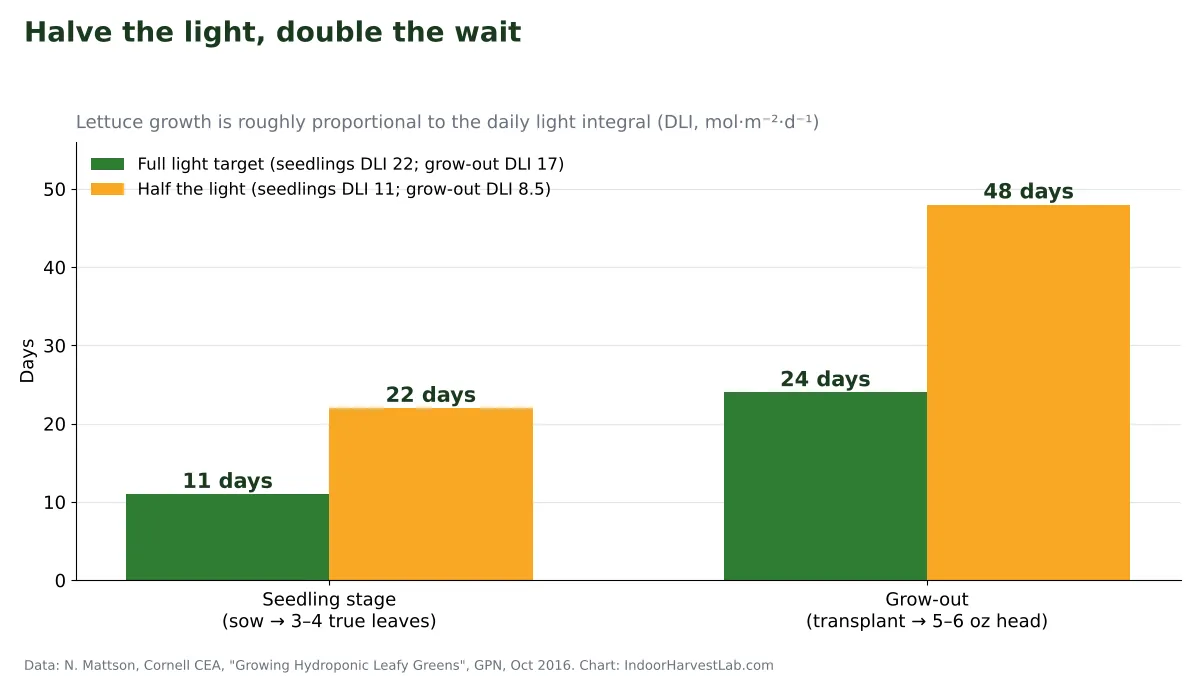
That’s why a windowsill crop or a small, weak LED panel can double your hydroponic lettuce growing time without anything being “wrong”. The plants are simply collecting light more slowly.
Turning DLI into a light setting
DLI is the total light the plants get in a day. To convert, multiply the light intensity (PPFD, in µmol·m⁻²·s⁻¹) by the hours the light is on, then by 0.0036. The rows below are worked out with that formula; Cornell’s own seedling targets are included for comparison.
| Goal | 16 hours on | 18 hours on | 20 hours on |
|---|---|---|---|
| DLI 12 (lower end of the optimal range) | About 210 µmol·m⁻²·s⁻¹ | About 185 | About 165 |
| DLI 14 | About 245 | About 215 | About 195 |
| DLI 17 (Cornell grow-out target) | About 295 | About 260 | About 235 |
| DLI 22 (Cornell seedling target) | 375 (Cornell) | About 340 | About 305 |
A longer photoperiod lets a smaller light reach the same DLI. Gavhane and colleagues (2023) grew iceberg lettuce at 200 µmol·m⁻²·s⁻¹ for 12, 16 or 20 hours, giving DLIs of 8.6, 11.5 and 14.4. Head weight rose from 275.5 g to 393 g as DLI went from 8.6 to 11.5, but dropped again at 14.4, and the authors recommended 11.5 for that cultivar and system. More light helps only up to the point the plant can use it. Our PPFD chart lists targets for other crops.
Why not just blast the light?
Because tipburn sets the ceiling. Cornell found that heads grown above a DLI of 17 developed tipburn, a calcium shortage in the fast-growing inner leaves. Without vertical airflow fans, Mattson recommends a lower target of 13–14. The University of Kentucky adds that a shorter production cycle is itself one of the ways to avoid tipburn, which is why summer crops are often cut a little early. If you’ve already seen brown edges inside your heads, read lettuce tip burn before you raise the light.
Step by step: a 35- to 45-day schedule you can follow
This schedule follows Cornell’s research timing for the shortest hydroponic lettuce growing time but leaves room for home equipment. Each step tells you what to aim for and what tells you it’s time to move on.
Days 0–2: sow and germinate
Pre-soak plugs or cubes in a mild nutrient solution. The University of Kentucky suggests EC 1.0 mS/cm at pH 5.5–6.0. Sow one seed per cell on the surface and keep the room near 68°F (20°C). Cover with a humidity dome, then remove it as soon as seeds emerge, about two days after sowing. If you use rockwool, our rockwool cubes guide explains how to condition the pH first.
Days 2–11 (or up to 21): grow strong seedlings
Give seedlings real light from the start. The University of Kentucky recommends starting at about 50 µmol·m⁻²·s⁻¹ and raising it to 200–300 as seedlings develop. Feed with the same EC 1.0 solution. Cornell’s seedlings reached transplant size by about day 11 under very high light; under typical home lights, 14–21 days is normal.
Transplant day: move them at 3–4 true leaves
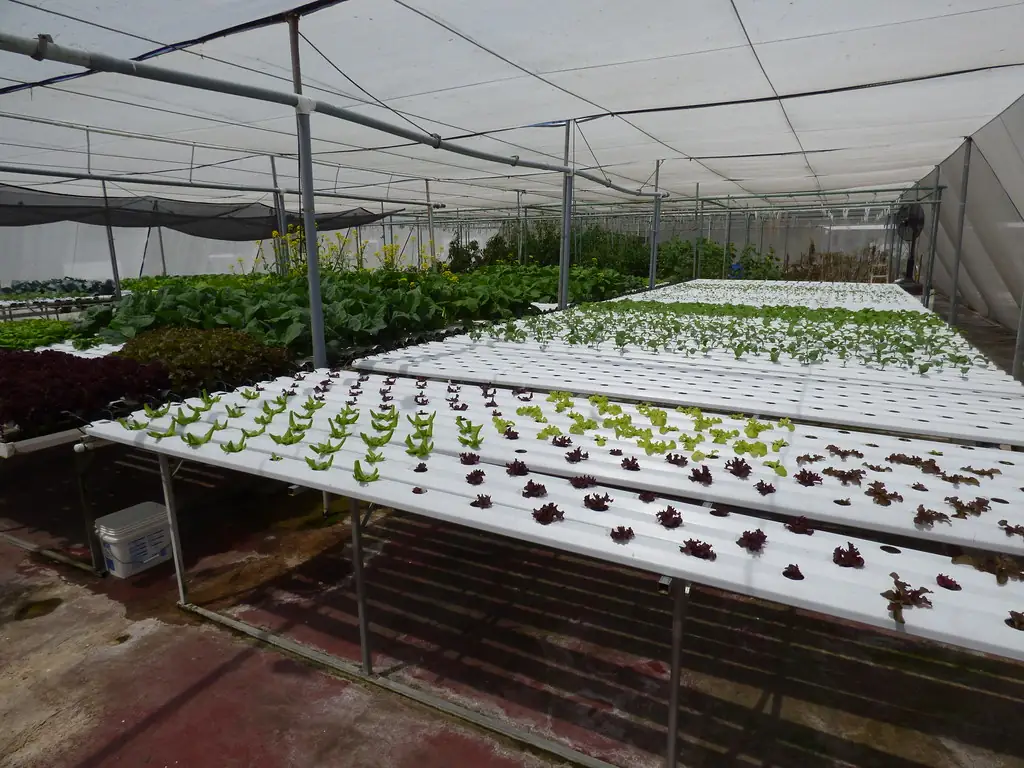
Transplant when seedlings have 3–4 true leaves and roots are poking out of the bottom of the plug. Water seedlings first, and make sure roots touch the nutrient solution in a DWC or NFT system. With so little substrate, a plug can dry out in hours if its roots hang in air.
Days 11–35: grow out at the full targets
Hold the numbers from the table above: DLI 12–17, 75°F days and 65°F nights, pH 5.5–6.0, EC around 1.2–1.5 and well-aerated water. Top up the reservoir every few days and check pH and EC each time. The University of Kentucky suggests a full or partial solution change every 3–4 weeks; our guide to changing hydroponic water covers small home reservoirs. Commercial growers also re-space plants partway through so the leaves don’t shade each other.
Harvest day: pick the right moment
Harvest when heads reach the size you want. The University of Kentucky gives 100–210 g (3.5–7.5 oz) for a full head. Harvest early in the morning, as Kratky recommends. Don’t let heads sit for weeks past maturity: the University of Kentucky warns that heat stress leads to bolting, bitterness and a shorter harvest window.
Why is my hydroponic lettuce growing slowly?
When hydroponic lettuce growing time drags on, the cause almost always comes back to light, temperature or the root zone. Use this table to find the most likely cause before you change anything.
| What you see | Likely cause | What to do |
|---|---|---|
| Healthy color but small plants after 3–4 weeks | Low DLI (under about 10) | Lower the light, extend hours or upgrade the fixture; see the DLI table above |
| Tall, stretched seedlings that flop | Too little light in the seedling stage | Raise light toward 200–300 µmol·m⁻²·s⁻¹ (UK Extension) |
| Slow growth in a cold room in winter | Air near 50–59°F (10–15°C) | Lettuce tolerates this, but growth slows; warm the room toward 65–75°F |
| Brown, slimy roots and wilting | Warm water, low dissolved oxygen | Keep water below 68°F, add aeration; see hydroponic root rot |
| Pale new leaves, slow growth | EC too low, or pH out of range | Check EC (about 1.2–1.5) and pH (5.5–6.0) |
| Brown edges on inner leaves | Tipburn from too much light without airflow | Add a fan, lower DLI to 13–14, harvest a little early |
| Center stretching upward, bitter taste | Bolting from heat | Keep days under 75°F; choose bolt-resistant cultivars |
One more check is often overlooked: seed age. Old seed germinates slowly and unevenly, which can cost you a week before the crop has even started. If yours have been stored warm, check our seed viability chart and test a few first.
From the lab bench
Here’s the way I’d read the research if you want to predict your own timeline instead of guessing.
Think in accumulated light, not days. Cornell’s growth models tied final head weight to the total light a plant received since sowing. In other words, days are just a proxy. A crop at DLI 17 collects in 24 days roughly what a crop at 8.5 collects in 48. Once you know your DLI, you can estimate your hydroponic lettuce growing time before you sow a single seed.
Treat temperature as the brake, and light as the accelerator. The University of Kentucky notes that lettuce tolerates nights as low as 50°F and days of 59°F. It survives. It just grows more slowly. A cool basement under a strong light will still out-pace a warm windowsill in December, because light is the bigger limit.
Don’t chase the ceiling. The Gavhane study is a useful warning: the highest DLI wasn’t the best. At home, where airflow is often weak and humidity high, a DLI of 12–14 is a sensible target. You give up a few days, but you lose far fewer heads to tipburn.
Plan in batches. Kratky points out that growers who keep plants at several stages can harvest one tank and replant it the same day. At home, sowing a few seeds every week or two gives you steady salads instead of a glut.
FAQ
How long does hydroponic lettuce take to grow?
Under research conditions, about 35 days from seed to a 5–6 oz head: 11 days as a seedling and 24 days after transplant at a DLI of 17 (Cornell CEA). Most home systems take 5–9 weeks because they give less light.
How many days after transplant is hydroponic lettuce ready?
About 21–35 days after transplanting, according to University of Kentucky Extension. Cornell reached 5–6 oz heads in 24 days at a DLI of 17. Winter crops under weaker light take longer.
Does hydroponic lettuce grow faster than soil lettuce?
It can, because the roots always have water, oxygen and nutrients. In practice, light and temperature still set the pace. A hydroponic system under weak light won’t beat a well-lit soil crop.
How can I make hydroponic lettuce grow faster?
Raise the daily light integral toward 12–17 mol·m⁻²·d⁻¹, keep days near 75°F and nights near 65°F, keep water below 68°F with good aeration, and hold pH at 5.5–6.0 and EC near 1.2–1.5.
How long does Kratky lettuce take?
University of Hawaii researcher B.A. Kratky reports leaf and semi-head lettuce is ready about 4–6 weeks after transplanting 1–3-week-old seedlings, or about 5–7 weeks when seeds are sown directly in a bucket.
Can you regrow hydroponic lettuce after harvest?
Leaf and baby-leaf types can be cut above the growing point and allowed to regrow. Johnny’s suggests cutting about 1 inch above the growing point for baby leaf. Full heads are usually harvested whole and replanted.
What light schedule is best for hydroponic lettuce?
There’s no single best schedule; the daily total matters. Longer hours let a weaker light reach the same DLI. For example, about 295 µmol·m⁻²·s⁻¹ for 16 hours or about 235 for 20 hours both give a DLI near 17.
Sources
- Both, A.J. (2003). Ten Years of Hydroponic Lettuce Research. Cornell University Controlled Environment Agriculture / Rutgers University.
- Mattson, N. (2016). Growing Hydroponic Leafy Greens. Greenhouse Product News, October 2016. Cornell University CEA.
- Sharma, A., Leonberger, K., Gauthier, N. and Ying, Q. Hydroponic Lettuce Production in Controlled Environments (CCD-CP-63). University of Kentucky Center for Crop Diversification.
- Kratky, B.A. (2010). A Suspended Pot, Non-Circulating Hydroponic Method for Leafy, Romaine, and Semi-Head Lettuce (VC-1). University of Hawaii CTAHR.
- Kratky, B.A. Growing lettuce in a 5 gallon bucket. University of Hawaii CTAHR.
- Eason, H. (2025). “Set It and Forget It” Hydroponic Lettuce (HS1488). University of Florida IFAS Extension.
- Gavhane, K.P., Hasan, M., Singh, D.K., Kumar, S.N., Sahoo, R.N., Alam, W. et al. (2023). Determination of optimal daily light integral (DLI) for indoor cultivation of iceberg lettuce in an indigenous vertical hydroponic system. Scientific Reports.
- Johnny’s Selected Seeds. Salanova® Hydroponic Green Sweet Crisp Pelleted Lettuce Seed: growing information.