
You sowed a full tray of lettuce on Saturday, set it somewhere nice and warm, maybe even on a heat mat, and waited. By Wednesday your tomatoes in the next tray are up, but the lettuce cells are still bare. The seed was new. The mix was moist. So what went wrong?
Short answer: lettuce seed germination works best in a cool room, about 60–70°F (16–21°C), with the seed on or just under the surface where it can see light. At those temperatures lettuce emerges in 2–4 days. Above roughly 77–86°F (25–30°C), many varieties go into a heat-triggered dormancy called thermoinhibition and simply wait, which is why warm rooms and heat mats so often give patchy trays.
This guide gives you the temperature data behind that answer, a step-by-step sowing method for trays and hydroponic cubes, a troubleshooting table and the numbers commercial growers use. By the end you’ll know exactly why your lettuce stalled and how to get even, fast emergence every time.
Why Lettuce Seed Germination Is Different
Most vegetable seeds you start indoors want warmth. Tomatoes, peppers and squash all germinate faster as the mix warms toward 80°F or more. Lettuce breaks that rule in two ways, and both trip up indoor growers.
1. Lettuce germinates better with light
Iowa State University Extension lists lettuce as a crop that needs light to germinate (an “L” in its germination table) and gives 60–70°F as the germination temperature (Iowa State University Extension). That is the practical reason seed packets say to sow lettuce shallowly. Bury it half an inch deep like a bean and you take away one of its germination signals.
The biology behind this is classic plant physiology. Lettuce seeds read light through phytochrome, a pigment that responds to red light. In lettuce, light switches on gibberellin (GA) production through phytochrome, and gibberellin is one of the hormones that pushes the seed to germinate (Argyris et al., 2008).
2. Heat puts lettuce seed to sleep
The second quirk is thermoinhibition. Seeds of the standard iceberg variety ‘Salinas’ fail to germinate when they absorb water at temperatures above 25–30°C (77–86°F) (Argyris et al., 2008). The seed is not dead. A heat-sensitive gene in the abscisic acid (ABA) pathway switches on, ABA builds up and the seed holds still until conditions cool down.
From the seed’s point of view this is clever: a cool-season plant that sprouts in a heatwave would likely bolt or die. From your point of view, it means the warm spot that works for peppers can stop lettuce in its tracks.
Light and heat interact. Red light can raise the upper temperature limit for lettuce seed germination, while ABA lowers it (Argyris et al., 2008). In the same study, both lettuce lines tested were unable to germinate at 35°C (95°F) in the dark. So a seed that is both too warm and too deep is getting a double “no”.
Lettuce Seed Germination Numbers to Hold
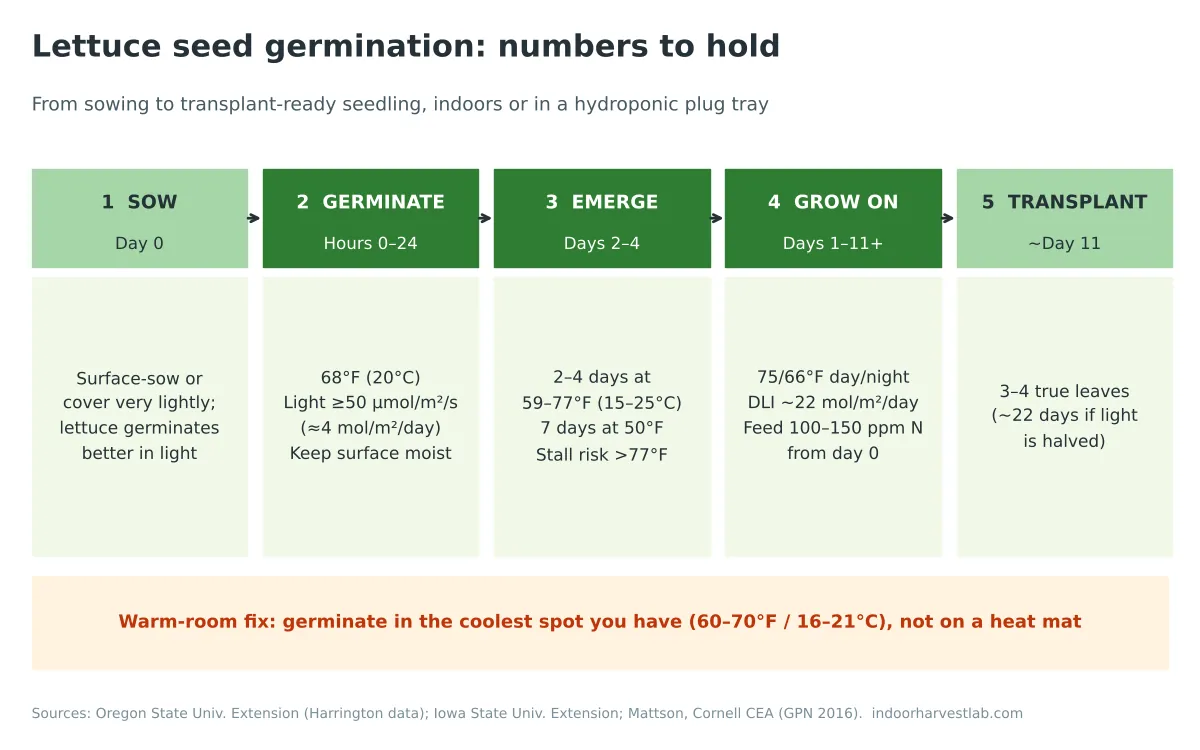
Here are the targets in one place. Every value comes from the sources listed at the end of the article; the commercial figures are from Cornell’s controlled-environment agriculture (CEA) program, which grows hydroponic lettuce on a tight schedule.
| What | Target | Source |
|---|---|---|
| Germination temperature (home growers) | 60–70°F (16–21°C) | Iowa State Univ. Extension |
| Optimum range for lettuce seed | 18–21°C (64–70°F) | Wei et al., 2020 |
| Soil temperature range that works | 40–80°F (4–27°C); optimum 75°F, minimum 35°F, maximum 95°F | Oregon State Univ. Extension |
| Where problems start | Above 25–30°C (77–86°F) for heat-sensitive varieties | Argyris et al., 2008 |
| Sowing depth | On the surface or very lightly covered (light helps) | Iowa State; Mattson, Cornell CEA |
| First 24 hours (commercial) | 68°F (20°C); light at least 50 µmol/m²/s or a DLI of 4 mol/m²/day | Mattson, Cornell CEA (2016) |
| Seedling stage (commercial) | 75/66°F day/night; DLI about 22 mol/m²/day | Mattson, Cornell CEA (2016) |
| Feeding | 100–150 ppm nitrogen from day 0, complete fertilizer | Mattson, Cornell CEA (2016) |
| Transplant-ready | 3–4 true leaves, about day 11 under optimal light (about 22 days at half the DLI) | Mattson, Cornell CEA (2016) |
Not sure how PPFD and DLI relate to your light? Our PPFD chart for indoor crops converts between them for any photoperiod.
Lettuce Seed Germination Temperature: What the Data Show
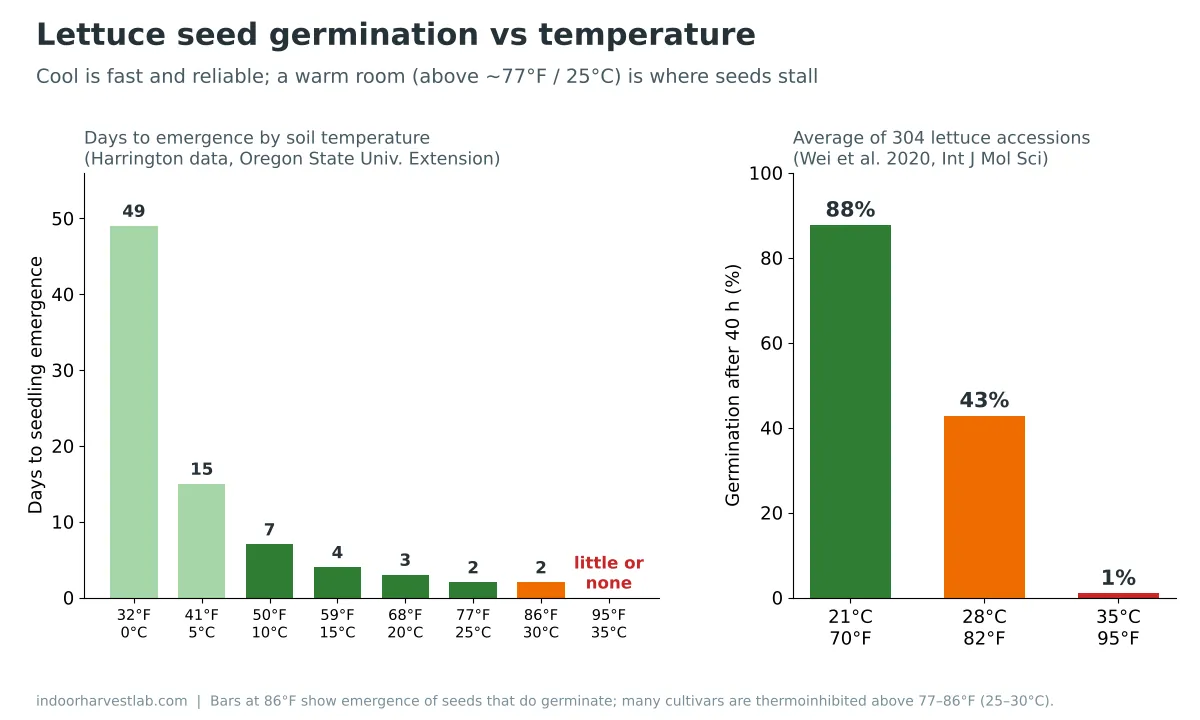
Two data sets tell the whole story. The first is the long-standing Harrington data published by Oregon State University Extension, which measured how many days it takes lettuce to emerge at different soil temperatures (Oregon State University Extension).
| Soil temperature | Days to emergence (lettuce) |
|---|---|
| 32°F (0°C) | 49 |
| 41°F (5°C) | 15 |
| 50°F (10°C) | 7 |
| 59°F (15°C) | 4 |
| 68°F (20°C) | 3 |
| 77°F (25°C) | 2 |
| 86°F (30°C) | 2 |
| 95°F (35°C) | Little or no germination |
| 104°F (40°C) | Little or no germination |
Read that table carefully. Emergence speeds up steadily from near freezing to the mid-70s °F, and lettuce still sprouts in a week at 50°F, a temperature where tomatoes and peppers crawl along. Then it falls off a cliff: by 95°F there is little or no germination.
The second data set shows how variable the middle zone is. Researchers at the Shanghai Agrobiological Gene Center germinated seed from 304 lettuce accessions for 40 hours at three temperatures (Wei et al., 2020):
- 21°C (70°F): all 304 germinated well, averaging 87.72%.
- 28°C (82°F): the average dropped to 42.84%.
- 35°C (95°F): germination fell to 1.01%.
So the 86°F row in the Oregon table is the speed of the seeds that do germinate. Whether yours do depends on the variety, and in a mixed or unknown packet, roughly half may sit out a warm spell. That is the patchy tray from the opening paragraph.
If you’re starting several crops at once, our seed germination temperature chart puts lettuce side by side with tomatoes, peppers and herbs so you can group trays by temperature instead of by convenience.
How to Germinate Lettuce Seeds Indoors, Step by Step
This method works for soil-mix cell trays, small pots and open flats. The hydroponic version follows in the next section.
Step 1: Check the seed
Seed vigor drops with age and with warm, humid storage, so an old packet is a common cause of poor lettuce seed germination. If your seed is more than a couple of years old or was stored somewhere warm, run a quick 10-seed test first. Our guide on how long seeds last walks you through it, and the paper towel germination method works well for lettuce as long as the towel stays in a cool, lit spot rather than on top of the fridge.
Step 2: Fill and pre-moisten the cells
Use a fine, fluffy seed-starting mix. Moisten it before you sow, so the tiny seeds don’t wash into corners when you water. The surface should feel like a wrung-out sponge.
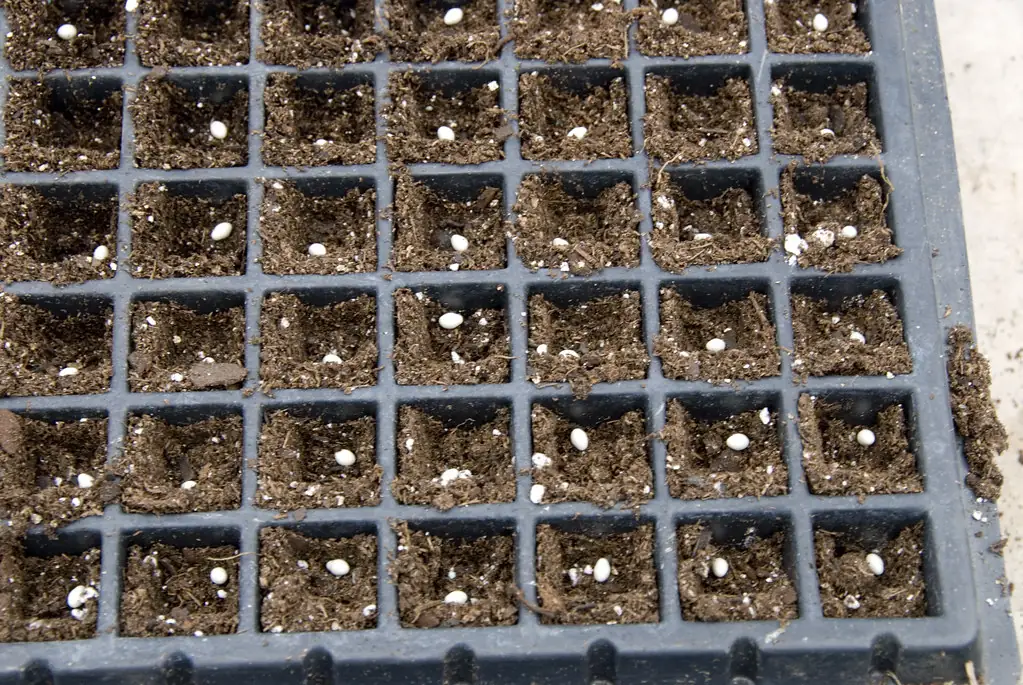
Step 3: Sow on the surface
Drop 1–2 seeds per cell (or one pelleted seed) and press them gently into contact with the mix. Either leave them uncovered or dust a very thin layer of fine vermiculite over the top. Cornell’s commercial lettuce system surface-sows seed into 1-inch cells of rockwool, Oasis or other substrate (Mattson, 2016).
Step 4: Keep the surface moist, not wet
Because the seed sits on top, the top few millimetres must not dry out in the first 2–4 days. A clear humidity dome does this job well. Take it off as soon as most cells show green; our guide on when to remove a humidity dome explains why leaving it on invites damping off.
Step 5: Choose a cool, bright spot
Aim for 60–70°F. In most homes that means a basement shelf, a cool bedroom or an unheated spare room in winter, not the top of the fridge and not a heat mat. If you already use a heat mat for peppers, unplug it under the lettuce tray or move the lettuce off it.
Turn your grow light on from day 0. Unlike most seeds, lettuce benefits from light during germination, and seedlings that emerge in the dark start stretching within hours.
Step 6: Give strong light as soon as they emerge
Cornell keeps lettuce seedlings at 75/66°F day/night under a DLI of about 22 mol/m²/day, which they reach with 250 µmol/m²/s for 24 hours or 375 µmol/m²/s for 16 hours (Mattson, 2016). At home you don’t need to match that, but the same study notes that with half the light, seedlings took twice as long to reach transplant size. Weak light is also the main cause of leggy seedlings.
Step 7: Thin and feed
Snip extra seedlings at the soil line once true leaves appear, leaving the strongest one per cell. Start a dilute complete fertilizer early; Cornell feeds lettuce seedlings at 100–150 ppm nitrogen from day 0 in its commercial system.
Germinating Lettuce Seeds for Hydroponics
Hydroponic growers face the same two rules, with a twist: cubes and plugs sit right next to warm pumps, ballasts and lights. Here is how two university research programs set up lettuce seed germination for hydroponic production.
| Setting | Cornell CEA (Mattson, 2016) | Cornell CEA trials (Both, 2003) |
|---|---|---|
| Substrate | 1-inch cells of rockwool, Oasis or similar | Peat-vermiculite 1:1 in trials; rockwool more practical commercially |
| Seed placement | Surface-sown | Plug trays |
| Temperature | 68°F (20°C) for first 24 h, then 75/66°F | Constant 24°C (75°F) growth room |
| Light | ≥50 µmol/m²/s during germination, then about 22 mol/m²/day DLI | About 200 µmol/m²/s |
| Humidity | Not specified | Clear cover for the first 2 days |
| Time to transplant | About 11 days at full light | 11 days in the growth room |
A few practical notes for home systems:
- Rockwool: soak and pH-adjust cubes before sowing (rockwool starts alkaline), then press the seed into the top of the cube instead of dropping it into the deep hole.
- Pelleted seed: the clay coating makes tiny lettuce seeds easy to place, but it must stay evenly moist so it softens and splits. Water gently from below or mist.
- Kratky and DWC: germinate in cubes first, then move to the net pot once roots poke out of the bottom. Our Kratky method guide covers the water-level part.
- Heat sources: keep propagation trays away from pumps, ballasts and the warm air at the top of a grow tent. A thermometer at seed level tells you more than the room thermostat.
When your seedlings are ready, our guide to growing lettuce indoors takes it from transplant to harvest, and the lettuce tip burn guide helps you avoid the most common problem in fast hydroponic lettuce.
Lettuce Seeds Not Germinating? Troubleshooting Table
Use this table to match what you see with the likely cause. Start with temperature: it explains more failed lettuce trays than everything else combined.
| What you see | Likely cause | What to do |
|---|---|---|
| Nothing after 5–7 days; tray on a heat mat or near a heater | Thermoinhibition (seed too warm) | Move to 60–70°F; most seeds then germinate within days |
| Patchy emergence in summer or a warm room | Variety differences in heat tolerance | Germinate somewhere cooler, or sow at night in a cool spot |
| Nothing after 10+ days in a cold room (around 40–50°F) | Slow germination at low temperature | Be patient (about 7 days at 50°F, 15 at 41°F) or move somewhere slightly warmer |
| Seed buried 1/4 inch or deeper; poor emergence | Too little light reaching the seed | Resow on the surface or under a dusting of vermiculite |
| Pelleted seed sitting whole and dry | Coating never softened | Keep surface evenly moist; use a dome for the first days |
| Old packet, slow and uneven emergence | Low seed vigor | Run a 10-seed test; buy fresh seed |
| Seedlings up but tall and floppy | Not enough light after emergence | Light from day 0; raise intensity; lower the fixture |
| Seedlings collapse at the soil line | Damping off | Remove dome, improve airflow, avoid overwatering |
From the Lab Bench
If you take one idea away from the research, make it this: a lettuce seed that won’t germinate in a warm room is not broken. It is making a decision. The ABA pathway behaves like a thermostat built into the seed, and in heat-sensitive varieties it is set low. That is why moving a stalled tray to a cooler spot so often works.
The light requirement fits the same logic. A tiny seed buried deep has little stored food to reach the surface, so lettuce has evolved to germinate when it senses light, a sign that it is near the top. The useful practical point from Argyris and colleagues is that red light can raise the upper temperature limit for germination. In plain terms, a lit seed tolerates a bit more warmth than a dark one. Surface sowing under a grow light gives you a small buffer.
Commercial growers solve the heat problem with seed priming: controlled partial hydration followed by drying, which is used commercially to improve germination and reduce thermoinhibition (Eckhardt et al., 2024). In one study published in Acta Horticulturae, primed seed of the heat-sensitive butterhead ‘Dark Green Boston’ germinated 100% at 35°C (95°F), compared with only 4% for unprimed seed (Nascimento et al., 2000). If you sow in summer or in a hot apartment, primed lettuce seed is worth looking for. For the rest of the year, a cool shelf does the same job for free.
One more rule of thumb: group your trays by temperature, not by sowing date. Lettuce, spinach and other cool-season crops share one cool, bright shelf. Tomatoes and peppers get the heat mat. Mixing them on one mat is the single most common reason the lettuce side fails.
FAQ
How long does lettuce seed germination take?
At 59–77°F (15–25°C), lettuce usually emerges in 2–4 days, according to Oregon State University Extension data. It takes about 7 days at 50°F and around 15 days at 41°F. Above about 86°F, many varieties stall.
Do lettuce seeds need light to germinate?
Light helps. Iowa State University Extension lists lettuce as needing light for germination, so sow it on the surface or under a very thin layer of fine vermiculite rather than burying it.
What temperature is too hot for lettuce seeds?
Problems start above about 77–86°F (25–30°C) for heat-sensitive varieties. In a study of 304 lettuce accessions, average germination fell from 88% at 70°F to 43% at 82°F and about 1% at 95°F.
Should I use a heat mat for lettuce seeds?
Usually no. Lettuce germinates well at normal room temperature or cooler, about 60–70°F. A heat mat can push the seed into heat dormancy and leave you with a patchy tray.
How deep should I plant lettuce seeds?
Plant them on the surface or very lightly covered. Commercial hydroponic growers at Cornell surface-sow lettuce into 1-inch cubes of rockwool or similar substrate.
Why are my lettuce seeds not germinating?
The most common reasons are a seed tray that is too warm, seed buried too deep, a surface that dried out, or old seed. Move the tray to a cool, lit spot, keep the surface moist, and test old seed with a 10-seed germination test.
Can I germinate lettuce seeds in a paper towel?
Yes. Keep the towel damp in a clear bag or container somewhere cool (60–70°F) and lit, not on top of the fridge, and transfer seeds as soon as the root tip appears.
Sources
- Oregon State University Extension Service. Soil temperature conditions for vegetable seed germination. https://extension.oregonstate.edu/gardening/soil-compost/soil-temperature-conditions-vegetable-seed-germination
- Iowa State University Extension and Outreach. Germination requirements for annuals and vegetables. https://yardandgarden.extension.iastate.edu/how-to/germination-requirements-annuals-and-vegetables
- Argyris J, Dahal P, Hayashi E, Still DW, Bradford KJ. (2008). Genetic variation for lettuce seed thermoinhibition is associated with temperature-sensitive expression of abscisic acid, gibberellin, and ethylene biosynthesis, metabolism, and response genes. Plant Physiology 148(2):926–947. doi:10.1104/pp.108.125807
- Wei S, et al. (2020). Distinct metabolome changes during seed germination of lettuce (Lactuca sativa L.) in response to thermal stress as revealed by untargeted metabolomics analysis. International Journal of Molecular Sciences 21(4):1481. doi:10.3390/ijms21041481
- Nascimento WM, Cantliffe DJ, Huber DJ. (2000). Endo-β-mannanase activity during lettuce seed germination at high temperature conditions. Acta Horticulturae 517:107–112. doi:10.17660/ActaHortic.2000.517.12
- Mattson N. (2016). Growing hydroponic leafy greens. GPN, October 2016. Cornell University CEA. cea.cals.cornell.edu (PDF)
- Both AJ. (2003). Ten years of hydroponic lettuce research. Rutgers University (summary of Cornell CEA hydroponic lettuce research). PDF
- Eckhardt J, et al. (2024). Chemical disruption of ABA signaling overcomes high-temperature inhibition of seed germination and enhances seed priming responses. PLoS One 19(12):e0315290. doi:10.1371/journal.pone.0315290