
Your lettuce looked great for the first ten days. Now the outer leaves are fading to a pale yellow-green, the heads aren’t filling out, and the bottle on the shelf says “for all plants” in big friendly letters. You start wondering whether lettuce needs something different, or just more of the same.
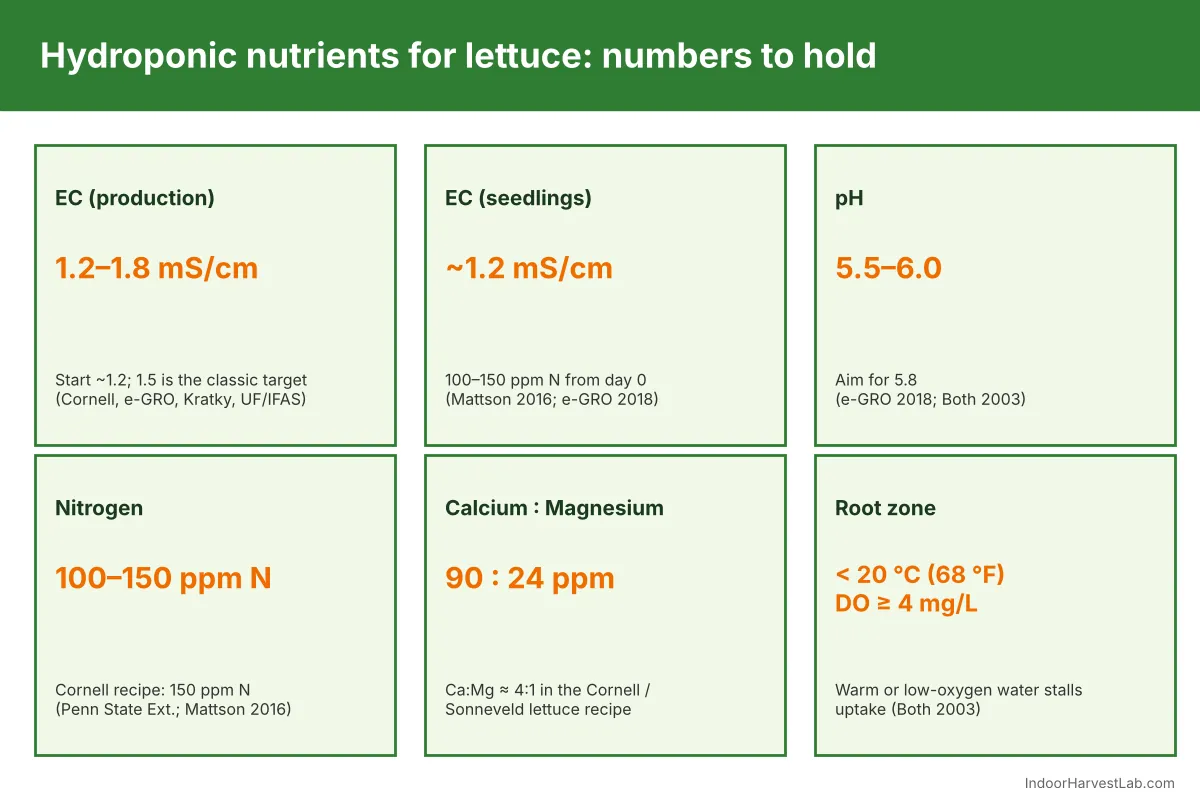
Short answer: the best hydroponic nutrients for lettuce are a complete, calcium-containing fertilizer mixed to about 100–150 ppm nitrogen, which reads roughly 1.2–1.8 mS/cm EC, held at pH 5.5–6.0 (aim for 5.8). Cornell’s long-running lettuce program uses a recipe with 150 ppm N, 210 ppm K and 90 ppm Ca at an EC of about 1.5. Lettuce is a light feeder, so more fertilizer rarely means more lettuce.
In this guide you’ll get the element-by-element targets that university research actually uses, a “numbers to hold” table, an honest comparison of one-part, two-part and DIY nutrient approaches, a step-by-step reservoir mix (including a proven two-part recipe from the University of Hawaii), and a symptom table for when the leaves start telling you something is off. By the end, you’ll be able to mix a lettuce reservoir with confidence and fix it when it drifts.
What hydroponic nutrients for lettuce need to supply
Lettuce is a fast, leafy crop with no fruit to fill, so its appetite is modest. The e-GRO nutritional factsheet from NC State, Michigan State and Iowa State classes lettuce as a medium feeder and recommends 1.0–2.0 mS/cm for hydroponic solutions, with pH held between 5.5 and 6.0 and an optimum of 5.8 (Henry et al., 2018).
What matters most is balance, not strength. Lettuce needs plenty of nitrogen and potassium for leaf growth, steady calcium for the soft new leaves in the centre of the head, and small but reliable amounts of iron and other micronutrients. A “grow” formula built for tomatoes or cannabis can work, but it is usually mixed far stronger than lettuce wants.
The table below shows the full recipe Cornell’s Controlled Environment Agriculture (CEA) group has used for years: Sonneveld’s hydroponic lettuce solution, supplied at 150 ppm nitrogen (Mattson, 2016). Penn State Extension reprints the same values as a model recipe for leafy crops and herbs (Penn State Extension, 2024).
| Element | Target in the tank (ppm = mg/L) | Why lettuce cares |
|---|---|---|
| Nitrogen (N) | 150 | Drives leaf expansion and green colour; shortage shows first as pale lower leaves |
| Phosphorus (P) | 31 | Root growth and energy transfer; lettuce needs surprisingly little |
| Potassium (K) | 210 | Water balance, leaf turgor and sugar movement; the largest single nutrient by weight |
| Calcium (Ca) | 90 | Builds cell walls in young leaves; poor delivery causes tipburn |
| Magnesium (Mg) | 24 | Centre of the chlorophyll molecule |
| Sulfur (S) | 32 | Proteins and flavour compounds |
| Iron (Fe) | 1.0 | Chlorophyll production in new leaves; locks up as pH climbs |
| Manganese (Mn) | 0.25 | Photosynthesis enzymes |
| Zinc (Zn) | 0.13 | Growth hormones and enzymes |
| Boron (B) | 0.16 | Cell-wall formation at the growing point |
| Copper (Cu) | 0.023 | Enzyme function |
| Molybdenum (Mo) | 0.024 | Nitrate processing inside the leaf |
Rutgers researcher A.J. Both describes Cornell’s optimum solution as closely resembling a half-strength Hoagland solution (Both, 2003). That’s a useful mental anchor: if a general-purpose nutrient’s label rate is built for heavy fruiting crops, half to two-thirds of it is often the right neighbourhood for lettuce. Your EC meter, not the label, has the final word.
Numbers to hold for hydroponic lettuce nutrients
Every source uses slightly different units, so here’s the shortlist pulled into one place. If you only remember one row, make it EC 1.2–1.8 with pH 5.8. For a deeper dive into conversion factors, our PPM to EC conversion guide explains why one meter’s “800 ppm” is another meter’s “1,100 ppm”.
| Parameter | Target | Source |
|---|---|---|
| EC, seedlings / germination | ≈1.2 mS/cm (100–150 ppm N) | e-GRO (Henry et al., 2018); Mattson (2016) |
| EC, production | 1.5 mS/cm typical; 1.2–1.8 working range | Mattson (2016); Kratky (UH CTAHR); Vought et al. (2025) |
| EC, research trials on RO water | 1.15–1.25 mS/cm | Both (2003) |
| EC, same crop on municipal water | 1.65 mS/cm | Both (2003) |
| Source water EC before nutrients | Below 0.2 mS/cm ideal | Kratky (UH CTAHR) |
| pH | 5.5–6.0; aim for 5.8 | e-GRO (2018); Mattson (2016); Both (2003): 5.6–6.0 |
| Nitrogen | 100–150 ppm N | Penn State Extension (2024); Mattson (2016) |
| Dissolved oxygen | ≥4 mg/L; Cornell aims for 7–8 ppm and saw crop failure below 3 ppm | Both (2003); Mattson (2016) |
| Solution temperature | Below 20 °C (68 °F) | Both (2003), citing Thompson et al. (1998) |
| Air temperature | 75/66 °F (24/19 °C) day/night | Mattson (2016) |
| Light (for context) | DLI 17 mol·m⁻²·d⁻¹ max for head lettuce without tipburn | Both (2003); Mattson (2016) |
Why list light and temperature in a nutrient article? Because they set how much the plant can use. Cornell found lettuce growth is roughly proportional to light received: halve the DLI and the crop takes about twice as long (Mattson, 2016). Under a weak winter windowsill, a strong solution just sits in the tank. If your light is the bottleneck, our PPFD chart shows how to check it.
Choosing hydroponic nutrients for lettuce: 3 approaches compared
Penn State Extension groups nutrient strategies into three families: a single complete fertilizer, a fertilizer program (a base product plus calcium nitrate and magnesium sulfate), and a from-scratch recipe built from individual salts (Penn State Extension, 2024). All three can grow excellent lettuce. They differ in effort, cost and how much control you get.
| Approach | What you buy | Pros | Cons | Best for |
|---|---|---|---|---|
| One-part complete fertilizer | One soluble product with N-P-K plus micronutrients (e.g. a 20-10-20 type) | Simplest; one container, one measuring scoop | Many lack enough calcium and magnesium; can’t fix one element on its own | Small Kratky jars, countertop units with soft water |
| Two-part program (A + B) | A lettuce or “hydroponic” base (with Mg and micros) plus calcium nitrate, mixed as separate stocks | Calcium supplied properly; little maths; proven on lettuce | Two stocks to keep apart; still fixed ratios | Most home DWC, NFT and Kratky growers |
| DIY salt recipe | Calcium nitrate, potassium nitrate, mono-potassium phosphate, magnesium sulfate, chelated iron and micronutrient salts | Cheapest per litre; adjust for your water’s own minerals | Needs a 0.01 g scale for micronutrients and careful arithmetic | Larger systems, growers who test their water |
For most home growers, the two-part approach hits the sweet spot. Lettuce is famously prone to tipburn, a calcium-delivery disorder of the youngest leaves, and calcium nitrate is the simplest way to supply calcium. The e-GRO factsheet points to calcium nitrate as a tool against tipburn and stresses it must be kept in a separate stock tank so calcium doesn’t precipitate out (Henry et al., 2018). If you’ve already met brown leaf edges, our lettuce tip burn guide covers airflow and light fixes too.
What about one-part “all-in-one” bottles?
They’re fine when they contain calcium and your water is soft. Penn State’s main warning about complete fertilizers is that they may not provide the right balance, and some leave out calcium and magnesium entirely. Read the guaranteed analysis: if it lists no calcium, plan on adding a calcium source, or read our cal-mag guide to see whether your tap water already covers it.
Nitrate or ammonium nitrogen?
Penn State notes that ammonium is used immediately and can push soft, excessive growth in poor light, with ammonium toxicity showing as yellowing and dead growing points. Nitrate is stored in the plant and holds growth steadier, which suits cool weather and lower light (Penn State Extension, 2024). For indoor winter lettuce, choose a formula where most of the nitrogen is nitrate.
How to mix hydroponic nutrients for lettuce, step by step
This routine works for a deep water culture tote, an NFT loop or a passive Kratky tank. The numbers come from the University of Hawaii’s two-part lettuce program developed by B.A. Kratky, which uses a hydroponic base fertilizer (8-15-36) with magnesium sulfate in stock A and calcium nitrate in stock B (Kratky, UH CTAHR).
Step 1: Test your source water
Measure the EC of plain water before adding anything. Kratky’s notes say the water should read below 0.2 mS/cm and must not be salty (Kratky, UH CTAHR). Hard tap water already carries calcium and magnesium, which is why Both’s team ran lettuce at 1.65 mS/cm on municipal water versus about 1.2 on RO water. Our tap water for hydroponics guide walks through what a water report tells you.
Step 2: Make two separate stock solutions
Kratky’s commercial-scale stocks are 1 lb per gallon: stock A is 1 lb of 8-15-36 plus 0.6 lb of magnesium sulfate per gallon of stock; stock B is 1 lb of soluble-grade calcium nitrate per gallon. Each gets its own measuring cup and stirring stick, because the concentrates react if they meet. Once diluted in the tank, they don’t.
Step 3: Add A, stir, then add B
Kratky’s rate is ½ fl oz (1 tablespoon) of stock A and ½ fl oz of stock B per gallon of water, which gives about 1.5 mS/cm. In his 4 × 8 ft tank holding 100 gallons, that’s 50 oz of each stock. Add A first, stir thoroughly, then add B. Never pour the two concentrates into the same jug.
Step 4: No stocks? Use the dry equivalent
For a small tote it’s easier to weigh powder. Working the Kratky rate backwards (our arithmetic from 1 lb per gallon of stock and 1 tablespoon per gallon of tank water), each gallon of tank water receives roughly:
- 1.8 g of the 8-15-36 base fertilizer
- 1.1 g of magnesium sulfate (Epsom salt)
- 1.8 g of calcium nitrate
- For a 5-gallon tote: about 9 g base, 5.3 g magnesium sulfate and 9 g calcium nitrate, each dissolved separately before mixing
If your base fertilizer has a different analysis, check the EC rather than trusting the grams. A complete fertilizer can also be dosed by nitrogen: Penn State suggests 100–150 ppm N for lettuce. Grams per litre equals the target ppm divided by (the %N × 10), so a 20-10-20 product at 150 ppm N needs 150 ÷ 200 = 0.75 g/L, or about 2.8 g per US gallon.
Step 5: Check EC, then set pH last
Read the EC after everything has dissolved and adjust with water or more stock until you’re in the 1.2–1.8 band. Then adjust pH toward 5.8; fertilizer salts shift pH, so setting it first wastes acid. Our guides to hydroponic pH targets and the hydroponic EC chart cover the details for other crops in the same tank.
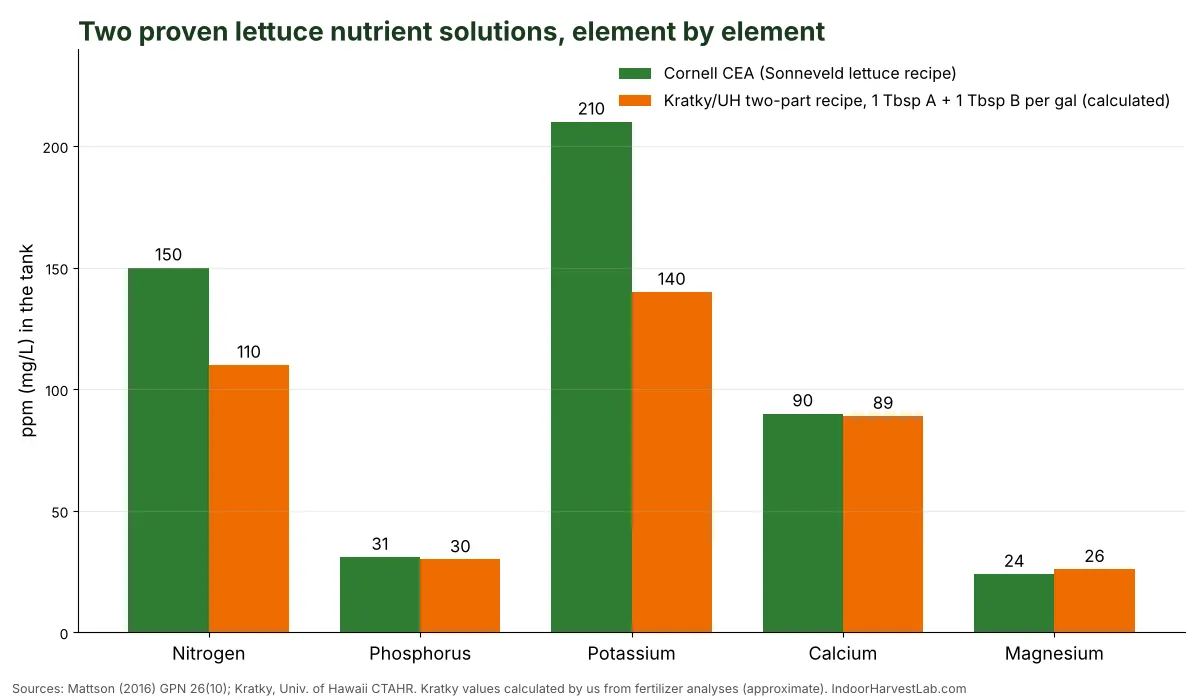
How do the two proven recipes compare? Our calculation shows the Kratky dilution lands remarkably close to Cornell’s recipe for phosphorus, calcium and magnesium, but with about a quarter less nitrogen and a third less potassium. Both produce marketable lettuce, which is a good reminder that lettuce tolerates a fairly wide nutrient window as long as the ratios are sensible and calcium is present.
Adjusting lettuce nutrients from seedling to harvest
Lettuce changes what it needs from hydroponic nutrients as it grows, but the shifts are gentle. Here’s how the research-backed programs handle each stage.
| Stage | Typical timing | Feeding target | Notes |
|---|---|---|---|
| Germination | First 24 hours | Plain water or very dilute | Cornell germinates at 68 °F under at least 50 µmol·m⁻²·s⁻¹ (Mattson, 2016) |
| Seedling | Day 1 to about day 11 | 100–150 ppm N; EC ≈1.2 | Fertilize from day 0 with a complete fertilizer (Mattson, 2016; e-GRO, 2018) |
| Transplant to harvest | About 24 days at DLI 17 | EC ≈1.5 (1.2–1.8) | 5–6 oz heads in about 35 days from seed under optimum conditions (Mattson, 2016) |
| Low-light growing | Winter windowsill, weak LEDs | Lower end of range | Growth slows in proportion to light; don’t push EC to compensate |
Top up or change the water?
As lettuce drinks, the tank shrinks and EC drifts. A 2025 University of Florida IFAS study compared NFT lettuce held at EC 1.2 and 1.6 dS/m for 35 days and found the higher dose did not increase fresh or dry biomass; nitrogen, phosphorus and calcium piled up unused in the solution, and more than half of most elements were never taken up (Vought, Bayabil and Martin-Ryals, 2025). The authors suggest starting at EC 1.2 and matching later additions to the crop’s stage.
The practical message: don’t keep topping a tank up with full-strength solution just to hold a fixed EC. Top up with plain water or half-strength solution, and replace the whole reservoir on a schedule. Kratky notes some growers just add new solution after harvest and change it every three crops or so (Kratky, UH CTAHR); in a small home tote, a change every two to three weeks is simpler to manage. Our guide to changing hydroponic water lays out the signs.
Lettuce nutrient problems: symptoms and fixes
Lettuce is quick to show when the solution is wrong, and red and green types show it differently. These symptom descriptions come mainly from the e-GRO factsheet’s photo-documented trials (Henry et al., 2018).
| What you see | Likely cause | What to do |
|---|---|---|
| Pale yellow-green lower leaves (green types) or dark purpling (red types) | EC too low; nutrient-starved solution | Raise EC gradually toward 1.5; check the meter is calibrated |
| Brown, dead spots on lower leaves; leggy growth; early bolting | EC too high (salt stress) | Dilute with fresh water; drop to EC 1.2–1.5 |
| Stunting, lower-leaf yellowing, necrotic spots; dull purple on red types | pH too low | Raise pH back toward 5.8; check for over-correction with acid |
| Yellowing between veins on the newest leaves | pH too high, locking up iron | Lower pH to 5.5–6.0; confirm your nutrient contains chelated iron |
| Brown, puckered edges on young inner leaves | Tipburn: calcium not reaching fast-growing tips | Keep calcium in the solution, add airflow over the heads, avoid pushing light above DLI 17 |
| Wilting at midday, brown slimy roots | Low dissolved oxygen or warm water | Add aeration, keep solution below 20 °C (68 °F); see our root rot guide |
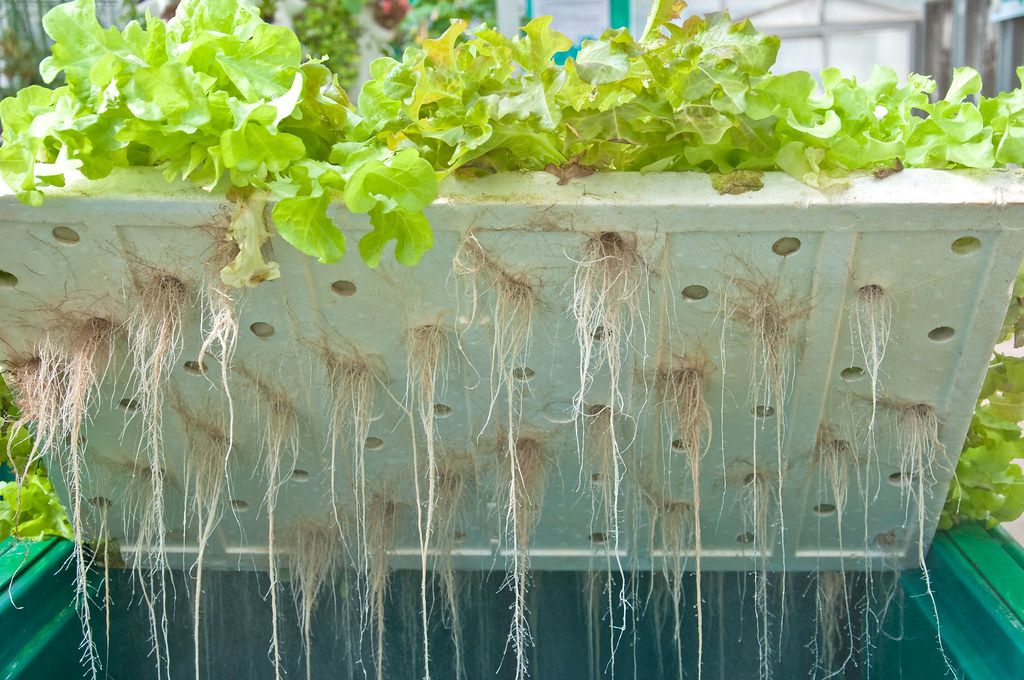
Tipburn deserves a special note because it often appears even when the solution has plenty of calcium. Calcium moves with the transpiration stream, and the enclosed young leaves in the heart of a head transpire very little. Both’s Cornell work found tipburn appeared when DLI exceeded 17 mol·m⁻²·d⁻¹, and vertical airflow fans delayed its onset (Both, 2003). In other words: adding more calcium nitrate is rarely the fix. Airflow and sensible light are.
If you can, send a sample of recently matured leaves for tissue analysis. e-GRO lists hydroponic lettuce sufficiency ranges of 3.75–5.60% N, 3.0–6.5% K, 1.25–2.5% Ca and 50–150 ppm Fe, which turns guesswork into a measured answer.
From the lab bench
When you line up the university sources, one pattern stands out: the targets for hydroponic nutrients for lettuce agree on ratios far more than on strength. Cornell runs EC 1.5, Rutgers ran about 1.2 on pure water and 1.65 on tap water, Hawaii’s passive tanks sit near 1.5, and Florida found no yield gain going from 1.2 to 1.6. That spread tells you lettuce has a broad plateau. Hitting 1.4 instead of 1.5 is never the reason a crop fails.
What does sink lettuce is a solution that’s unbalanced: no calcium, pH drifting above 6.5 so iron disappears, or ammonium-heavy feed under weak light. That’s why a two-part program with calcium nitrate is such a reliable default. It locks in a sensible calcium supply and leaves you only two dials to watch, EC and pH.
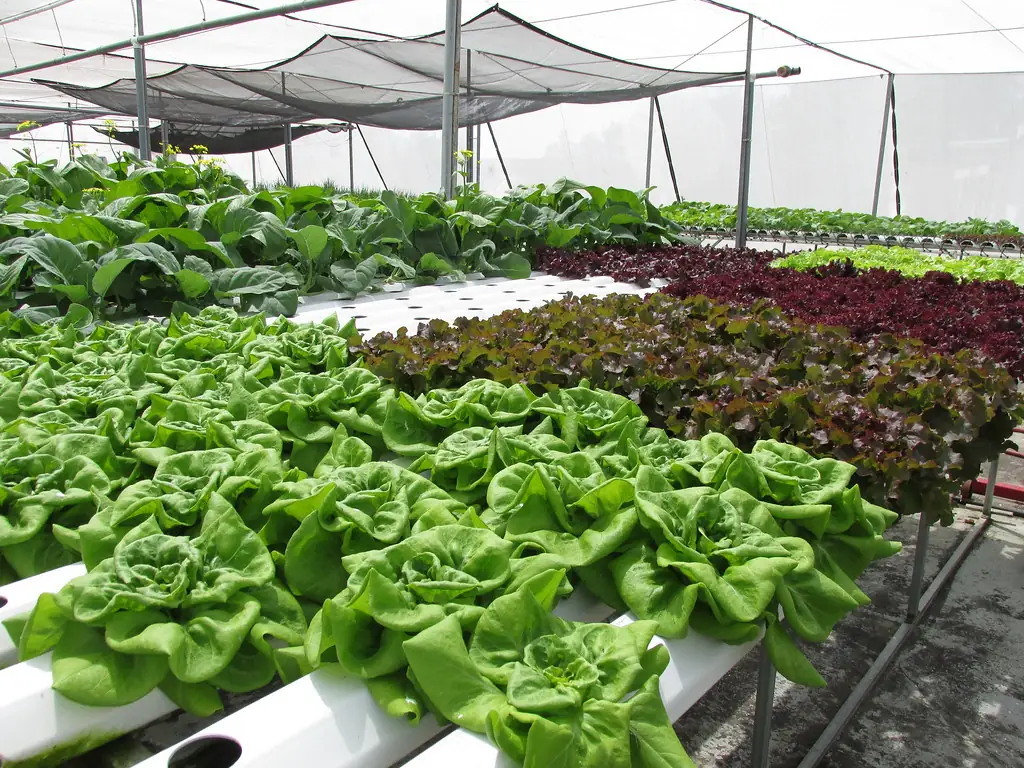
The Florida nutrient-budget work is worth sitting with, too. If most of what you add stays in the water, chasing a higher EC mostly buys you a saltier tank and a higher fertilizer bill. A lean start at EC 1.2, plain-water top-ups, and a scheduled full change will usually beat constant dosing.
Finally, treat light as the accelerator and nutrients as the fuel line. Under a weak light, the plant simply can’t use a rich solution, and surplus salts raise the risk of leaf-edge burn. If growth is slow, fix light and root-zone temperature first, then revisit the nutrients. For a full setup walk-through, see our guide to growing lettuce indoors or the low-effort Kratky method.
FAQ
What are the best hydroponic nutrients for lettuce?
A complete hydroponic fertilizer that includes calcium and micronutrients, or a two-part program of a lettuce base plus calcium nitrate. Mix it to about 100–150 ppm nitrogen (EC 1.2–1.8 mS/cm) and keep pH near 5.8.
What EC should hydroponic lettuce be at?
About 1.2 mS/cm for seedlings and around 1.5 mS/cm during production, with 1.2–1.8 as a practical range. A 2025 University of Florida study found EC 1.6 gave no more biomass than 1.2.
What ppm is best for hydroponic lettuce?
In nitrogen terms, 100–150 ppm N. Meter “ppm” readings depend on the conversion factor: EC 1.5 mS/cm reads about 750 ppm on a 0.5 (NaCl) meter and about 1,050 ppm on a 0.7 meter.
What pH does hydroponic lettuce need?
Keep it between 5.5 and 6.0 with a target of 5.8. Above about 6.5, iron becomes less available and the newest leaves can yellow between the veins.
Can I use regular plant food for hydroponic lettuce?
Only if it is fully water-soluble and contains calcium, magnesium and micronutrients. Many garden feeds rely on soil to supply those, so lettuce in water can run short. Check the label and measure EC.
Does hydroponic lettuce need cal-mag?
Lettuce needs calcium and magnesium, about 90 and 24 ppm in Cornell’s recipe, but you only need a cal-mag supplement if your nutrient and water don’t already supply them. Two-part nutrients with calcium nitrate usually cover it.
How often should I change the nutrient solution for lettuce?
In a small home system, every two to three weeks is a simple rule, topping up with plain water in between. Larger commercial tanks are sometimes refreshed after each harvest and fully changed every few crops.
Sources
- Mattson, N. (2016). Growing hydroponic leafy greens. Greenhouse Product News 26(10): 16–20. Cornell University CEA. PDF
- Henry, J., Whipker, B.E., Owen, W.G. and Currey, C. (2018). Nutritional Monitoring Series: Lettuce (Lactuca sativa). e-GRO, Vol. 1 No. 13. NC State, Michigan State and Iowa State Universities. PDF
- Both, A.J. (2003). Ten years of hydroponic lettuce research. Rutgers, The State University of New Jersey. PDF
- Kratky, B.A. Fertilizer stock solutions for lettuce. University of Hawaii, College of Tropical Agriculture and Human Resources. PDF
- Kratky, B.A. Hydroponic lettuce production: suggestions and notes. University of Hawaii CTAHR. PDF
- Penn State Extension (2024). Hydroponics systems: nutrient solution programs and recipes. Updated 18 March 2024. Web page
- Vought, K., Bayabil, H. and Martin-Ryals, A. (2025). How efficient are hydroponic lettuce production systems in nutrient usage under low and high salinity? UF/IFAS EDIS AE610. doi:10.32473/edis-AE610-2025. Web page