
You open a fresh sheet of rockwool cubes, drop a lettuce seed into each little hole, water them from the tap and wait. A week later half the seeds have rotted, the rest look pale, and the cubes are still soaking wet. What went wrong? Almost always it’s one of three things: the pH, the water level, or the way the cube was handled before sowing.
Short answer: Rockwool cubes are spun from molten basalt rock, hold far more water than peat and come out of the bag alkaline, at around pH 7.0–8.0. Before you sow, condition rockwool cubes by soaking them in water adjusted to about pH 5.5–6.0, then gently squeeze out the excess so the cube holds both water and air. Feed seedlings with dilute nutrient solution from the first true leaves, because rockwool supplies no nutrients of its own.
This guide walks you through the whole process, step by step: what rockwool actually is, the numbers that matter, how to prep and sow, how to water without drowning roots, how to move cubes into DWC, NFT or Kratky systems, and when a different starter plug is the smarter buy. By the end you’ll be able to diagnose a failing tray in a minute and fix it.
What Are Rockwool Cubes (and Why Hydroponic Growers Use Them)?
Rockwool, also sold as stone wool, is made by melting basaltic rock at a temperature above 1,500 °C and spinning the melt into fine fibres, a little like cotton candy. According to a review by Holcomb, Fonteno and Contrisciano of Penn State and NC State, additives during manufacture make the wool either water-absorbent (the kind sold for growing) or water-repellent (the kind used in some insulation). The fibres are then pressed with binders into sheets, slabs, blocks and the small starter cubes or plugs you buy for seed starting (Holcomb et al., 2000).
Oklahoma State University Extension calls rockwool culture the most widely used medium in commercial hydroponics, and a 2019 review in Agronomy cites estimates of more than 10,000 hectares of crops grown on rockwool slabs worldwide (OSU Extension, Hydroponics; Gruda, 2019). Home growers mostly meet it as 1-inch (25 mm) or 1.5-inch (36–40 mm) starter cubes. Grodan’s lettuce brochure, for example, lists propagation plugs of 25 mm and 36 mm diameter, both 40 mm deep, sold in sheets of 200 and 98 (Grodan, 2022).
Why so popular? Three properties do most of the work:
- It’s sterile and inert. Rockwool is made at furnace temperatures, so a new cube carries no weed seeds or soil-borne pathogens, and its exchange capacity is described as “rather low” with little, if any, nutrient storage (Holcomb et al., 2000). Whatever reaches the roots is exactly what you put in the water.
- It holds a lot of water and still keeps some air. Holcomb and colleagues report rockwool holds more water than peat moss, while OSU Extension notes it keeps at least 18% air space (OSU Extension).
- It doesn’t shrink or swell. The cube keeps its shape wet or dry, so it sits snugly in a net pot or NFT channel for the life of the crop.
Those strengths come with matching weaknesses, and every common rockwool failure traces back to them: the high starting pH, the zero nutrient content and the tendency to stay too wet. Let’s put numbers on that.
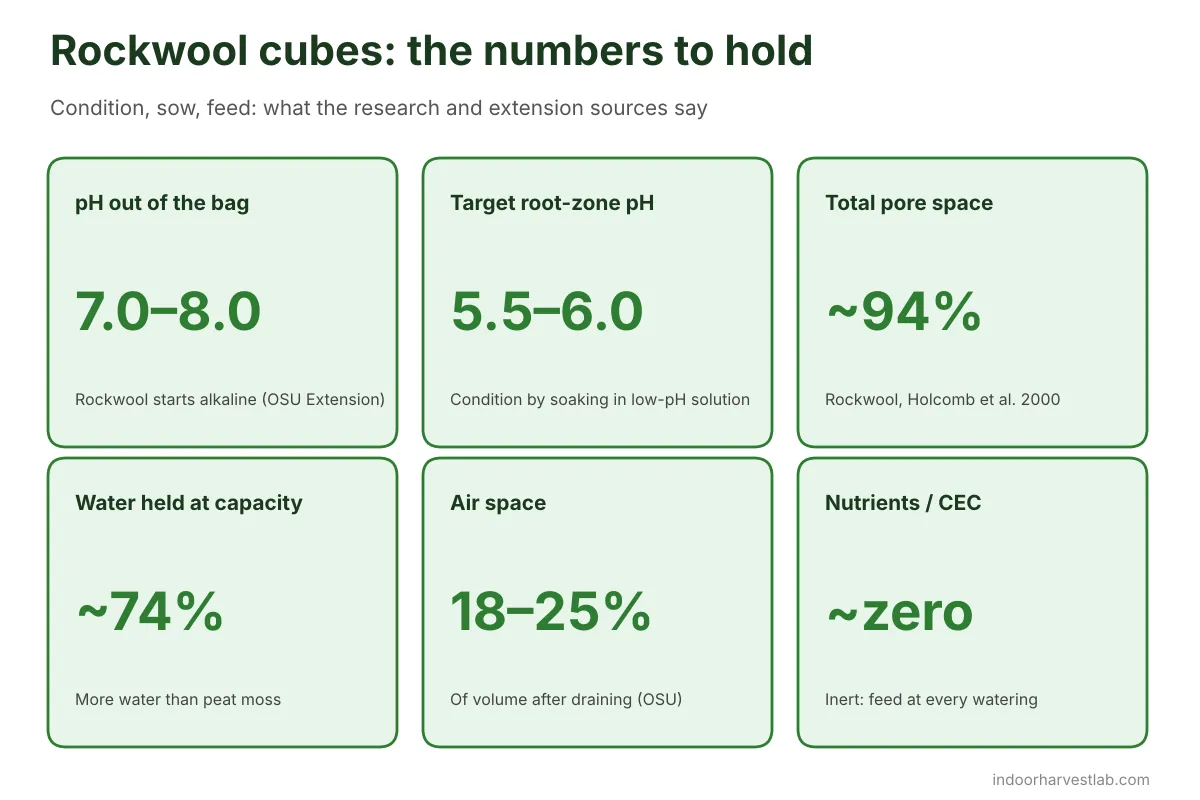
Rockwool Cube Numbers to Hold
Before any step-by-step, here are the values you’ll steer by. Every figure below comes from the sources cited in the table; where a source gives a general hydroponics range rather than a rockwool-specific one, the table says so.
| What | Value | What it means for you | Source |
|---|---|---|---|
| pH of new rockwool | 7.0–8.0 (about 8.0 if unamended) | Too alkaline for seedlings; condition before sowing | OSU; Holcomb 2000 |
| Target root-zone pH | 5.5–6.0 | Aim for this in the soak water and the feed | OSU |
| General hydroponic pH range | 5.0–6.0 | Stay inside this band once plants are growing | OSU |
| General hydroponic EC range | 1.5–3.0 dS/m | Mature-crop range; seedlings start at the low end or below | OSU |
| Total porosity | ~94% (slabs ~95%) | Almost all of the cube is pore space | Holcomb 2000 |
| Water held at container capacity | ~74% by volume | Wetter than peat; overwatering is the main risk | Holcomb 2000 |
| Air space after draining | ~20% (OSU: 18–25%) | Roots need this air; don’t let cubes sit in water | Holcomb 2000; OSU |
| Bulk density | ~0.18 g/cm³ | Very light; cubes float until saturated | Holcomb 2000 |
| Cation exchange capacity | Very low, little if any | No nutrient buffer: feed with every watering once true leaves appear | Holcomb 2000 |
| Manufacturing temperature | Above 1,500 °C | New cubes are sterile | Holcomb 2000; Grodan |
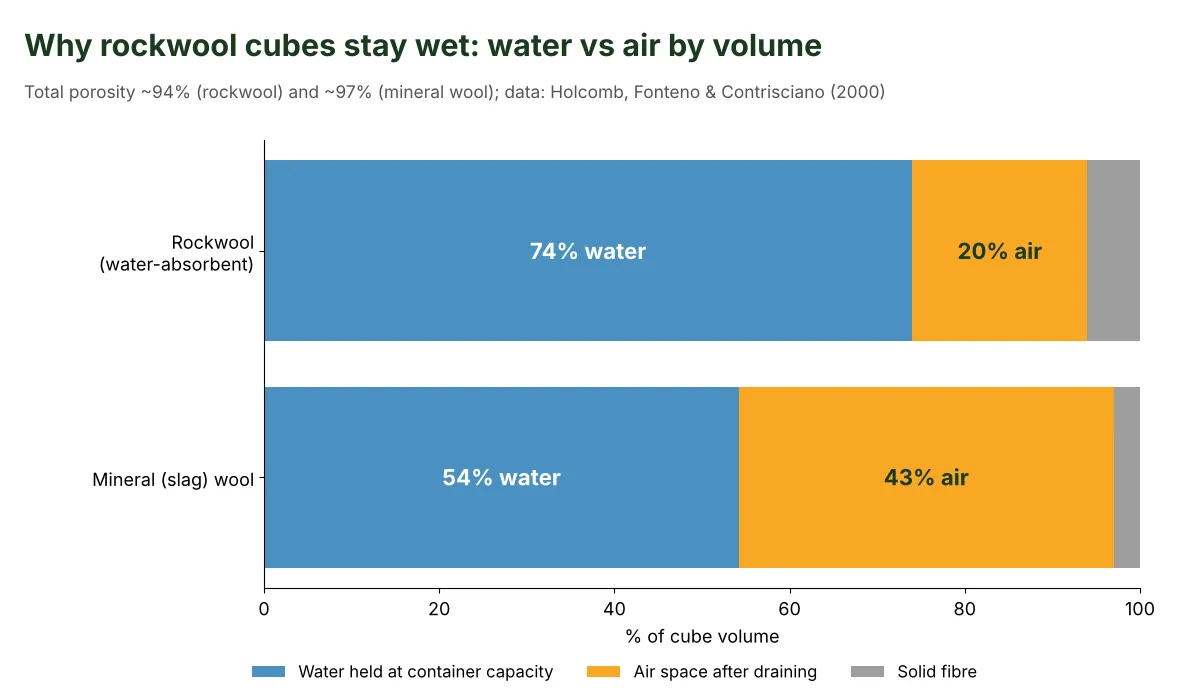
The chart above is the single most useful picture of rockwool behaviour. In the Holcomb data, water-absorbent rockwool held about 74% water and 20% air by volume after draining, while slag-based mineral wool held 54% water and 43% air. In other words, a rockwool cube is designed to be wet. Your job isn’t to add water; it’s to protect that 20% of air space.
How to Use Rockwool Cubes for Seeds: Step by Step
Here’s the full routine, from opening the bag to the first true leaves. The steps are short, but the order matters: most problems start at step 2 or step 4.
Step 1: Wet the cubes before you handle them much
OSU Extension notes that many people find mineral wool dust irritating to the skin (OSU Extension). Dry rockwool sheds the most fibres, so wear light gloves and wet the sheet before breaking it into individual cubes. Working over a tray rather than at eye level keeps loose fibres out of your face.
Step 2: Condition the pH
Mix a bucket of water and adjust it to about pH 5.5–6.0 with pH-down; OSU Extension describes this kind of soak in a low-pH solution as the standard way to bring rockwool’s high starting pH into range (OSU Extension). Submerge the cubes until they stop floating and no more bubbles come out. Then check the run-off with a calibrated meter (our pH meter guide covers calibration). If the drained water reads well above 6, soak again in fresh adjusted water. You’ll find exact pH-down handling in how to lower pH in hydroponics.
Why bother? A seed doesn’t need nutrients to germinate, but the root that emerges into pH 7.5–8 water does badly, and the problem gets worse as you start feeding, because iron and other micronutrients become less available at high pH.
Step 3: Squeeze, don’t wring
Lift each cube and give it a gentle press or a shake so excess water drains out. You’re trying to restore that roughly 20% air fraction. Don’t wring or crush the cube; compressing the fibres collapses the pore structure that holds air in the first place.
Step 4: Sow at the right depth
Drop one or two seeds into the pre-made hole. Small seeds like lettuce sit best near the top of the hole, because lettuce germination responds to light and warmth (our lettuce seed germination guide explains why). Larger seeds such as tomatoes, peppers or cucumbers can go a little deeper. Either way, pinch the top of the hole partly shut so the seed touches wet fibres on all sides.
A practical tip from commercial propagation: HortiDaily’s report on substrate trials notes that covering seed with a thin layer of vermiculite or perlite can help when trays are watered from below (Kuack, 2017).
Step 5: Hold warmth and humidity
Set the sheet in a tray, add a humidity dome, and keep it at the germination temperature your crop prefers (see our seed germination temperature chart). Add only a thin film of pH-adjusted water to the tray, never enough to flood the cubes. Remove the dome as soon as most seedlings are up; our guide to when to remove a humidity dome explains the timing.
Step 6: Start feeding at the first true leaves
Because rockwool has little, if any, nutrient-holding capacity, Holcomb and colleagues stress that plants grown in it need nutrients supplied with the irrigation water (Holcomb et al., 2000). Once the first true leaves open, switch the tray water to a weak hydroponic nutrient solution, then raise strength gradually as the seedlings grow. Our hydroponic EC chart gives crop-specific targets.
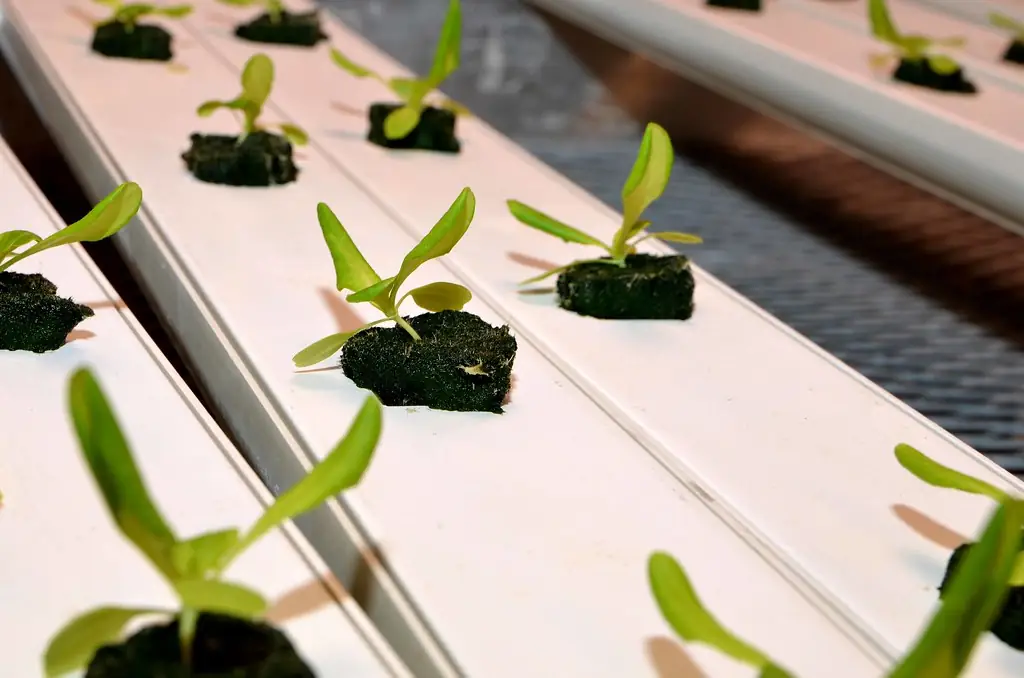
Watering Rockwool Cubes Without Drowning the Roots
If you remember one thing from this article, make it this: a rockwool cube that looks dry on top can still be wet inside. With roughly three-quarters of its volume holding water at container capacity, the cube dries from the top down while the bottom stays saturated (Holcomb et al., 2000).
Use these checks instead of guessing:
- Weight test. Lift the sheet after soaking and remember the weight. Water again only when it feels noticeably lighter, not when the surface changes colour.
- Bottom water, then drain. Pour a shallow film into the tray, let the cubes wick for a short while, then tip off whatever is left. Standing water fills the air pores.
- Keep the top dry-ish. A constantly wet surface grows green algae and invites fungus gnats and damping-off.
- Water with the pH-adjusted solution every time. Plain tap water slowly drifts the cube back up toward its alkaline starting point, especially in hard-water areas.
How often is “often”? It depends on light, warmth and seedling size. In commercial propagation of leafy greens, growers interviewed by HortiDaily irrigate stone wool plugs a couple of times per day, but that’s in bright greenhouses with large, fast-growing plug sheets (Kuack, 2017). A home tray under a modest LED in a cool room may need water only every few days. Let the weight test, not the calendar, decide.
Algae on the surface isn’t harmful in itself, but it’s a flag that the top is staying too wet and too bright. Our algae in hydroponics guide covers light-proofing cubes and reservoirs.
Moving Rockwool Cubes Into Your Hydroponic System
Transplant when roots poke out of the bottom or sides of the cube. Rockwool’s big advantage here is that you never disturb the roots: the whole cube goes into the system.
| System | How to place the cube | Watch out for |
|---|---|---|
| Deep water culture (DWC) | Set the cube in a net pot, packed around with clay pebbles; water level just touching the base at first | Water touching the cube’s full height keeps it soggy; lower the level as roots reach down |
| Kratky | Net pot with the cube’s bottom third in solution | Leave the growing air gap; don’t top the reservoir up to the original line |
| NFT | Drop the cube straight into the channel hole; OSU Extension describes small rockwool pieces sitting in NFT channels | Cubes too tall for the channel lid; roots blocking flow late in the crop |
| Ebb and flow | Sit cubes or blocks directly on the flood table | Flood cycles too frequent for rockwool’s high water holding |
| Soil or coir pots | Bury the cube so its top is just below the surface | A rockwool cube buried in drier soil can dry out at a different rate; water carefully the first week |
Larger crops like tomatoes are often stepped up from a starter cube into a bigger rockwool block before the final system; our potting up seedlings guide explains why gradual size increases help root development. Commercially, Grodan describes a three-phase sequence of seeding and germination, propagation, and cultivation on slabs (Grodan, 2022).
Rockwool Cube Problems: Symptoms and Fixes
Most rockwool problems show up within the first two weeks. Use this table to triage a struggling tray.
| What you see | Most likely cause | What to do |
|---|---|---|
| Seeds rot or never sprout | Cubes waterlogged; seed sitting in water with no air | Squeeze out excess water, drain the tray, re-sow in a properly drained cube |
| Pale, yellowish seedlings after true leaves | No nutrients (rockwool supplies none) or high pH locking out iron | Start a dilute nutrient feed; check run-off pH and bring it to 5.5–6.0 |
| Seedlings collapse at the soil line | Damping-off favoured by constant wetness | Increase airflow, water less, remove dome; see our damping-off guide |
| Green slime on top of cubes | Light plus surface moisture = algae | Let the surface dry between waterings; cover cubes with caps or pebbles |
| Brown, slimy roots after transplant | Warm, low-oxygen water around the cube | See our hydroponic root rot guide; lower the water line |
| Seedlings stretched and floppy | Too little light, not the cube | Lower or strengthen the light; see leggy seedlings |
| Itchy hands or forearms | Dry fibres on skin | Wet cubes before handling; wear gloves |
Notice how many fixes come back to drainage and pH. Rockwool is very predictable: when it misbehaves, it’s almost always because the water inside it was wrong in amount or in pH.
Rockwool Cubes vs Alternatives: Oasis, Coco Plugs, Peat and Foam
Rockwool isn’t the only starter plug, and it isn’t always the best one for a home grower. Here’s how the main options compare, using the research available.
| Starter medium | Water vs air | Starting pH | What research and extension sources say | Best for |
|---|---|---|---|---|
| Rockwool cubes | Very high water (~74%), ~20% air | Alkaline (7–8); needs conditioning | Performed as well as Oasis and better than foam cubes for lettuce and chard in NFT, but cost more than Oasis (Singh & Dunn, 2017) | DWC, NFT, Kratky, tomatoes in block systems |
| Oasis (phenolic foam) cubes | Holds water well | Check the product label | Similar growth to rockwool for lettuce and chard in NFT, at lower cost (Singh & Dunn, 2017) | Lettuce and leafy greens in NFT |
| Polyurethane foam cubes | Not reported | Check the product label | Lower height, width and fresh/dry weight than rockwool and Oasis; germination took two weeks longer (Singh & Dunn, 2017) | Rarely the best choice |
| Coco (coir) plugs | Hold more water than stone wool | Check the product label | Commercial trial notes coco plugs hold more water than stone wool, phenolic foam and polymer-bound peat plugs (Kuack, 2017) | Growers wanting a biodegradable plug |
| Peat-based plugs | High water, moderate air | Varies by product | Peat has the highest climate-change and resource impact of common substrates in a life-cycle comparison cited by Gruda (2019) | Soil transplants |
The Oklahoma State trial is the most relevant one for home hydroponics: in NFT, rockwool and Oasis cubes gave similar lettuce and Swiss chard growth, both clearly better than polyurethane foam, and survival didn’t differ between the three (Singh & Dunn, 2017). So if you already own rockwool, keep using it. If you’re buying fresh and growing mostly lettuce, Oasis-type cubes are a fair, cheaper alternative.
Is Rockwool Safe, and Can You Reuse It?
Two questions come up constantly: is it safe to handle, and what do you do with it afterwards?
Handling and health
The International Agency for Research on Cancer re-evaluated man-made vitreous fibres in 2002 and placed rock (stone) wool in Group 3, “not classifiable as to its carcinogenicity to humans” (IARC Monographs Vol. 81). That’s reassuring, but the fibres can still irritate skin, a point OSU Extension makes as well (OSU Extension). Sensible habits are enough: wet cubes before handling, wear gloves, don’t snap dry sheets apart in front of your face, and wash hands afterwards.
Reuse and disposal
OSU Extension says rockwool slabs can be reused after steam sterilization between crops and keep their structure for about three to four years, but also that the material doesn’t biodegrade and is an environmental nuisance at disposal (OSU Extension). Gruda’s 2019 review likewise notes that the disposal problem has drawn criticism of mineral wool use (Gruda, 2019). Grodan says its growing media can be recycled, though collection depends on the region (Grodan, 2022).
For starter cubes at home, reuse is rarely worth it: roots fill the fibres, and old cubes can carry over pathogens. Treat cubes as single-use, keep the number you use small, and if sustainability matters most to you, coco plugs are the more compostable alternative.
From the Lab Bench
Here’s how I’d read the evidence if you’re deciding whether rockwool cubes belong in your setup.
First, rockwool is best thought of as a water-delivery device, not a growing medium in the soil sense. With about 94% pore space and close to zero nutrient storage, it does nothing chemically; it just holds whatever solution you give it against the roots. That’s exactly why commercial growers love it: it’s reproducible. It’s also why beginners struggle with it: there’s no buffer to forgive a wrong pH or a missed feed.
Second, the most common mistake isn’t pH; it’s water. The physical data show a cube built to hold nearly four times as much water as air. Germinating seeds and young roots need oxygen, so a cube left sitting in a tray of water has quietly turned its 20% air fraction into near zero. If you only change one habit, drain the tray after every watering.
Third, the conditioning soak matters more than people think, but for a different reason than usually given. The seed doesn’t care much about pH while germinating; it’s the first week of feeding, when micronutrients like iron become less available in alkaline conditions, where an unconditioned cube costs you. Pale new growth a week after the first true leaves is the classic sign.
Finally, be honest about scale. For a few net pots of lettuce, basil or a couple of tomato plants, rockwool cubes are cheap, clean and reliable. For large numbers of seedlings that will end up in soil, a peat or coco plug, or plain seed starting mix, makes more practical sense.
Rockwool Cubes FAQ
Do you need to soak rockwool cubes before planting?
Yes. New rockwool is alkaline, around pH 7.0–8.0, according to Oklahoma State University Extension. Soak the cubes in water adjusted to about pH 5.5–6.0 until fully saturated, then gently squeeze out the excess so the cube holds both water and air.
What pH should rockwool cubes be?
Aim for a root-zone pH of about 5.5–6.0. Check the run-off from a soaked cube with a calibrated pH meter; if it reads well above 6, soak again in freshly adjusted water.
How long do seeds take to sprout in rockwool cubes?
About the same time as in any other well-drained, warm medium, because germination timing depends mainly on the crop and temperature. Seeds that take much longer than normal are usually too wet or too cold.
Can you reuse rockwool cubes?
Large rockwool slabs can be steam-sterilized and reused for a few years, according to OSU Extension, but small starter cubes filled with old roots are not worth reusing at home because they can carry over disease.
Are rockwool cubes safe for growing food?
Rockwool is inert and supplies no nutrients or contaminants of its own. IARC places rock wool in Group 3, not classifiable as a human carcinogen. The fibres can irritate skin, so wet the cubes and wear gloves when handling them.
Why are my rockwool cubes turning green?
Green growth on the cube surface is algae, caused by light reaching a constantly wet surface. Let the top dry between waterings and cover the cubes with caps or clay pebbles after transplanting.
Are rockwool cubes better than Oasis cubes?
In an Oklahoma State University trial in NFT, rockwool and Oasis cubes gave similar lettuce and chard growth, both better than foam cubes, but rockwool cost more. Either works well for leafy greens.
Sources
- Thakulla, D., Dunn, B. and Hu, B. Soilless Growing Mediums. Oklahoma State University Extension. extension.okstate.edu
- Oklahoma State University Extension. Hydroponics (fact sheet). extension.okstate.edu
- Holcomb, E.J., Fonteno, W.C. and Contrisciano, T.M. (2000). Non-organic substrates: rock and mineral wools revisited. Southeastern Floriculture, Nov/Dec 2000. NC State HortScans (PDF)
- Gruda, N.S. (2019). Increasing sustainability of growing media constituents and stand-alone substrates in soilless culture systems. Agronomy 9(6): 298. doi:10.3390/agronomy9060298
- Singh, H. and Dunn, B. (2017). Evaluation of different growing mediums in nutrient film technique. ASHS Annual Conference abstract. ashs.confex.com
- IARC (2002). Man-made Vitreous Fibres. IARC Monographs on the Evaluation of Carcinogenic Risks to Humans, Vol. 81. publications.iarc.who.int
- Kuack, D. (2017). Substrate trials help growers avoid propagation-related issues. HortiDaily. hortidaily.com
- Grodan / ROCKWOOL B.V. (2022). Stone wool growing media: the clean choice, with reliable results (lettuce brochure; manufacturer information). grodan.com (PDF)