
You check your lettuce raft after a few days away and something’s off. The older leaves have crisp, tan edges, the tips of your basil look singed, and the plants droop a little in the afternoon even though their roots are sitting in water. You fed them well. Maybe a little too well.
Short answer: nutrient burn in hydroponics is salt injury from a nutrient solution that’s too concentrated, meaning its EC (electrical conductivity) is above what the crop can handle. It shows first as brown, dry leaf tips and margins on older leaves, often with afternoon wilting. Fix it by measuring EC, diluting or replacing the solution so it sits back inside the crop’s range (lettuce is about 1.2–1.8 mS/cm), and topping off evaporation with plain water instead of more nutrient mix.
By the end of this guide you’ll be able to confirm nutrient burn with a meter rather than a guess, tell it apart from the four problems it’s most often confused with, calculate exactly how much water to swap out, and set up a simple routine so it doesn’t happen again.
What Nutrient Burn in Hydroponics Actually Is
“Nutrient burn” is a grower’s term. Horticulturists usually call it high soluble salts or salt injury. Every fertilizer is a mix of salts, and your EC meter is really a salt meter: the more dissolved ions in the reservoir, the higher the reading. That’s why our hydroponic EC chart is the first tool to reach for when leaves start to brown.
Oklahoma State University’s hydroponics guide puts the damage in three buckets: excessively high nutrient levels “induce osmotic stress, ion toxicity and nutrient imbalance” (Singh & Dunn, OSU Extension). Here’s what each one means for your plants, and why nutrient burn in hydroponics can look like three different problems.
1. Osmotic stress: the plant can’t drink
Water moves from low salt to high salt. When the solution around the roots gets too concentrated, roots have to work harder to pull water in. University of Florida extension compares adding salt to the root zone to drying the soil out (Zekri, UF/IFAS 2022). That’s why a burned plant can wilt in a full reservoir.
2. Ion toxicity: salts pile up in the leaf edges
Water leaves the plant through the leaves, but the salts it carried stay behind. They concentrate where transpiration ends, at the tips and margins, until those cells die. Cornell’s lettuce specialist describes outer-leaf marginal necrosis as “high salts accumulating in these regions causing cellular damage” (Mattson, e-GRO 2015).
3. Nutrient imbalance: too much of one thing blocks another
A strong solution rarely has every element in perfect balance. Excess of one ion can crowd out uptake of another, so burned plants sometimes show deficiency-like yellowing alongside the brown edges. It’s one reason the symptoms can be confusing.
Nutrient Burn Symptoms: What to Look For
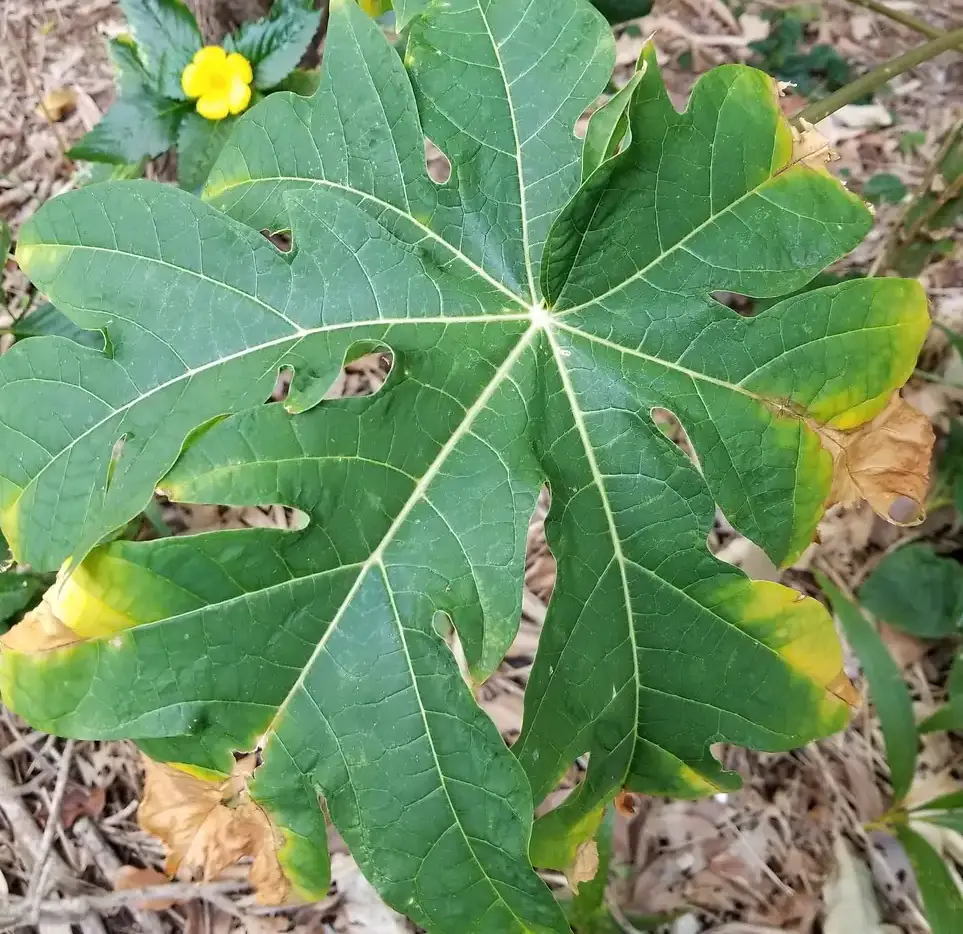
The pattern matters more than any single symptom. A Cornell study of salt stress in greenhouse crops found that the osmotic effects come first: plants grow shorter and may wilt “even though the substrate is moist,” especially in the afternoon. With continued exposure, leaf tip or edge burn becomes the most common leaf symptom, starting on older leaves and, in grasses and onion-family plants, at the very tip (Villarino & Mattson, Greenhouse Grower).
University of Maryland Extension lists the same signature for over-fertilized indoor plants: browning or dieback of leaf tips and margins, reduced growth, lower-leaf drop, dead root tips, and wilting (UMD Extension). In an inert medium like rockwool or clay pebbles you may also see a white crust where the solution evaporates.
| Stage | What you see | Where on the plant |
|---|---|---|
| Early (osmotic) | Slower growth, darker or stiffer leaves, afternoon droop that recovers overnight | Whole plant |
| Developing | Crisp tan or brown tips; dry, papery margins | Older, outer leaves first |
| Advanced | Brown edges creep inward; lower leaves yellow and drop | Older leaves, spreading upward |
| Root zone | Brown, dead root tips; fewer fine white roots | Root tips |
| Media surface | White salt crust on rockwool, LECA or net-pot rims | Where the solution evaporates |
One warning from that Cornell work: young seedlings are much more sensitive than established plants, and the longer the exposure, the bigger the risk. A strength that a mature tomato shrugs off can scorch a two-week-old lettuce plug.
What Causes Nutrient Burn in Hydroponic Systems
Almost every case of nutrient burn in hydroponics traces back to one of five habits. Knowing which one you have is the difference between fixing it once and fighting it all season.
| Cause | Why it raises EC | Quick check |
|---|---|---|
| Topping off with full-strength nutrient | Plants drink water faster than they take up salts, so adding more mix stacks salt on salt | Has EC crept up week after week? |
| Mixing too strong | Label rates are often written for fruiting crops; leafy greens and herbs need less | Compare your reading with the crop’s range |
| Evaporation without top-off | Water leaves, salts stay; a shrinking reservoir gets stronger | Is the water line much lower than at mixing? |
| Salty source water | Your tap water already has an EC before you add anything | Measure plain tap water on its own |
| Never replacing the solution | Unused ions (like sodium and chloride) build up as you keep adding water and nutrients | When was the last full change? |
That last point is worth stressing. Oklahoma State notes that sodium chloride “will increase in concentration with the constant addition of water and nutrient adjustments, resulting in toxicities” (OSU Extension). Your meter can’t tell useful nitrate from useless sodium, so a solution can read “right” and still be out of balance. If your water is hard or softened, read our guide to tap water for hydroponics.
Heat makes everything worse. UF/IFAS points out that salinity stress is worst in hot, dry weather, because plants transpire more and salts concentrate faster (Zekri 2022). Indoors, that means a grow tent running warm under strong lights is a prime suspect.
Numbers to Hold: EC Targets That Prevent Burn
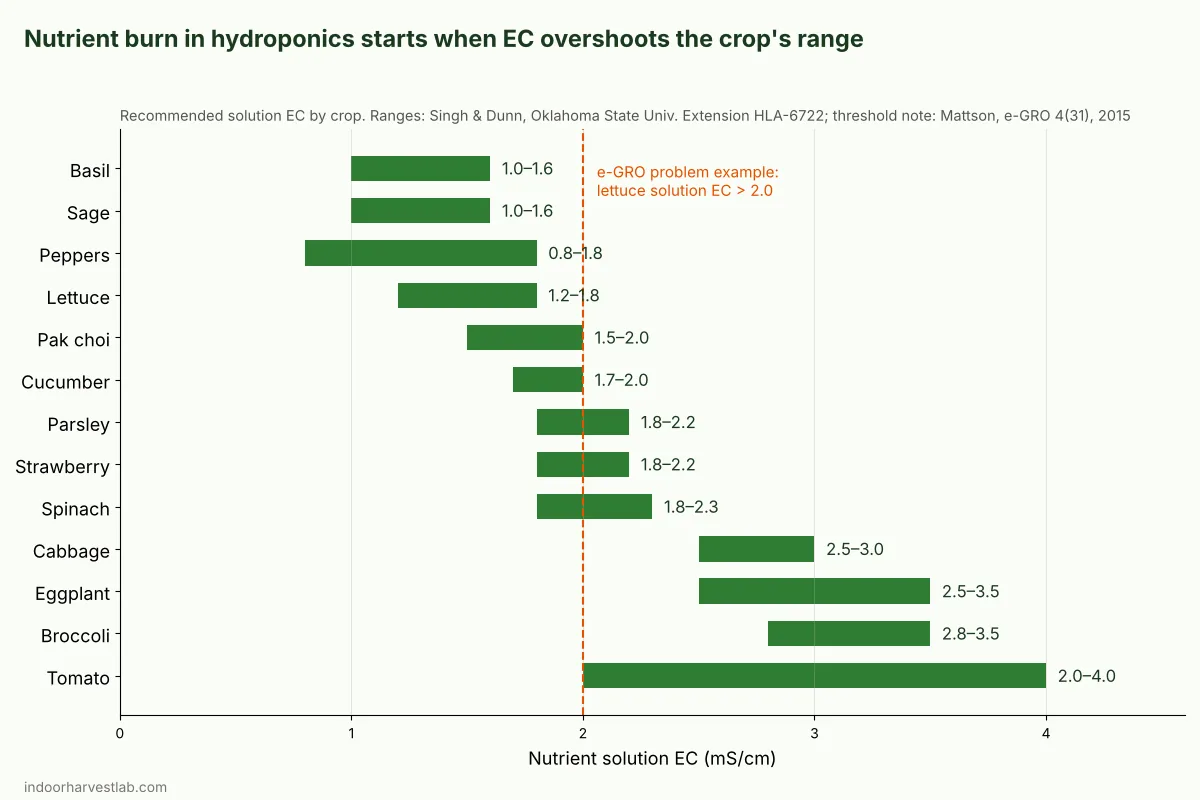
This is the table to tape to your reservoir lid, because the simplest defence against nutrient burn in hydroponics is knowing each crop’s EC range. The ranges come from Oklahoma State’s EC and pH guide; the lettuce research rows show what happens at the edges of that range.
| Crop or item | Target | Source |
|---|---|---|
| Lettuce | EC 1.2–1.8 mS/cm, pH 6.0–7.0 (general solution target: pH 5–6, usually 5.5) | OSU HLA-6722 |
| Basil, sage | EC 1.0–1.6 mS/cm | OSU HLA-6722 |
| Peppers | EC 0.8–1.8 mS/cm | OSU HLA-6722 |
| Spinach | EC 1.8–2.3 mS/cm | OSU HLA-6722 |
| Strawberry, parsley | EC 1.8–2.2 mS/cm | OSU HLA-6722 |
| Tomato | EC 2.0–4.0 mS/cm | OSU HLA-6722 |
| Cornell CEA lettuce recipe | About 1.4 mS/cm | Mattson, e-GRO 2015 |
| Lettuce: no gain above | 1.6 dS/m gave no more growth than 1.2 dS/m (NFT, growth chamber) | Vought et al., UF/IFAS 2025 |
| Lettuce: yield peak | At or above 1.8 mS/cm in NFT; fresh weight fell above 1.8 in a fall trial | Samarakoon et al. 2019, 2020 |
| EC meter calibration buffer | 1.41 mS/cm | OSU HLA-6722 |
| Check EC and pH | Daily, at the same time of day | OSU HLA-6722 |
| Full solution change | About every 2 weeks | OSU HLA-6722 |
| Solution temperature | 72–75 °F (22–24 °C) | OSU HLA-6722 |
Note that 1 mS/cm equals 1 dS/m, so the papers and fact sheets are speaking the same language. If your meter reads in ppm, convert first with our ppm to EC conversion guide, because a “1,000 ppm” reading means different EC values on the 500 and 700 scales.
Two things jump out of the research. First, the safe band for leafy greens is narrow. In NFT trials at Ohio, lettuce yield peaked around 1.8 mS/cm, but fresh and dry weight dropped above that in the fall trial at 2.4 mS/cm (Samarakoon et al. 2019). Second, more isn’t always better even inside the range: a 2025 UF/IFAS study found 1.6 dS/m didn’t grow bigger lettuce than 1.2 dS/m, and recommended starting at 1.2 (Vought et al. 2025).
How to Fix Nutrient Burn in Hydroponics, Step by Step
Here’s the rescue sequence. It works the same in Kratky jars, DWC totes, NFT channels and ebb-and-flow trays; only the volumes change.
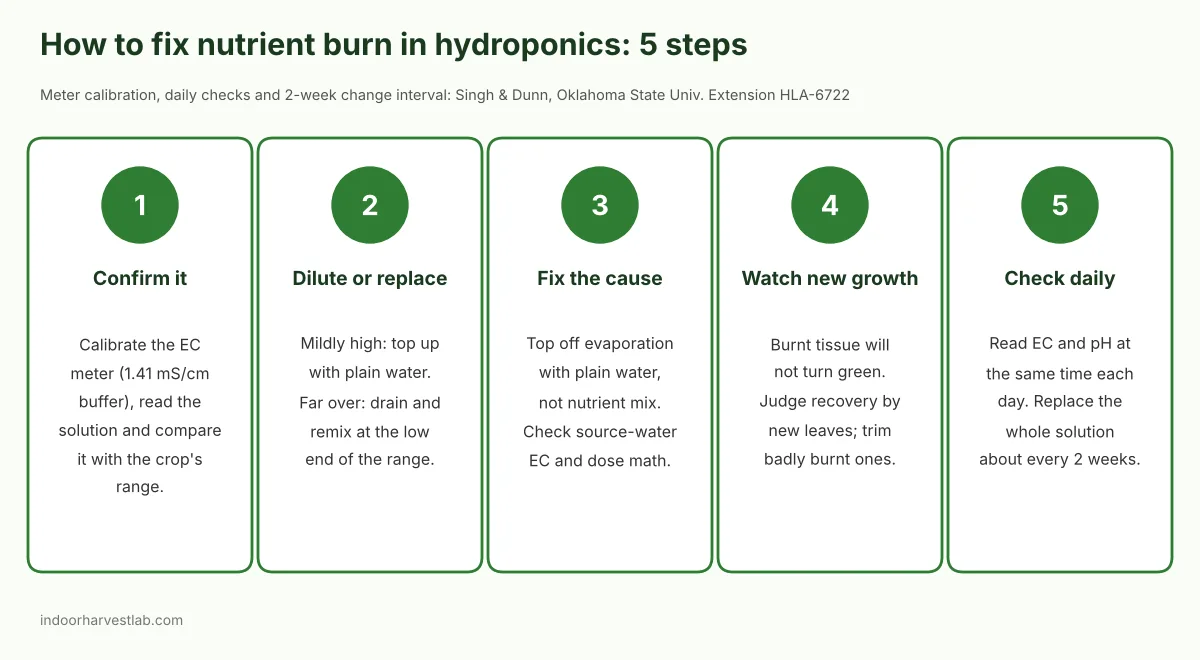
Step 1: Confirm with a calibrated meter
Calibrate your EC pen in 1.41 mS/cm solution, then read the reservoir. Also read your plain source water. If the reservoir is clearly above the crop’s range in the table above, you’ve found your problem. If it’s in range, skip to the lookalikes section, because something else is browning those leaves. Check pH at the same time; our pH meter guide covers calibration.
Step 2: Dilute (mild) or replace (severe)
If EC is a little high, dilute. Use this simple formula to work out how much solution to remove and replace with plain water:
Litres to swap = reservoir volume × (1 − target EC ÷ current EC)
Worked example: a 20 L tote reads 2.6 mS/cm and you want 1.8 for lettuce. 20 × (1 − 1.8 ÷ 2.6) = 20 × 0.31 ≈ 6.2 L. Remove about 6 L and refill with plain water. If your tap water has its own EC, you’ll land slightly above target, so re-measure and repeat a small top-up if needed. This is just mass balance; it’s the same math whether you work in litres or gallons.
If EC is far over the range, or plants are wilting hard, don’t fiddle with dilution. Drain, rinse the reservoir, and remix fresh solution at the low end of the crop’s range. Our guide to changing hydroponic water walks through a full swap.
Step 3: Flush the medium if you use one
In DWC and NFT the roots sit in the solution, so fixing the reservoir fixes the root zone. In rockwool, coco or clay pebbles, salts can stay trapped in the medium. University of Maryland Extension recommends leaching with clear water, using several irrigations of at least the container’s volume each time (UMD Extension). For hydro, a mild, half-strength solution at the right pH is a reasonable alternative to plain water, so the roots aren’t suddenly starved.
Step 4: Trim and watch the new growth
Burned tissue is dead tissue. It won’t turn green again. Remove leaves that are mostly brown, since they no longer feed the plant, and leave lightly tipped leaves alone. Recovery shows up in the new leaves: if they come in clean, the fix worked.
Step 5: Find and remove the cause
Go back to the causes table and pick the habit that got you here. The single most common fix is to top off with plain water between changes and only adjust nutrients after you’ve measured. Then keep the daily EC check going for at least a week.
Nutrient Burn or Something Else? Lookalike Triage
Brown leaf edges have several causes, and treating the wrong one wastes weeks. Not every brown tip is nutrient burn in hydroponics. The meter is your tie-breaker: true nutrient burn always comes with an EC that’s high for the crop.
| If you see… | EC reading | Most likely cause | What to do |
|---|---|---|---|
| Brown tips/edges on older leaves, afternoon wilt | High for the crop | Nutrient burn (salt injury) | Dilute or replace; top off with plain water |
| Brown, burned edges on the youngest inner leaves of lettuce | Normal | Calcium tipburn | Improve airflow, moderate light; see lettuce tip burn |
| Yellow band behind a brown edge on older leaves | Normal or low | Potassium deficiency | Check feed strength and pH; don’t dilute further |
| Bleached or crispy leaves only near the lamp | Normal | Light or heat stress | Raise the light or lower intensity |
| Wilting, brown slimy roots, bad smell | Any | Root rot | See hydroponic plants wilting |
| Even yellowing, no brown edges | Low | Nitrogen or general deficiency | See yellow leaves in hydroponics |
The tipburn row trips people up most. Cornell’s e-GRO alert explains that “tipburn” in lettuce is really two disorders sharing one name: inner-leaf tipburn comes from poor calcium delivery to fast-growing young leaves, and is “rarely” a lack of calcium in the root zone, while outer-leaf marginal necrosis is the salt injury described in this article (Mattson 2015). Adding cal-mag fixes neither.
How to Prevent Nutrient Burn From Coming Back
Preventing nutrient burn in hydroponics is mostly routine. These habits, taken together, keep the reservoir in a boring, safe range.
- Start low and step up. Mix to the bottom of the crop’s range, especially for seedlings, and only raise it if growth is pale and slow. The UF/IFAS lettuce work supports starting at 1.2 dS/m (Vought et al. 2025).
- Top off with plain water. Between full changes, replace what the plants drank with water, then measure before adding anything else.
- Measure daily, at the same time. EC and pH drift through the day, so consistent timing makes trends easy to spot (OSU Extension).
- Replace the whole solution about every two weeks. This resets the salts your meter can’t distinguish, such as sodium and chloride.
- Know your source water. e-GRO gives a source water EC of 1.0 mS/cm as an example of a problem, since it uses up most of a lettuce crop’s budget before you add any fertilizer (Mattson 2015).
- Keep the room from cooking. Higher heat means more transpiration and faster salt build-up in leaf edges. Keep solution near 72–75 °F (22–24 °C).
- Read the label for leafy crops. Many bottle rates assume tomatoes. Halve them for lettuce and herbs, then let your meter decide.
From the Lab Bench
If there’s one idea to take from the research, it’s this: EC is a budget, not a target to max out. The Ohio NFT trials are a neat illustration. Pushing lettuce from 1.4 to 1.8 mS/cm bought extra yield (Green Butter gained about 75 g per head), but in the same work tipburn was worst at the higher EC, and in one season yield fell again above 1.8 (Samarakoon et al. 2020; Samarakoon et al. 2019). The curve is flat-topped and then drops. When nutrient burn in hydroponics shows up, growers are usually sitting on that falling side without knowing it.
The second lesson is that your meter measures total salts, not useful salts. A long-running reservoir that reads 1.8 can be quite different from a fresh one at 1.8, because the plants have taken up the nitrate and potassium and left behind what they don’t want. That’s why a scheduled full change beats endless top-ups, even if the numbers look fine.
Third, think about the leaf, not just the reservoir. Salt injury happens where water exits the plant. Anything that drives transpiration up — high heat, low humidity, strong airflow, intense light — concentrates salts in leaf margins faster. So a solution that’s fine in a cool basement can burn the same crop in a hot tent. When you diagnose burn, look at the climate as well as the meter.
Finally, be wary of fixing burn with more products. If EC is high, the answer is almost always water, not an additive. Supplements like cal-mag add more salts on top of a problem caused by too many salts.
FAQ
How long does it take plants to recover from nutrient burn?
The damaged leaves never recover; burnt tissue stays brown. What you’re watching is new growth. Once EC is back in range, new leaves should come in clean as the plant puts out its next few leaves. If new leaves still burn, the cause hasn’t been fixed.
What EC causes nutrient burn in hydroponic lettuce?
There’s no single trigger number, but Oklahoma State recommends 1.2–1.8 mS/cm for lettuce, and Cornell’s e-GRO cites a solution above 2.0 mS/cm as a problem example. Ohio NFT trials saw fresh weight fall above 1.8 mS/cm in a fall crop.
Should I flush with plain water or weak nutrients?
For DWC, NFT and Kratky, simply dilute or replace the reservoir. For rockwool, coco or clay pebbles, leach with several container-volumes of water or a mild, half-strength solution at the correct pH so the roots aren’t starved.
Can nutrient burn kill hydroponic plants?
Yes, if it’s severe and continues. Salt stress damages root tips and leaves, and seedlings are far more sensitive than mature plants. Caught early and corrected, most established plants carry on growing.
Is nutrient burn the same as tipburn?
Not always. Nutrient burn in hydroponics is salt injury. In lettuce, outer-leaf edge burn is usually salt injury, while burn on the youngest inner leaves is calcium tipburn caused by poor calcium delivery to fast-growing leaves. They need different fixes.
Why does my EC keep rising?
Plants are drinking water faster than they’re taking up nutrients, or you’re topping off with nutrient solution instead of plain water. Top off with water, measure, and only then adjust nutrients.
Do I cut off leaves with nutrient burn?
Remove leaves that are mostly brown, since they no longer photosynthesize much. Leaves with just a little brown at the tip can stay; they still feed the plant.
Sources
- Singh, H. & Dunn, B. Electrical Conductivity and pH Guide for Hydroponics. Oklahoma State University Extension, HLA-6722.
- Mattson, N.S. (2015). Tipburn of hydroponic lettuce. e-GRO Alert 4(31), Cornell University.
- Villarino, G. & Mattson, N.S. (2011). Salts in greenhouse crops: don’t get burned. Greenhouse Grower (Cornell University).
- University of Maryland Extension. Fertilizer toxicity or high soluble salts in indoor plants.
- Samarakoon, U., Palmer, J., Ling, P. & Altland, J. (2020). Effects of electrical conductivity, pH, and foliar application of calcium chloride on yield and tipburn of Lactuca sativa grown using the nutrient–film technique. HortScience 55(8): 1265–1271.
- Samarakoon, U.C., Fyffe, C., Bale, J., Ling, P., Basnagala, S., Donley, N. & Altland, J. (2019). Effect of electrical conductivity on the productivity and nutrient uptake of Lactuca sativa L. grown using NFT. Acta Horticulturae 1266: 137–144.
- Vought, K., Bayabil, H. & Martin-Ryals, A. (2025). How efficient are hydroponic lettuce production systems in nutrient usage under low and high salinity? UF/IFAS EDIS AE610.
- Zekri, M. (2022). Extension connection: citrus and salinity. UF/IFAS Citrus Industry newsletter, February 2022.